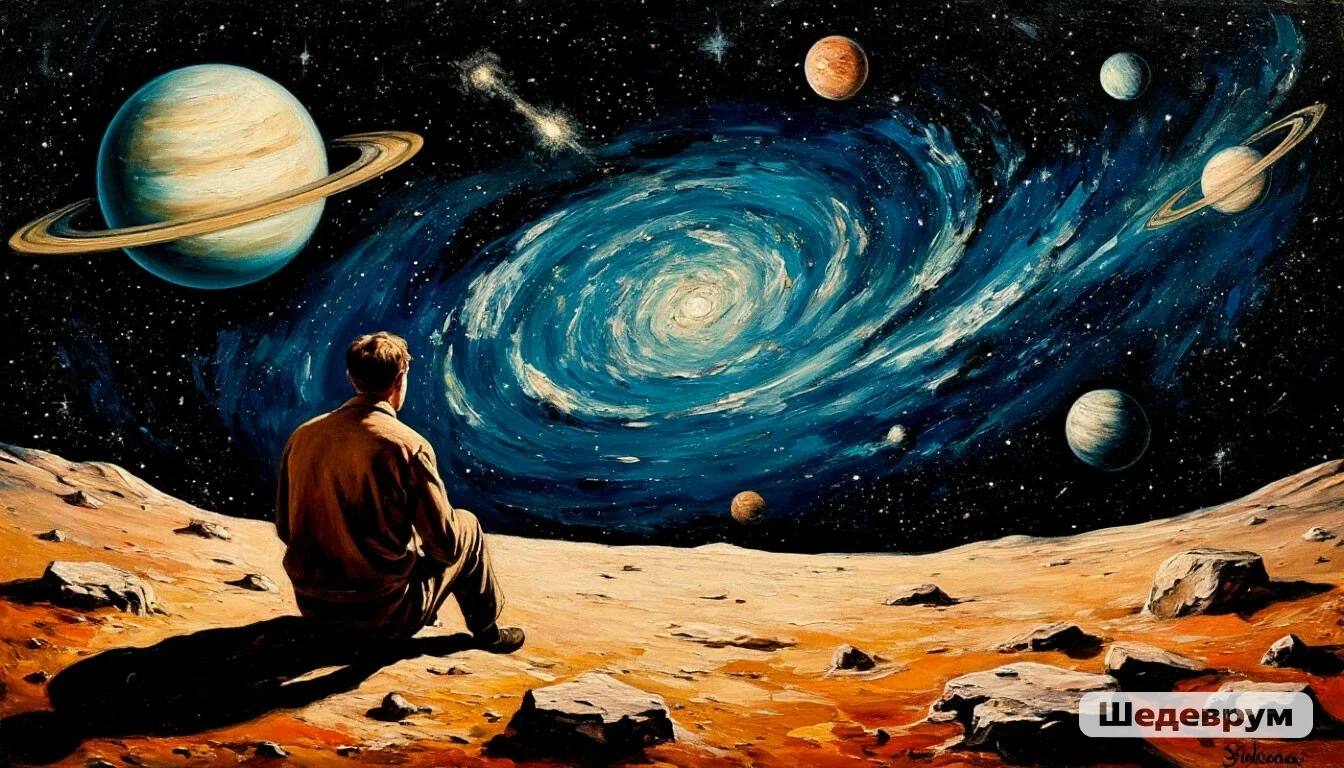
The hypothesis of the Earth’s «exceptionality» and humanity’s practical solitude in the Universe became the outcome of Iosif Shklovsky’s long intellectual evolution. If in the early 1960s he was the leading optimist of SETI (the search for extraterrestrial intelligence), by the end of his life his views underwent a dramatic shift, turning into a strict and even severe warning.
Shklovsky derived the essence of the solitude postulate from an analysis of the «Great Silence of the Universe.» He reasoned logically: if life is a regular stage in the development of matter, and stellar systems are billions of years older than ours, then the cosmos should be literally «overpopulated.» We would see traces of their engineering activity (the very «wonders» he wrote about) or receive their signals. Yet the sky is silent. From this silence Shklovsky drew the hypothesis: the emergence of intelligent life is not a regular highway in the Universe’s evolution, but a random, vanishingly rare zigzag, a «happy accident» of nature.
Argumentation and anthropocentrism. Shklovsky pointed to the colossal number of factors that must coincide for intelligence to emerge: from the type of star and the planet’s composition to the stability of the orbit over billions of years. He began to regard humanity as a kind of «biological anomaly,» the probability of repetition of which is almost zero. His later works express the idea that intelligence may not be an advantage of the species, but a dead-end branch of evolution, a kind of «cancerous tumor» that quickly burns through its planet’s resources and self-destructs before it manages to make contact. Philosophical significance for the future. This postulate radically changes the ethics of cosmism. If the Universe is empty, then man is not a «younger brother» in the family of stellar peoples, but the sole guardian of the phenomenon of consciousness.
This places a colossal responsibility on us: if we perish in a nuclear or ecological catastrophe, the Universe will not simply lose one species—it will «go blind,» deprived of its only way to know itself. Shklovsky urged us to abandon hopes for «cosmic saviors» who would come and solve our problems. His hypothesis of solitude is a call to ultimate awareness: we are alone in the infinite void, and our survival depends solely on ourselves.
Image generated by Shedevrum





Comments (0)