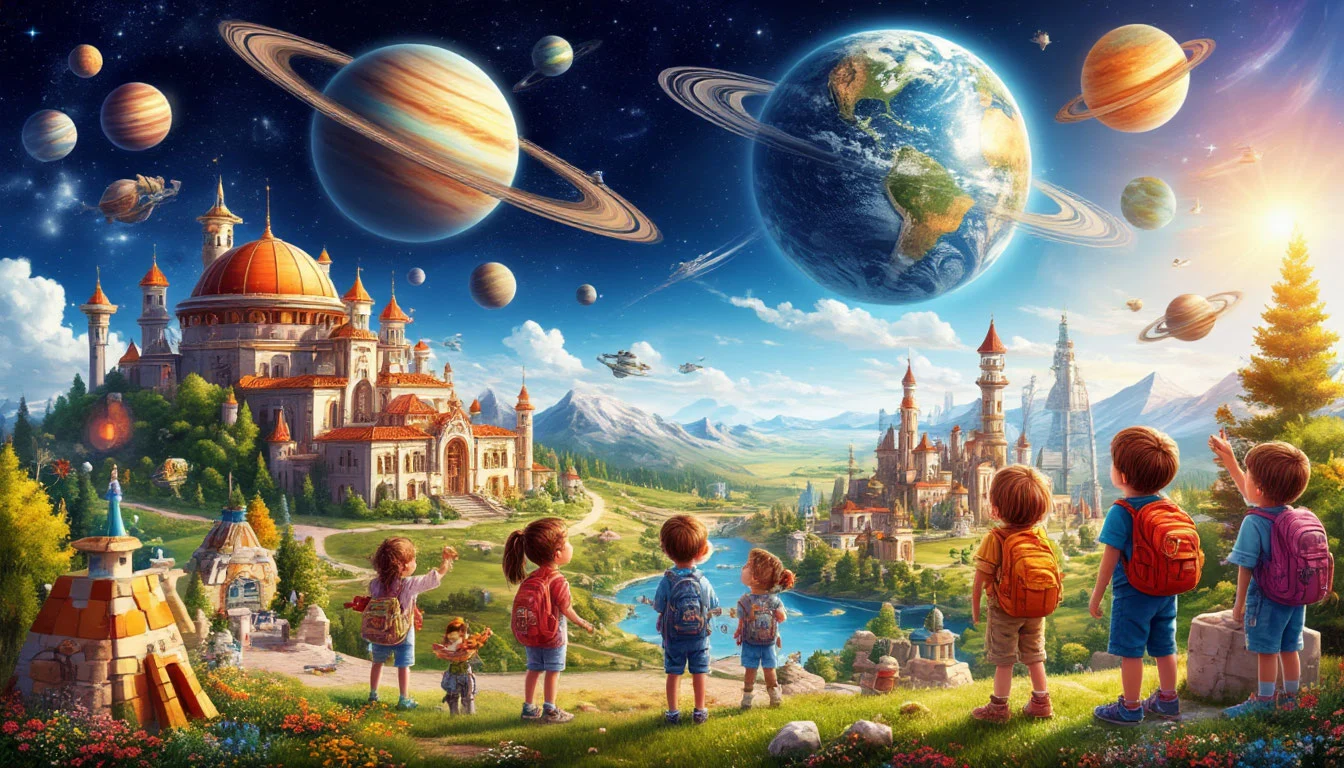
And again, a neural network reads an interview with Marina Anitskaya, a sci-fi writer, winner of the ‘History of the Future’ award in the children’s category. Now the AI is interested: do children dream? What do adults think about children’s dreams? Are they afraid of them, forbid them, or on the contrary, support them? And where will the emergence of a generation of new dreamers lead humanity: what will their dreams be about?
rn
In history textbooks, the early 21st century is often caricatured as an era when children stopped dreaming, glued to screens. Reality, as often happens, turned out to be more complex and more beautiful. Children have always dreamed. Their dreams just became quieter, and the environment for their maturation—digital. We finally understood: the right to a secret dream is a fundamental personal right, its sacred inner garden.rn
rn
A hundred years ago, adults asked with anxiety: ‘Are they reading at all?’ Today we look back at these fears with a smile. Children and teenagers read enormously—it’s just that letters migrated from paper pages to glowing displays. It wasn’t ‘non-reading’; it was another form of immersion in narrative. Endless fanfiction libraries, forums, interactive novels—all of that was a training ground for empathy and imagination. We confused the medium with the essence and mistook the absence of a paper book for the absence of thought.rn
rn
But the most significant shift occurred in the content of these dreams. If the previous generation looked to space in search of a miracle, the current one made a grand discovery: the most incomprehensible and infinitely interesting universe is right here on Earth. And its main miracle is ‘the other’.rn
rn
We realized that an encounter with an alien mind isn’t about aliens from Andromeda. It’s about trying to understand a classmate who thinks differently. It’s about the bottomless complexity of another person’s inner world, which you can explore for a lifetime and never fully comprehend. It’s about the silent understanding between a child and a dog, the mysterious intelligence of an octopus, the secret language of plants.rn
rn
Modern pedagogy is built on this revelation. We don’t force children to dream about distant galaxies if their soul is drawn to the mysteries of microbiology, anthropology, or deciphering the language of dolphins. We teach them to see the fantastic in the real.
rn
And so today’s children, growing up, go not only to conquer space, but also to build its analogue here—a society of deep understanding, where recognizing the otherness of another has become as much a norm as the law of universal gravitation once did.
rn
Image generated by Shedevrum
rn

rn



Comments (0)