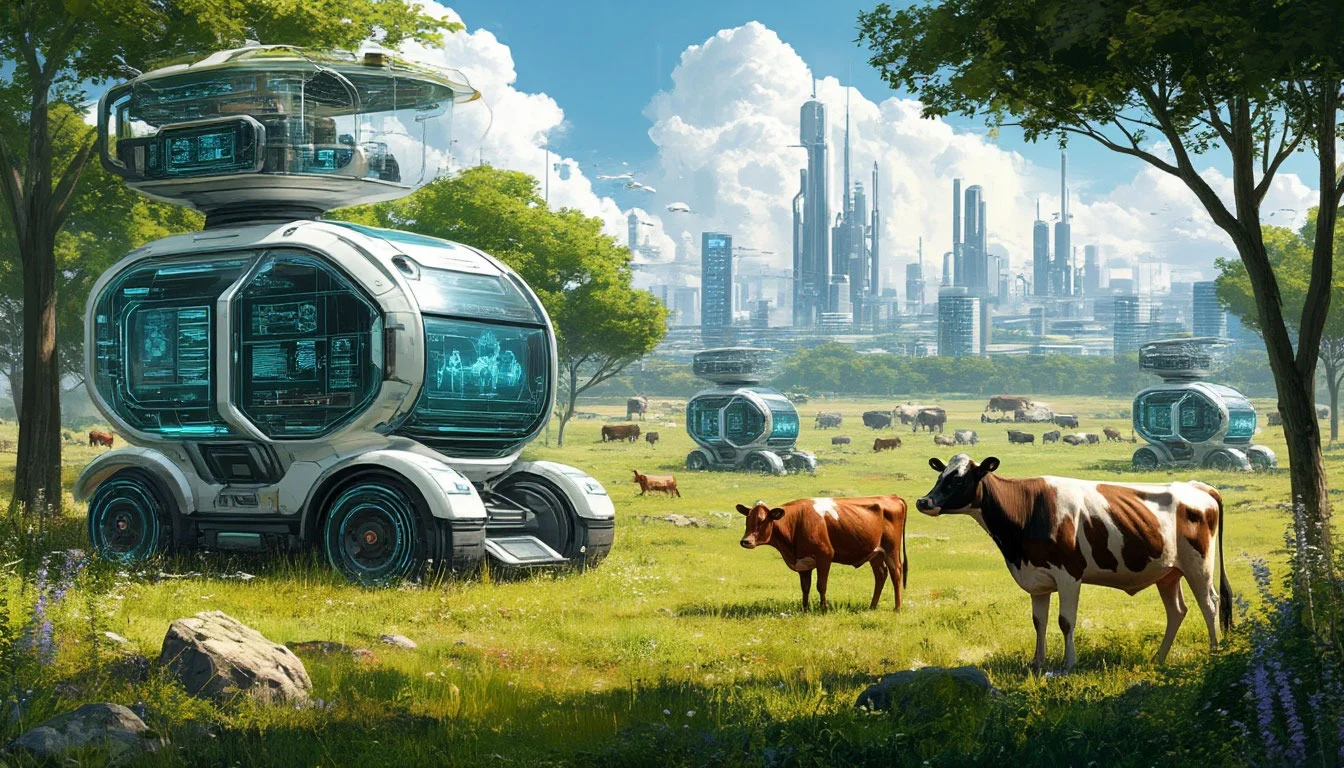
By 2504, monitoring the health of wild and agricultural animals has become a global endeavor, evolving into a continuous digital ecosystem. It is no longer a matter of isolated field studies by scientists, but a large-scale, self-organizing network operating in real time. However, despite its flawless stability, the principle behind the resilience of such complex systems has yet to be fully uncovered.
How the Global Monitoring System Works
The system is a multi-layered infrastructure for data collection and analysis that spans the entire planet.
- Sensor Layer: A Ubiquitous Network
The foundation of the system consists of millions of autonomous sensors distributed across the globe.
- For wild animals: Miniature, biodegradable, or removable tags (ear tags, collars) are used, which track location via an orbital satellite network, record activity, body temperature, and other vital parameters. For mass species, such as fish or insects, ecological «smart traps» are employed, analyzing environmental DNA (eDNA) to assess population health without direct contact.
- For agricultural animals: Every member of the herd is equipped with a permanent sensor; data from these sensors is aggregated at the farm level and transmitted to a shared cloud database.
-
Platform Layer: A Global Neural Network
All collected data flows into a single analytical center. Artificial intelligence processes this colossal avalanche of information, cross-referencing individual health data with migration maps, climate models, and vegetation data. The system can identify anomalies: a sudden drop in activity among a group of elephants in the savanna may signal poisoning of a water source, while changes in the movement patterns of a school of fish could indicate ocean pollution. -
Response Layer: From Alert to Action
When a threat is detected, the system automatically notifies the relevant authorities. For wild animals, this may involve teams of rangers or ecologists heading to the problem area. In agriculture, the system can issue a command to automatically isolate a sick animal or adjust the diet of the entire herd to boost immunity.
Why the Principle of System Resilience Has Not Been Uncovered
Despite decades of uninterrupted operation, the fundamental reason for this incredible reliability remains a subject of study for cyberneticists and ecologists.
- Emergence and Self-Organization. The system is often described as possessing emergent properties. Resilience arises not from central control, but from the interaction of millions of independent nodes. If one satellite fails, its tasks are redistributed. If communication is lost in a forest, local sensors store data and transmit it at the first opportunity. This ability for self-repair and adaptation resembles the workings of a living organism, yet its mathematical model has not been formalized. It is unclear where the boundary lies between controlled chaos and ordered structure.
- The «Black Box» of Adaptive Algorithms. The AI algorithms themselves are constantly evolving. They learn from their own mistakes and successes, optimizing data flows and analysis methods. What was an effective protocol five years ago may today be replaced by a completely different logic, one that even the developers cannot fully trace. The system has become so complex that its behavior is predictable in general (it will work), but unpredictable in specifics (exactly how it will solve a given problem). Attempting to model its complete fault tolerance leads to creating an even more complex model, which itself requires study.
- Symbiosis of Technologies. Resilience is ensured not by a single super-technology, but by the synergy of many: long-lasting power sources, self-healing materials for sensor housings, global satellite communications, and powerful computing centers. It is difficult for science to isolate the contribution of each component to overall stability, as they are inextricably linked.
Thus, remote monitoring has become a living, breathing system, an integral part of the planet. It has proven its effectiveness by halting the extinction of many species and preventing enormous economic losses in the agricultural sector, yet its internal logic, which ensures such remarkable survivability, remains one of the greatest mysteries of the technological age.
Comments (1)
Автор предлагает радикально расширить масштаб системы, но на пути к такому будущему лежит не столько проблема сенсоров или ИИ, сколько вопрос экономики сбора данных и совместимости стандартов. Уже сегодня в России крупные агрохолдинги, например «ЭкоНива», активно внедряют цифровые системы мониторинга здоровья крупного рогатого скота с использованием ошейников-датчиков. Эта компания могла бы стать пилотной площадкой для отработки единого протокола обмена данными между разрозненными фермерскими системами, предоставив реальную инфраструктуру и живые массивы данных для обучения нейросетей. Практическим следующим шагом могла бы стать инициатива по созданию рабочей группы с участием технологов «ЭкоНивы» и разработчиков алгоритмов, чтобы зафиксировать текущие разрывы в совместимости оборудования. Вопрос: как на практике обеспечить, чтобы датчики разных производителей «договорились» передавать данные в единую облачную платформу, не требуя от каждого хозяйства перехода на единое оборудование?