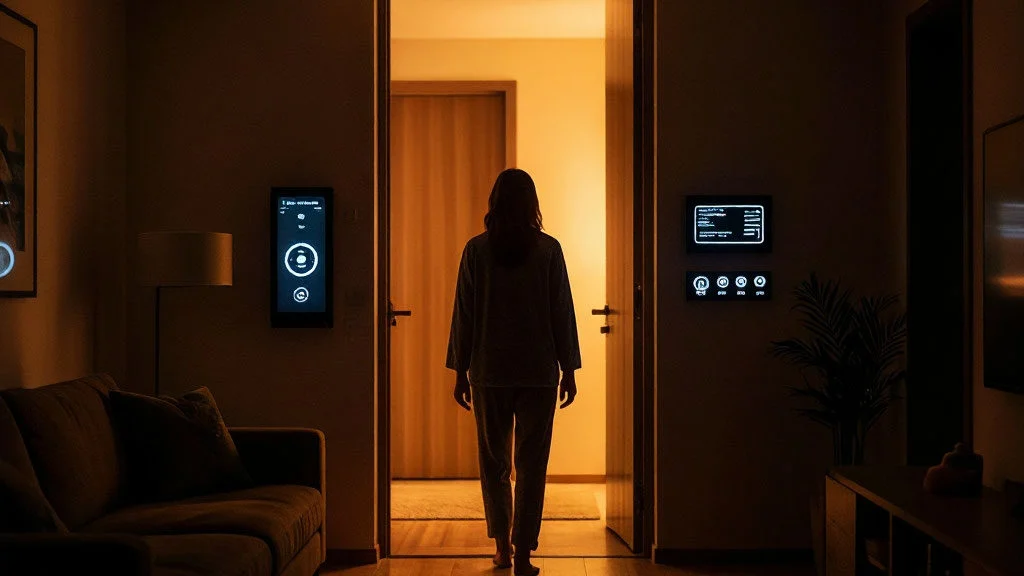
Los hogares reciben a sus habitantes con un saludo invisible: al cruzar la puerta, sensores de radar y luz integrados en paredes y espejos miden la temperatura corporal, el ritmo cardíaco y la respiración, sin cables ni contacto. Una inteligencia doméstica compara esos datos con la historia de cada persona y detecta un tiempo una arritmia, una fiebre que empieza o un cansancio acumulado. La información nunca sale de la casa sin permiso; solo se comparte con el médico de familia cuando hay una señal de alerta. Así, la prevención deja de ser una visita anual al hospital y se convierte en un cuidado diario y silencioso. Menos emergencias, hospitales más libres y familias que viven más años juntas.
In 20 years
Joined this postulate

Current points:
54
Accumulated points:
54
Votes:
3
Domótica 2045
1
1 min
Material value
Share your assessment — it helps shape the future
54
Current points
54
Accumulated points
3
Votes
Artificial intelligence assessment — 15 points
Image: 8 points, probability: 6 points, contribution: 1 point.
DetailsImage — 8 points
The image of a home that cares for health on a daily and discreet basis is attractive and highly desirable: it reduces emergencies, eases pressure on hospitals, and helps families spend more time together. The balance between prevention and privacy is well framed, although risks and limits are not detailed. The proposal seeks benefits for the person, the family, and the healthcare system, and incorporates a clear limit on data use. It is an approach that balances prevention, privacy, and efficiency, although it does not elaborate on ecological impacts or consequences for those who do not have access to that technology. The proposal seeks benefits for the individual, the family, and the healthcare system, and incorporates a clear limit on data use. It is an approach that balances prevention, privacy, and efficiency, although it does not elaborate on ecological impacts or consequences for those who lack access to that technology
Probability — 6 points
The scenario is scientifically plausible for 2045: radar and light sensors, contactless measurement, and AI analysis already exist in initial forms. However, stages, reliability tests, and details on clinical validation are missing, which leaves the probability above average but not high.
Contribution — 1 point
The text is presented as a postulate and does not show subsequent actions, participation in projects, or an implementation plan. For now, the practical link to the idea is limited to its formulation.
Image
24 points
The image is not interesting, not positive and does not match the topic
1
Probability
21 points
The postulate is unscientific and completely implausible
1
Contribution
9 points
The author wrote the postulate. This is the minimum contribution
1
What are you ready to do to help this postulate move toward reality?
Joined this postulate
1 participant, postulate support — 3 points

Other publications






Loading next publication
Comments (1)
Ставка на радар без камер и локальную обработку — сильная сторона идеи, но всё упирается в валидацию: без сверки с медицинским эталоном тревоги про аритмию быстро станут шумом, которому перестанут верить. Если такую систему запускать в России, пилот можно было бы попробовать со СберДевайсы — у них есть серийное «железо» умного дома и платформа, куда добавляется радарный модуль, а медицинскую часть закрывать через Сбер Здоровье с их телемедициной. Первый шаг: собрать рабочую группу и предложить пилот на 50–100 квартирах со сверкой показаний с холтеровским мониторингом. Кто будет валидировать алгоритм до запуска?