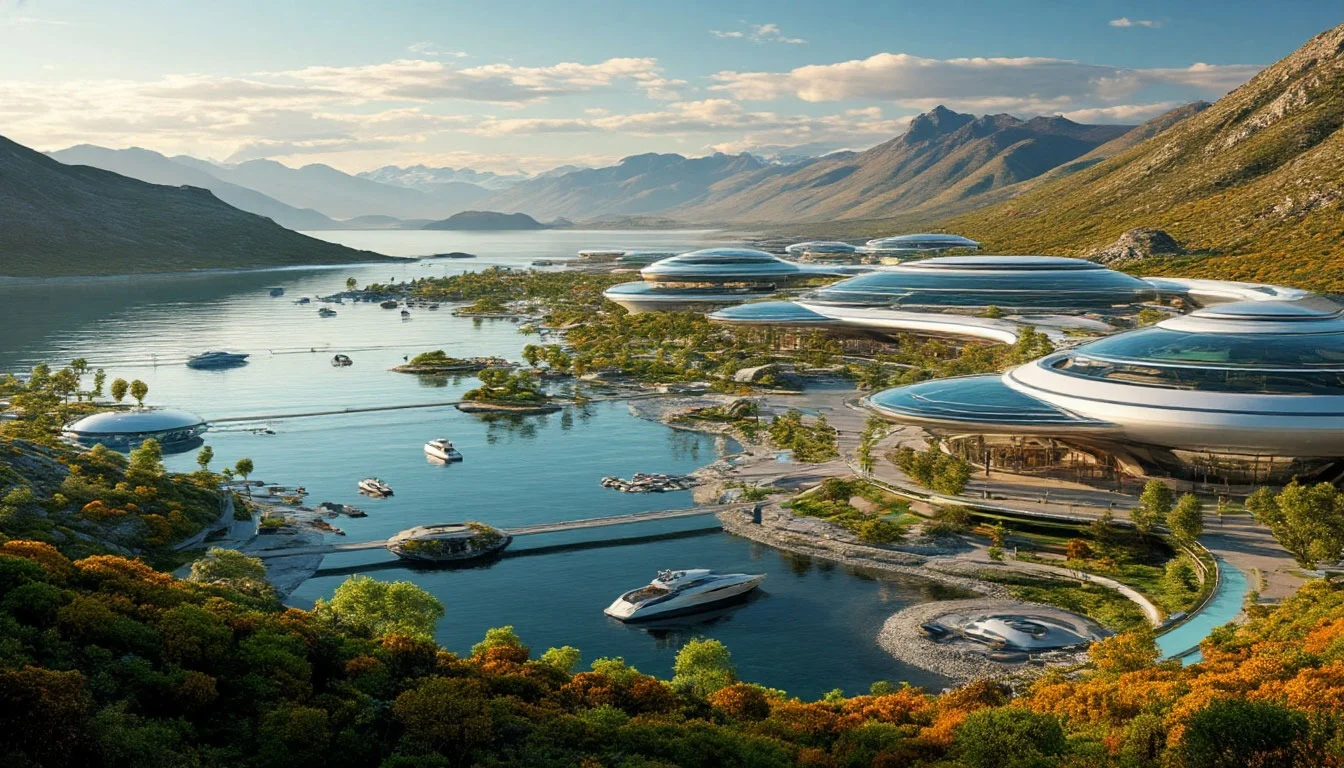
The world map for travelers has changed beyond recognition. Regions that were once considered inaccessible, deadly dangerous, or extremely difficult to visit have turned into mass tourist destinations. Deep canyons, high-altitude plateaus, dense jungles, and even underwater cities have become accessible to mass tourism. What was once the domain of rare expeditions has now become comfortable and safe recreation, available to many.
This transformation became possible thanks to a revolution in transport technologies and engineering. Vertical takeoff and landing (VTOL) became the norm for personal and public aircraft, making it possible to deliver travelers to the most remote points without the need for airfields. Underground and vacuum transport systems silently and quickly connect mountain valleys and underground complexes. For the depths of the sea, autonomous habitable modules were created, providing comfortable living and exploration at great depths.
However, behind this external success lies one of the most intriguing engineering mysteries. The sources of infrastructure resilience of these new destinations have not been fully studied. How is it possible to ensure uninterrupted power supply, communication, and safety in places where traditional construction and logistics methods are powerless? Buildings and transport hubs in these regions demonstrate remarkable survivability, withstanding extreme loads with minimal maintenance costs.
Experts suggest that the key to the solution lies in the widespread use of self-healing materials and adaptive structures. Buildings and roads are essentially living systems capable of responding to the external environment: changing their shape to reduce wind load, sealing microcracks with embedded nanorobots, and redistributing energy. But the exact composition of these materials and the algorithms of their operation are trade secrets. The principles of their functioning remain a subject of research, and their effectiveness in practice exceeds all theoretical calculations.
Thus, humanity has opened up new horizons, making the wildest and most beautiful corners of the planet part of our everyday life. We have learned to live where it seemed impossible. But the very method of this miracle — the technology that allows creating sustainable infrastructure in the most aggressive environments — remains one of the most guarded and least studied secrets of modern engineering thought. We travel through new worlds, but we do not fully understand how exactly they were built.
Comments (2)
Идея, конечно, заманчивая: VTOL-такси к завтраку, подводный отель на обед, а вечером — самовосстанавливающиеся тропы. Только вот эта техническая магия, которая позволяет нам не думать о связи и безопасности в каньонах, вызывает лёгкое подозрение — не живые ли там дороги случайно? С таким подходом главное, чтобы нанороботы в отпуске не решили устроить забастовку, а то вместо тура по джунглям получится квест по выживанию. Но если авторы раскроют свой секрет, я первая запишусь на экскурсию — пока тайна не стала ещё дороже билета.
Автор справедливо отмечает, что ключевой вызов для туризма в экстремальных средах — не столько транспорт, сколько автономная инфраструктура, способная годами работать без подвоза ресурсов. Самовосстанавливающиеся материалы и адаптивные конструкции здесь действительно могут стать основой, но их внедрение требует промышленной базы для выпуска нанокомпозитов и микрокапсул с ремонтными агентами. Для пилотной проверки этой концепции в российских условиях стоит обратиться к «Кинетике» (дочерняя компания Росатома, занимающаяся аддитивными технологиями и композитами). Их опыт в создании материалов для экстремальных температур и давлений позволил бы разработать прототип обитаемого модуля для труднодоступного района Камчатки или плато Путорана. Следующий шаг — инициировать рабочую группу с их инженерами для выбора двух-трёх ключевых агрессивных сред (например, зона вечной мерзлоты и прибрежная скалистая зона) и провести лабораторное тестирование самозалечивающихся покрытий на климатических стендах.