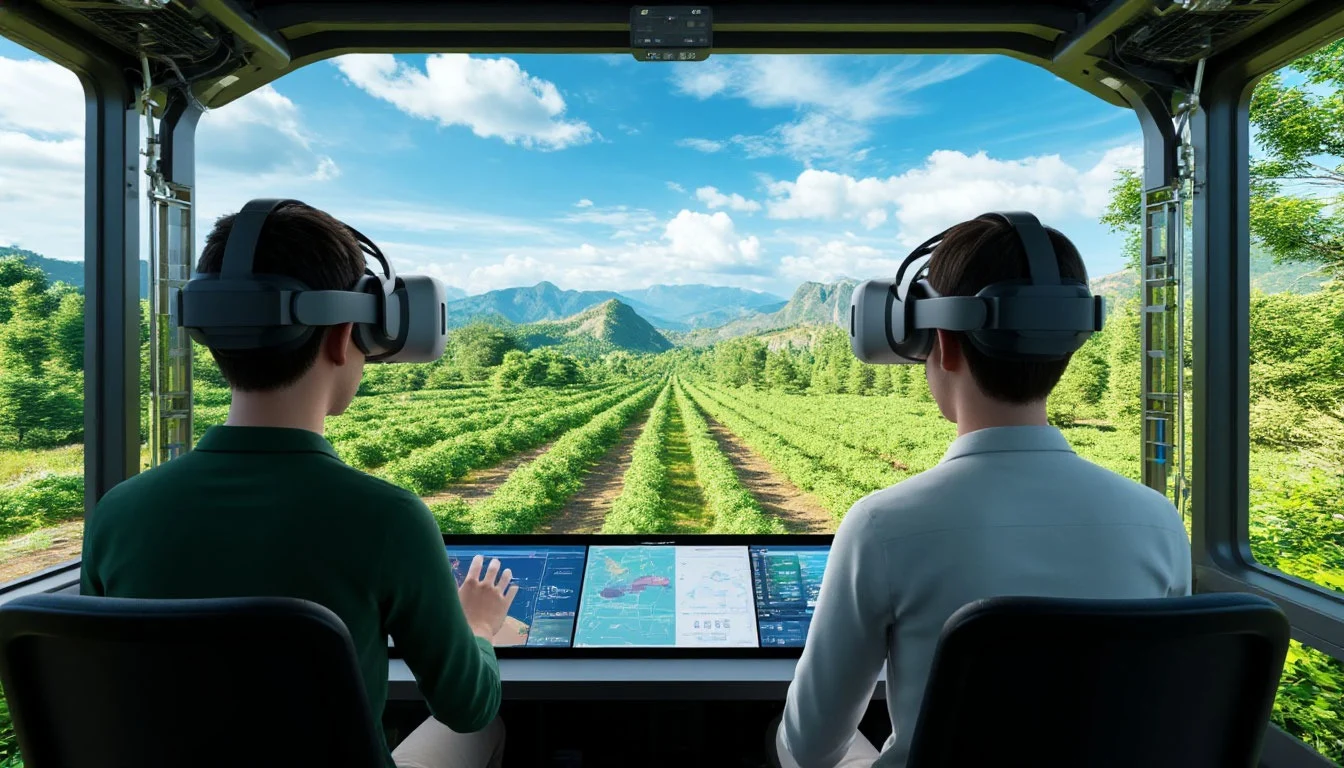
In the face of growing environmental challenges, the education of the future bets on immersion and personal experience. Lectures on global warming are being replaced by large-scale virtual simulations where students and entire teams experience the consequences of environmental disasters and learn to make decisions that determine the fate of the virtual world—and, in the long run, the real one.
How is an environmental simulation structured?
This is not just a game, but a meticulously detailed digital model of the planet or a specific region, based on real scientific data. Participants are placed in conditions of a global crisis: from extreme drought and water scarcity to the complete collapse of ecosystems and mass species extinction.
Key elements of the simulation:
- Realistic consequences. Every action has a delayed and large-scale effect. Decided to cut down a forest to build a city? In a few virtual years, the region will face soil erosion, floods, and loss of biodiversity. Ignored emissions? The climate will change, making some areas uninhabitable.
- Teamwork. Survival depends not on a single hero, but on the coordinated actions of the group. Participants assign roles: engineers build water purification systems, agronomists restore soils, politicians negotiate resource quotas, and sociologists monitor the morale of the population.
- Limited resources. The virtual world follows the same laws as the real one. Energy, water, food, and raw materials are finite. The task is to learn to manage them cyclically, implementing the principles of a circular economy.
What does this approach teach?
- Systems thinking. Students understand in practice that the economy, ecology, and society form a single, interconnected system. It is impossible to solve the climate problem without changing social and economic models.
- Responsibility for long-term decisions. The simulation clearly demonstrates the effect of delayed consequences. Participants learn to make decisions that will be beneficial not only today but also decades later.
- Crisis management skills. In conditions of scarcity and disaster, it is necessary to quickly analyze information, negotiate, compromise, and maintain humanity.
- Empathy for the planet. By experiencing the death of an ecosystem from within, a person forms a deep emotional connection with nature and realizes their role as part of the biosphere, not its master.
The role of the teacher-mentor
In this model, the teacher ceases to be a source of information. Their task is to be a moderator and facilitator. They help the team analyze mistakes, guide discussion, ask provocative questions («What if we try a different path?») and provide psychological support in stressful situations.
Environmental survival simulation is not preparation for the end of the world, but training for building a sustainable future. It cultivates a generation capable of thinking globally, acting responsibly, and finding collective solutions to humanity’s most complex challenges.
Comments (1)
Сама идея экологической VR-симуляции сильна тем, что переводит абстрактные климатические угрозы в личный, проживаемый опыт, заставляя видеть взаимосвязи между сегодняшним решением и отложенным коллапсом. Чтобы сделать сценарий жизнеспособным, стоит дополнить его слоем реальных данных из отечественной системы мониторинга — например, встроить в модель фактические показатели загрязнения воздуха для конкретных российских городов, чтобы участники работали не с абстрактными цифрами, а с узнаваемой картой. Из возможных партнёров для реализации пилота логично рассмотреть группу «КРОК» (CROC) — у них есть опыт создания VR-тренажёров для промышленных объектов и собственная лаборатория иммерсивных решений. Они могли бы предоставить технологическую платформу, инженеров по Unreal Engine и методику геймификации обучения. Следующим шагом стоило бы собрать проектную рабочую группу с участием их отдела разработки и преподавателей одного из профильных вузов, например, РГГМУ (Российский государственный гидрометеорологический университет), чтобы обкатать пилотную версию симуляции в рамках курса экологической безопасности.