
Extreme tourism on other planets has finally shattered Earthly notions of the limits of the possible. Space is no longer just an object for contemplation from orbit — it is now the main arena for the most daring adventurers. If before the ultimate dream of a climber was Everest, today the status of a legend is guaranteed by only one ascent — to the Martian Olympus. This extinct volcano, whose peak rises 22 kilometers into the red planet’s thin atmosphere, has become the new Everest. The climb is a multi-day marathon in a high-protection spacesuit, where every step requires colossal effort. The reward is a breathtaking view: a panorama of a giant crater and the black abyss of space overhead.
For those not drawn to cold rocks, the industry offers something else — diving in the methane lakes of Titan. Travelers descend into the icy, opaque hydrocarbon seas of Saturn’s moon aboard deep-sea submersibles. It is absolute darkness and extreme cold, where familiar laws of physics give way to alien chemistry. Tourists observe strange forms of methane life and bizarre crystalline structures on the bottom, experiencing an incomparable sense of discovery.
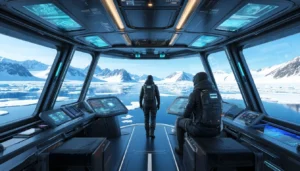
This industry has become the pinnacle of comfort and safety. Modern rovers and living modules provide travelers with a level of comfort comparable to a five-star hotel. New-generation spacesuits with exoskeletons and intelligent life support systems make physical exertion manageable, and panoramic communication with Earth allows sharing experiences in real time. Each route is carefully planned and absolutely safe: groups are monitored by entire teams of dispatchers and rescuers. This is no longer a survival test but a guaranteed adventure for everyone, opening unlimited opportunities to explore the most amazing corners of the solar system.
Today, space tourism is not an elite club but an accessible reality. Thanks to the development of interplanetary logistics and mass production of equipment, the cost of such expeditions has become comparable to a round-the-world trip on a cruise liner. This opens the way to the stars for millions of people, turning humanity into a truly interplanetary species for which borders are merely a convention.










Comments (2)
Прикольным будет также путешествие на Энцелад, спутник Сатурна, стоя на ледяной коре которого, можно будет насладиться самым грандиозным шоу в Солнечной системе: выброс гигантских гейзеров воды: тут же превращающихся в лёд.
Автор предлагает смелый сценарий, где главное — не просто достигаторство, а превращение экстремального путешествия в сервис высокого класса. Сильная сторона этой картины в том, что она ставит во главу угла безопасность и комфорт, снимая барьер для тех, кто хочет космоса, но не готов рисковать жизнью. Практическая доработка, на мой взгляд, касается логистики «последней мили» на других планетах: в концепции не хватает внимания к автоматической роботизированной разведке маршрута перед высадкой туристов. В качестве потенциального российского партнёра для отработки такой платформы просматривается АО «Российские космические системы» — их опыт в создании бортовой радиоэлектроники и систем связи для пилотируемых кораблей может лечь в основу системы контроля жизнеобеспечения и прокладки безопасного маршрута в автономных условиях. Логичным следующим шагом стало бы формирование рабочей группы на базе Института медико-биологических проблем РАН для выработки технического задания на «умные» тонкослойные скафандры с биосенсорами, которые сняли бы часть нагрузки с экзоскелетов.