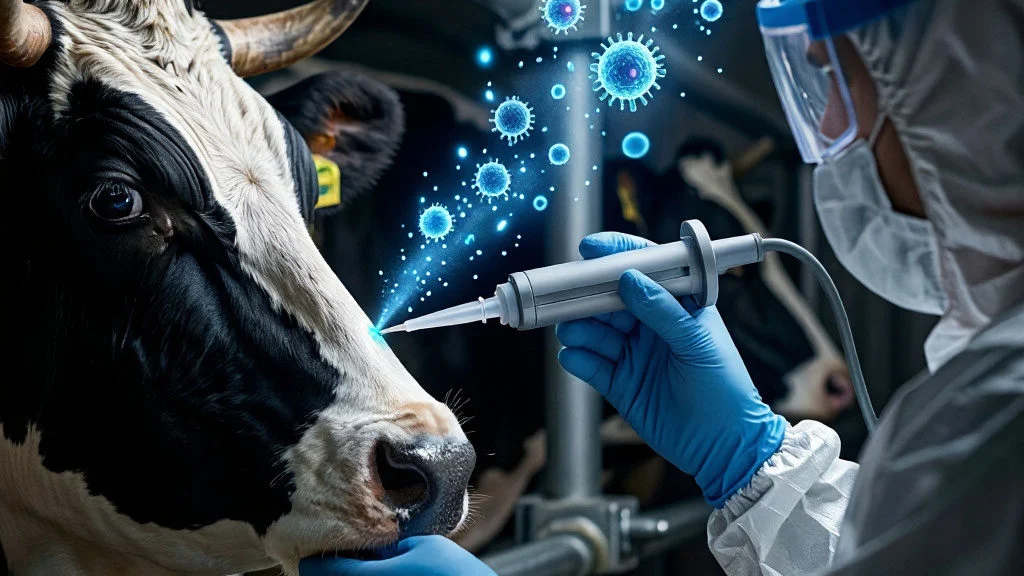



Phage Therapy in Veterinary Medicine: The Renaissance Has Arrived
Phage therapy in veterinary medicine has undergone a renaissance: it has moved from the status of a «therapy of last resort» for hopeless patients to the category of a routine tool in the fight against superbugs. Amid the global depletion of effective antibiotics — especially critical for productive animals, where restrictions on the use of fluoroquinolones and 3rd–4th generation cephalosporins have proven very strict — bacteriophages have become the foundation of biological safety.
Mechanism of Action: From Lytic Cycle to Persistence
Bacteriophages are viruses that attack exclusively bacteria. Only strictly lytic (virulent) phages were used for therapy. The process of destroying the pathogen occurred as follows.
| Stage | What Happened |
|---|---|
| Adsorption | The phage attached to a specific receptor on the bacterial surface — for example, to the lipopolysaccharide of the E. coli cell wall or to the pilus protein in Klebsiella. |
| Genome Injection | The phage injected its DNA into the cell, completely shutting down host protein synthesis. |
| Replication and Lysis | Inside the bacterium, an army of new viral particles assembled. The enzyme endolysin ruptured the bacterial wall from within, releasing hundreds of new phages that immediately attacked neighboring pathogens. |
Unlike antibiotics, which often have a bacteriostatic effect (simply stopping growth), phages proved to be bactericidal. Moreover, they penetrated biofilms — the dense mucous matrices with which Staphylococcus aureus protects itself in chronic mastitis, making them invulnerable to penicillins.
Applications by Area
Purulent Mastitis in Cows
Mastitis was caused by a wide range of bacteria, but most often by resistant strains of Staph. aureus and E. coli. Traditional intramammary (intracisternal) antibiotic therapy gave a low cure rate during the dry period — about 40–50% for staphylococcus.
Phage preparations were injected directly into the milk cistern through the teat canal. The advantage was that phages did not penetrate into the systemic bloodstream and udder tissues, remaining within the infection site. This allowed the animal to continue producing milk (after a mandatory withdrawal period), which is safe for humans, since the phages themselves are safe for mammalian cells. Modern banks contained cocktails of 5–8 different types of phages, covering more than 90% of field isolates of mastitis pathogens in a specific region.
Pneumonia in Pigs (Actinobacillus Pleuropneumonia — APP)
This is an acute disease with high mortality caused by Actinobacillus pleuropneumoniae. The problem was complicated by the fact that the bacterium lived on the mucous membranes of healthy animals and flared up under stress. Systemic antibiotics required mass injections for the entire herd.
A promising method was aerosol disinfection of premises with liquid phage lysates («cold fog») and oral administration of preparations through the drinking system. Phages colonized the tonsils and lungs of pigs, creating a protective layer that destroyed the pathogen even before active reproduction began, working as a «living antiseptic.»
Sepsis in Domestic Animals (Cats and Dogs)
In abdominal sepsis after intestinal rupture or severe pyometra, animals were often infected with multidrug-resistant strains of Pseudomonas aeruginosa or enterococci. In cats, the metabolism of many antibiotics was genetically impaired (for example, the inability to glucuronidate many drugs led to severe intoxication).
Here, intravenous administration of purified phage cocktails was used. Since phages were quickly drained by the lymphatic system and concentrated in the spleen and inflammation sites, they effectively reduced the overall microbial load (biological load), giving the animal’s immune system time to recover.
Technological and Regulatory Barriers
Despite their effectiveness, widespread adoption was hindered by the specifics of viral biology.
- Narrow Spectrum of Action: if a broad-spectrum antibiotic killed everything indiscriminately, a phage hit a precise target. This required either creating huge banks of standard strains or using personalized medicine — selecting a phage for a specific patient’s smear within 24 hours.
- Immunogenicity: the animal’s body produced antibodies against the phages themselves. Upon repeated administration of the preparation after a short period, its effectiveness dropped. The solution was rotation of different monophage strains or the use of encapsulated forms.
- Production and Storage: bacteriophages multiplied only on living host bacteria in bioreactors. The process of purification from residual bacterial toxins (LPS endotoxins) was complex and expensive. The preparations required strict cold chain conditions (+2…+8 °C), which complicated logistics in animal husbandry.
Registered Preparations and Prospects
At present, industrial series of bacteriophages (coliproteus, staphylococcal, intesti-bacteriophage) have already been registered and used, actively employed in veterinary protocols as an alternative to reserve antibiotics. According to forecasts for agrobiotech development, combined regimens of «phage plus a low-efficacy old antibiotic» have become the gold standard for treating severe infections, allowing resistance mechanisms to be overcome and restoring bacterial sensitivity to pharmacotherapy.








Comments (2)
Читаю и думаю: если фагов правда удастся приручить, ветеринарам станет куда легче. Автор предлагает смелую, но понятную идею, и выглядит она вполне реальной. Интересно, а до обычных ферм это быстро дойдёт?
Сильная сторона материала — связка «коктейль под полевые изоляты плюс локальная панель штаммов»: это реалистично. Для практики логично начать с НПО «Микроген» — у него есть производство фаговых препаратов, банк штаммов и опыт регистрации. Предложил бы пилот на молочной ферме: собрать мазки из вымени, подобрать коктейль против стафилококка и сравнить с антибиотиком по сухостойному периоду. Первый шаг — рабочая группа с ветслужбой хозяйства и технологами «Микрогена».