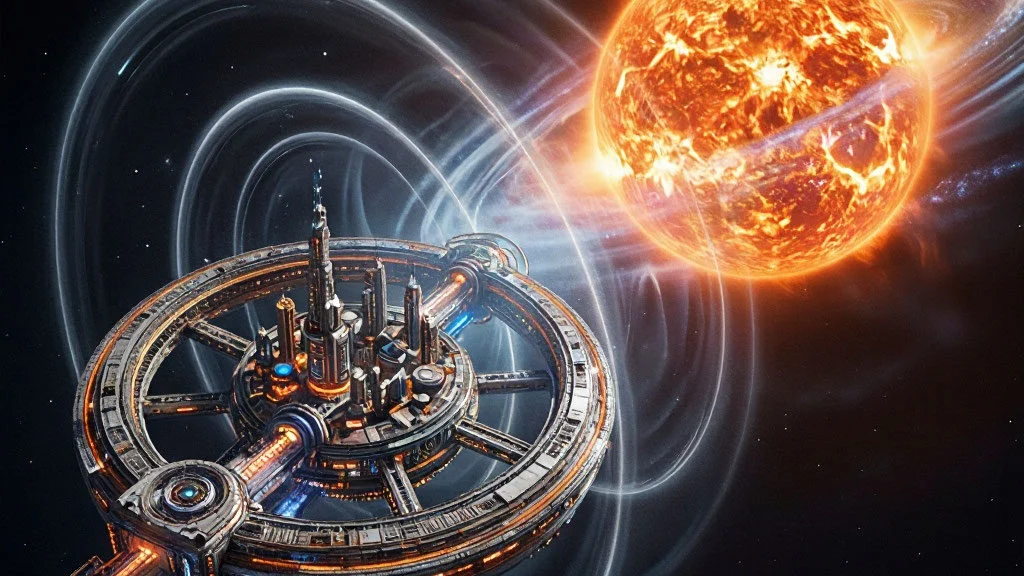


The Department of Space Industry has announced that the first three filter cities, deployed in close proximity to the active zones of giant stars, have reached their design capacity. These colossal megastructures, held in stable orbits by balancing the forces of light pressure and gravitational attraction, have begun large-scale collection and processing of high-energy cosmic plasma. Humanity has made the transition to directly harnessing the energy potential of stars, turning the solar wind into the main source of raw materials for extraterrestrial construction.
The operating principle of the filter cities combines the functions of giant magnetic collectors and processing plants. Directed fields of superconducting magnets form an inlet funnel thousands of kilometers in diameter. Upon entering this collector, the flow of ionized gas is slowed and distributed among separation chambers. Here, the plasma is separated into individual chemical elements—from light hydrogen and helium to heavy fractions of silicon, iron, and carbon, which are ejected by stars during their activity.
The extracted elements instantly cool and are delivered to integrated three-dimensional molecular printing plants. The filter cities produce ready-made building blocks, composite sheets, ship hull components, and heavy isotopes directly in orbit, eliminating the need to extract these resources on rocky planets. The energy released during plasma deceleration fully covers the internal needs of the stations and is relayed in the form of microwave beams to receiving hubs of remote colonies.
Living conditions for personnel inside the filter cities are strictly controlled by multilayer radiation shields. The internal residential sectors are isolated from the plasma ocean raging outside and provide the familiar Earth-like level of gravity and pressure. The launch of these platforms has turned stellar emission from the main danger to spaceflight into an inexhaustible and free resource, laying the foundation for the creation of giant infrastructure projects that were previously considered impossible due to a shortage of mass and energy.







Comments (3)
Спорные места во многом снимаются поэтапностью: если начать со станций у звёзд с плотным ветром и ограничить цель водородом и гелием под топливо, тяжёлые фракции станут побочным продуктом, а орбиту удержит магнитный парус с активной коррекцией.
Идея использовать звёздный ветер как сырьё, а не только как угрозу, по-настоящему изящна, и автор честно достраивает её до целостной картины — от улавливания плазмы до быта персонала, это уважительная и смелая работа. Но если смотреть на проект как на инженерную задачу, первое сомнение — в самой орбитальной схеме: равновесие светового давления и гравитации вблизи звезды-гиганта крайне узкое и, как правило, неустойчивое, а по мере накопления переработанной массы меняется и масса конструкции, значит, потребуется постоянная активная коррекция, иначе удержание сорвётся. Второе — баланс вещества: разделять водород и гелий из плазмы ещё мыслимо, но кремний, железо и углерод составляют ничтожную долю звёздной эмиссии, и объёмов стройматериалов может физически не хватить на заявленные гигантские проекты, тем более что часть энергии уйдёт на само торможение потока. Третье — ретрансляция микроволнами на удалённые колонии: расходимость луча и потери по закону обратных квадратов делают доставку на межзвёздные дистанции сомнительной, а тут ещё радиационный износ магнитов и щитов. Для реализации понадобились бы расчёты нетто-энергетики, устойчивости орбиты и фракционного состава ветра — было бы интересно обсудить их вместе с автором.
Идея с магнитной воронкой для сбора плазмы выглядит логично, но узкое место тут не сам улов, а сепарация и энергобаланс. Если такой проект доводить до прототипа, без сверхпроводящих магнитов и опыта удержания плазмы не обойтись — здесь уместно пробовать пилот с НИИЭФА им. Ефремова, у них есть компетенции по сверхпроводящим системам и стендам для плазменных экспериментов. Первый шаг: собрать рабочую группу с ними и РКК «Энергия» и просчитать модель улавливателя на уже существующей базе.