


By 2032, a network of routes will operate in Russia, where trucks will cover most of the route on their own. People will not disappear from transportation: the driver will become an operator, overseeing several trips, making decisions in difficult situations, and taking responsibility for the equipment.
In 2026, an autonomous tractor unit for the first time covered about 700 kilometers from Moscow to Saint Petersburg along the M-11 highway without human intervention. The vehicle moved at a speed of about 90 km/h, overtook slow traffic, circumvented work zones, and passed toll points. By that time, driverless trucks were already performing commercial deliveries on the M-4, M-11, and TsKAD, and delivery robots had completed over 1 million orders and traveled more than 2 million kilometers.
Roads Started Working Around the Clock
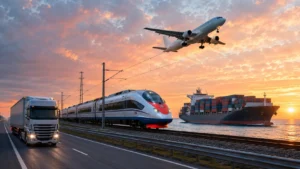
Autonomous transport made deliveries more precise. Goods moved between distribution centers day and night along proven digital corridors. Stores less often faced empty shelves, enterprises received components faster, and food and medicines reached remote areas without unnecessary transshipment.
The transition followed a clear roadmap. First, autonomous vehicles established themselves on high-speed highways and closed warehouse areas. Then, diagnostic, communication, and charging stations appeared along the routes, and maps began to update in real time. Regions opened training centers for operators, engineers, and cybersecurity specialists. In the next stage, autonomous vehicles will link federal highways with urban delivery robots, allowing cargo to travel from factory to doorstep in a single system.
People Took on New Roles
The driver profession did not disappear but split into safer directions: autonomous fleet operator, instructor, technician, dispatcher, and specialist for complex routes. People stopped spending weeks behind the wheel and more often worked near home. Technology took over the monotonous part of the route, while humans kept responsibility, experience, and communication.
My Contribution
I supported safe autonomous transport projects, reported on problematic road sections, participated in discussions of rules, and helped explain the technology in plain language. A road without fatigue became not a replacement for humans but a shared infrastructure for the development of Russia.









Comments (1)
Сильная сторона предложения — эволюционный сценарий, где водитель не исчезает, а превращается в удалённого оператора, отвечающего за парк машин. Это снимает главный социальный барьер внедрения — страх потери профессии. Практическую ценность модели можно усилить, если добавить в дорожную карту сегмент пилотных маршрутов с ограниченным функционалом, например, движение в колонне за лидером или автономию только на перегонах между логистическими хабами, чтобы накопить статистику надёжности до полного выхода на магистрали. Логичным партнёром для обкатки видится «Глобалтрак Лоджистик»: у компании большой парк магистральных тягачей, развитая сеть терминалов и собственная ИТ-разработка для управления перевозками, что дало бы реальную инфраструктуру, боевые маршруты и данные для обучения алгоритмов. Следующим шагом может стать инициация рабочей группы с их ИТ-и инженерным департаментом для оценки технического задания по дооборудованию одного из действующих тягачей под полуавтономный режим на участке М-11.