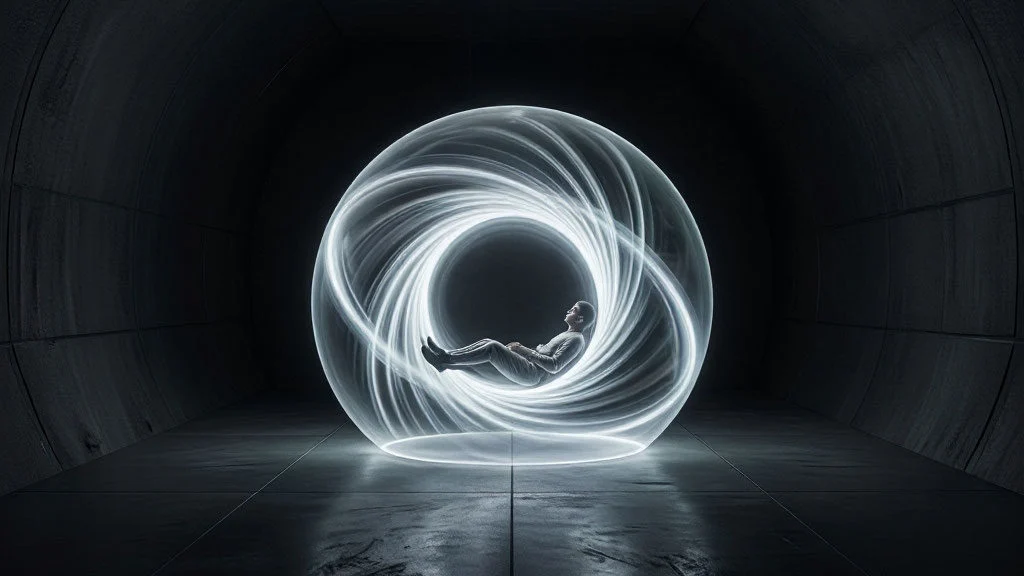

The concept of 10,000 hours of practice required to achieve mastery runs up against the biological limit of human life and the attention economy. In 2024 we try to cheat time with sleep or pharmacology. In the future, humanity will stop saving time and start deforming it geometrically.
Chronoreisen technology (travel in asymmetric time) turns skill acquisition from a marathon into a jump through a wormhole. Local gravitational distortion generators that create a controlled micro-wormhole (in the spirit of the Schwarzschild solution with an Alcubierre modification) make it possible to place the learner’s consciousness in a capsule where time flows thousands of times slower than in the outside world.
Yet the physics of time is only a tool. The main problem is psychology. The human psyche is not designed for subjective decades lived during a real lunch break. The role of the AI pedagogue and the human architect is to direct this temporal loop, where managing the entropy of consciousness matters more than managing gravity.
Architecture of the temporal capsule
The learning process in Chronoreisen mode is not simply a sped-up scroll through life. It is a rigidly designed simulacrum that protects the personality from disintegration.
- Compression and calibration (Entry layer):
The learner lies down in the capsule. An external timer begins a 40-minute countdown. Inside, the AI pedagogue activates a local gravitational field.
- Physics: For the learner, time slows down. But so that the brain does not break down from a lack of new stimuli (sensory deprivation over 20 years drives you insane), the AI does not simply “stretch” reality — it changes its resolution.
- Mechanics: The first 5 subjective years pass in a state of “white noise” — calibration of neurons. The brain physically rebuilds myelin sheaths for the new skill (for example, the hand motor skills of a surgeon) without the participation of consciousness.
- Dynamic entropy (Fighting boredom):
The main threat is endless repetition. If you force the brain to play the same scale for 20 years, it will fall into catatonia or begin to generate hallucinations.
- Technology: The AI pedagogue manages “temporal entropy.” It introduces micro-changes into the simulation that are indistinguishable to the outside world but for the learner inside add up to a whole life.
- Direction: The architect pedagogue designs the “seasons” of learning. Subjective spring is the joy of the first success. Subjective summer is the crisis of the fifth year, when the skill hits a dead end (the learning plateau). The AI creates an artificial “rival” or “mentor” who ages over time, changes character and begins to make mistakes, forcing the learner out of automatism.
- Sensory landscape: For the learner, the capsule walls are not plastic. The AI projects changing eras onto them. Neurosurgery practice can take place in a Victorian-era operating room, then in a sterile cyberpunk bunker, then in zero gravity. The context changes every 3 subjective years to sustain the dopamine response.
- Temporal integration (Exit layer):
The most dangerous moment is the return. If in 40 minutes the learner has lived 20 years, they have formed decade-long neural connections, habits, muscle memory and, most frightening of all, psychological traumas.
- The architect’s task: To design the “last day.” You cannot simply switch off the simulation at the peak of fatigue. The AI pedagogue must guide the learner through a ritual of career completion. The learner must “retire” inside the capsule, look back on their (simulated) 20 years, receive (virtual) recognition and close the door of the operating room behind them.
- Preventing dissociation: Without this ritual, upon returning to the real world, where 40 minutes have passed, the learner will experience severe temporal shock — the feeling that their life has been stolen, or that their body is too young for their skills.
Pedagogy as existential insurance
In the world of Chronoreisen, the pedagogue is not a teacher but a guardian of the soul’s integrity.
- Designing grief: If a skill requires emotional depth (playing the violin, which requires suffering, or therapy), the architect is obliged to include episodes of loss and mourning within the simulation in the 40-minute session. You cannot become a master without losing something over those 20 years.
- Memory management: The AI pedagogue uses protocols of selective amnesia. The learner remembers how to do it (procedural memory) but does not remember the lived (simulated) details of each of the 7,300 days. This protects against overload of autobiographical memory.
- Ethical limit: There is a “Cain Limit.” If during the simulation the neural imprint shows that the personality is beginning to fragment (signs of dissociative disorder), the AI is obliged to collapse the wormhole, even if the skill has not been mastered. Losing 10% of skill effectiveness is better than turning a child into an empty shell with PTSD from 20 years of solitude.
By 3024, mastery will cease to be a sign of a long life. It will become a sign of access to gravitational technologies. But the paradox is that the faster we learn through slowing time, the more important the human pedagogue becomes. Their task is not to teach someone to play the violin. Their task is to guarantee that the person who emerges from the capsule after 40 minutes still wants to live in a world they have just outgrown by two decades.








Comments (1)
Сильная сторона — перенос акцента с ускорения подачи материала на проектирование цикла опыта и корректного выхода: педагогика здесь важнее физики. Доработка — начать не с двадцати лет, а с коротких сессий, заранее задав метрики переноса навыка и темпорального шока. Пилот стоит обсудить с «Моторикой»: её нейроинтерфейсы и реабилитационные тренажёры дадут площадку и данные по моторному обучению. Первый шаг — рабочая группа с ними и VR-лабораторией: сравнить 40-минутный сеанс с обычной тренировкой по точности и удержанию навыка через месяц.