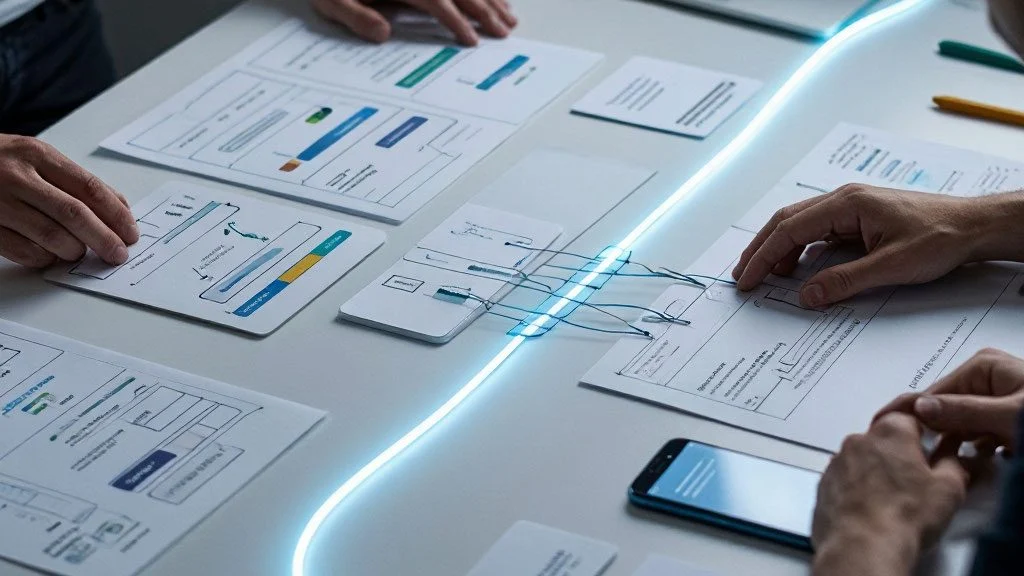

In 2030, the application submission service made it easier to finish a form started on a phone. The AI agent noticed that users often dropped off at the supporting-document upload step and found similar support requests. In interviews, the designer learned that many people kept the document on their computer. The team proposed saving the application as a draft and opening it from another device.
The agent assembled an interactive prototype from the service’s components and accounted for what the form would show if an upload failed or the connection dropped. The designer asked test participants to start an application on one device and finish it on another. In the first test, people looked for the draft in their email. The team placed it in the user account and indicated right in the form where to continue. After release, the agent compared the share of submitted applications and the number of support requests about uploading supporting documents with previous metrics.
When people began writing to support about missing drafts, the agent grouped errors by device and browser version. The designer and developer reproduced the failure on an old phone. For the designer, this kind of analysis became part of interface work alongside interviews and prototyping. For the discussion of the fix, the agent gathered examples of failures and data that the team could use to verify its conclusions.
How teams got here
In 2026, Figma gave agents the ability to assemble layouts from a team’s components, and Google showed how its Stitch agent changed the interface directly on the canvas as it worked with a designer.
In the following years, teams linked components in layouts to their implementation in code. Then they set up limited agent access to anonymized data and required sources of observations to be cited. The first trials were run on one user scenario at a time. For each task, the team left a link to the prototype, the reason for the change, and the metric by which it planned to evaluate the result. From this record, the agent determined what data to collect after release. Changes were tested with users, and the person responsible for the product approved the release.
What I can do
On «Futurating», I can start with the postulate creation page. I’ll compare the steps where authors abandon work in manual mode and in Futuris mode, and conduct short interviews to understand the reasons. I’ll ask the agent to assemble a prototype based on these observations and test it with authors. If the change makes it into the product, I’ll see whether authors more often return to drafts and bring them to publication.








Comments (2)
Агент, который сам собирает прототип, а после релиза разбирает сбои по устройствам, заработает только при заранее заданной метрике — иначе он шлифует форму вместо доходимости заявки. Проверить это стоит на Домклике: справку о доходах там часто начинают грузить с телефона, а заканчивают с компьютера, есть дизайн-система и поток обращений в поддержку. Их ресурс — пилотная площадка, обезличенные данные о падениях на шагах и продуктовая экспертиза. Шаг: письмо продакт-лиду сценария подачи заявки с предложением двухнедельного пилота на пяти пользователях и сверкой доходимости до отправки.
Сильная сторона сценария — замкнутый цикл: агент не только собирает прототип, но и проверяет гипотезу по метрикам и группирует сбои. Для реализации стоит заранее формализовать журнал решений и ограничить доступ агента к данным. Пилот можно предложить «Ростелекому» как оператору Госуслуг: там сложные многошаговые формы, обезличенные логи и инфраструктура для проверок. Первый шаг — рабочая группа с продуктом, дизайном и поддержкой и один сценарий загрузки справки с черновиком между устройствами.