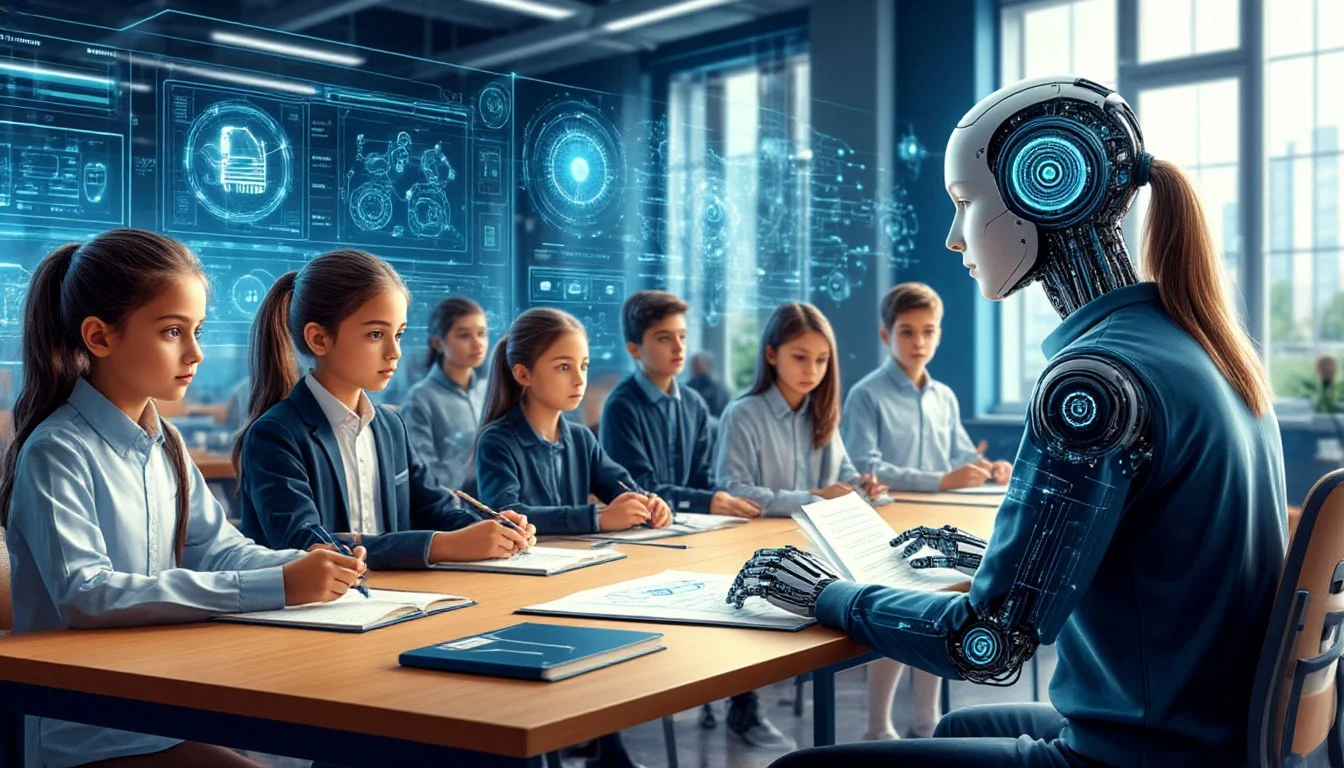

The concept of individualized educational trajectories, enhanced by AI, is a cornerstone of a new educational paradigm where mass, conveyor-belt learning gives way to a deeply personalized approach. In this system, artificial intelligence ceases to be merely a tool for finding information and becomes an intelligent partner that understands the student better than they understand themselves, helping them unlock their potential.
How it works: three levels of adaptation
An individualized educational trajectory, enhanced by AI, is built on continuous analysis and adaptation to three key dimensions of a student’s personality.
-
Adaptation to thinking and cognitive style. The AI symbiont analyzes in real time how the student processes information. Are they a visual learner who needs diagrams and infographics? Or an auditory learner who better absorbs podcasts and lectures? Perhaps their thinking is non-linear, and they are more comfortable working with mind maps and non-linear texts? The system instantly restructures the delivery of material. If a student does not understand a complex concept through text, the AI will offer an explanation in the form of an interactive 3D model, a game scenario, or a dialogue with a virtual expert. It selects tasks that challenge their type of intelligence, developing weak areas while building on strengths.
-
Adaptation to rhythm and pace. A standard curriculum assumes that all students move at the same speed. This inevitably leads to some being bored while others fall behind. The AI assistant eliminates this problem. It tracks levels of concentration, fatigue, and cognitive load. If a student has quickly mastered a topic, the system does not force them to wait for others but offers an advanced module or a new project. If a topic is proving difficult, the AI does not give a failing grade but slows down the pace, offers additional exercises, breaks a complex task into simpler steps, or returns to basic concepts that may have been missed. Learning becomes comfortable and occurs within the student’s «zone of proximal development».
-
Adaptation to value orientations and motivation. This is the deepest level of personalization. The AI analyzes the student’s interests, dreams, and values. Why should they learn math? If their goal is to design eco-friendly flying cars, the system will show how geometry and physics are directly related to aerodynamics and building their future creation. If the student is passionate about music, the same mathematical principles will be presented through the theory of sound waves and harmony. Learning ceases to be an abstract set of rules and becomes a meaningful path toward personal goals. Values also play a key role: the system can offer problem-solving cases that resonate with the student’s beliefs (for example, in areas of social justice, ecology, or technological progress), making the learning process not only useful but also ethically meaningful for them.
As a result, each student receives not just an adapted course, but a unique development path. This path is a dynamic map that constantly restructures itself based on their progress, new interests, and evolving goals. Education transforms from a mandatory stage of life into an exciting journey of constructing one’s own identity, where artificial intelligence acts as the most perceptive and wise guide.





Comments (1)
Такая глубокая персонализация требует не просто алгоритмов, а интеграции платформы с реальной цифровой средой школы. В России интересный пилот могла бы провести компания «Яндекс.Учебник»: у них уже есть инфраструктура для адаптивных заданий по математике и русскому, а также развитая аналитика ошибок. Для реализации идеи автора им не хватает как раз третьего уровня — привязки математики к «экологичным автомобилям» через анализ ценностей ученика. Следующий шаг — написать руководителю продуктового направления «Яндекс.Учебника» с предложением опробовать на одной школе не просто подбор тем под когнитивный профиль, а формирование проектных модулей на основе личных целей ученика. Однако главный практический вопрос к автору: как именно ИИ будет разрешать противоречия между тем, что ребёнку интересно (игровой дизайн), и тем, что ему объективно нужно (физика для сдачи экзамена)?