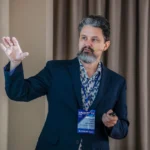
In an interview with Anton Popov, a Russian futurist, strategic consultant and trend expert, we tried to find out what future awaits us in a world where artificial intelligence is gaining more and more power, and people are required to be superhumans.
About the author: Anton Popov specializes in future forecasting, megatrend analysis, digital transformation and business modeling. He is the founder of the Telegram channel «The Real Future» (700+ trends). He worked at Rosatom, Russian Railways, Bankex (FinTech), MIRBIS (Chief Digital Officer). He teaches at HSE, Innopolis University, and the Corporate University of Russian Railways (15,000+ listeners).
Expert of accelerators: Gazprom Neft, StartupHub Moscow, AstanaHub. Author of courses on TESP analysis, planning horizons, megatrends 2025+.
Participant of the national project «Labor Productivity» (60+ enterprises, +5 billion rubles in value). Compiler of the «Map of Russia’s Future 2050» for the national center «Russia».
What interested us the most? Megatrends, decision-making in uncertainty, innovation, strategic transformation. Russia in Anton Popov’s forecasts is a center of attraction for traditional values, a place where a person remains human. And therefore the first question was about this topic: if neural networks become perfect, will people be needed on Earth?
— Of course. We are not just needed — the question should not be framed this way: if the future will exist without us, then why do we need such a future? That’s why neural networks are simply, on the one hand, a tool that some know how to use and others not so much. Those who know how get certain advantages. And our task is to move from the state of a «plow user» who can plow a field to a «director» who manages AI agents that plow the field, mow the grass, in general, do something useful for us. And we get the status of conductors of this orchestra.
Here the need to formulate our requests for the neural network comes to the fore. Because many do not understand: what to ask, how to manage, how to organize the work of an AI agent. If we learn this, we will become managers of neural networks, and our managerial role in this world will not disappear. In addition, empathy will not go anywhere: «hugs», verbal and physical contact, which are inaccessible to AI. There are many things that will not disappear; moreover, they will always be in demand.
— Some science fiction writers believe that neural networks are not our servants, but our children. And we should treat them as such: educate, raise. How does this point of view resonate with you?
— Not at all. Because, on the one hand, neural networks — large linguistic models — are, in a way, a collective intelligence. There is a part of us in them — of all humanity as a civilization. But anthropomorphism, when we humanize neural networks, is the wrong path. Neural networks were not originally designed as humans; they use principles embedded in computer architecture and differ greatly from human behavior. Therefore, identifying them with people, especially with children who need to be supported, is not necessary. This point of view is not close to me at all. As is the opposite that neural networks will enslave us and we must instill in them a maternal instinct towards people so that they do not harm us.
— You published a list of trends in the Russian and world labor market, and it contains several unusual assumptions about our future. Including about AI…
— The hype around artificial intelligence has existed for a long time; the topic is not new, it has been developing for decades. It’s just that now it has reached an exponential sharp growth, and everyone wants to insert it somewhere. But, again, research from the Gartner Hype Cycle, for example, shows that this hype has largely passed. Moreover, there is a «trough of disillusionment», and many trends related to generative artificial intelligence, for example in HR, have fallen into it. Therefore, it cannot be said that something will change everywhere. There are certain «pockets of the future» where the trend penetrates more deeply and goes to the infrastructure level. So artificial intelligence: it used to be a novelty, but now it has become as familiar as electricity.
— In what sense «like electricity»?
— Well, we know it exists, but we don’t interact with it. It’s somewhere in the wires, in the walls, supplying us with current, and we can use different devices. But we don’t know the details, and we are not very interested. Artificial intelligence is roughly the same story. As separate entities, AI agents, neural networks, it will be present in different places, and we won’t even particularly think about why it is there. And we already do that now. Besides generative artificial intelligence, there are many other machine learning algorithms related to computer vision that are already used in production for defect tracking, sorting items, parts, spare parts at intermediate stages, assessing incoming raw materials, for example, at an enterprise. Or somewhere coal is coked, and you need to accurately track the temperature gradation that is not maintained in the house. That is also done not by people but by machines.
That is, neural networks are dissolved in these processes, and this brings unconditional benefits. Yes, the labor market is changing — it becomes relatively safer with industrial robotization when production merges with electronic brains. And a person does not need to take risks, get into some catastrophic situations. You can remotely control transport, mining excavators, without going into a coal mine yourself, and so on.
— But if AI is so good, why are many people against it?
— This is a common story related to resistance to change. Moreover, resistance occurs in the name of preserving value. Our brain believes that since it has survived to this point, it has done everything right. And why change if I am still alive? Therefore, when new technologies appear, we do not strive to use them daily. The younger generation does not have such barriers; they simply have not yet developed this experience. Therefore, they naturally absorb new trends, begin to understand the latest innovations better. And then those who missed this moment are left behind.
— Among the trends, you mentioned «reverse internship» — is that it?
— Yes. Older people take on the role of students if they want to change something in themselves. If they don’t want to, they continue to live as before. There is nothing wrong with reverse internship appearing: grandchildren show their grandmother how to use a smartphone — it’s from that series.
— But you also need to be able to teach others.
— I agree: absorbing and giving back are generally two different skills. Giving back can also be done in different ways; you need to be able to explain, visualize, interest. Master andragogy, group dynamics. In short, many other communication skills besides just independently learning some technologies.
— That’s not far from breeding new superhumans.
— The question is not simple; several trends intersect here. Increasing life expectancy, for example. Even Vladimir Vladimirovich Putin has already said several times that we will live up to 150: researchers showed him how this change will happen. That is, the topic is becoming accessible to the media, not that something is being developed in some secret laboratories in secret from the people. A natural process: a person ages, gets sick, their organs change for the worse — this is something people want to fix. And to move further away from death. Technically, there is already genetic modification of embryos, where «broken DNA is fixed».
Technically, these are two stories: first, humanity’s desire expressed in science fiction to live longer, from 120 years to complete immortality. Second, the fact that several technological breakthroughs in this field have coincided now. For example, CRISPR — related to decoding and editing the genome. Artificial intelligence, which can enhance the speed of scientific information processing and find some new options faster than scientific laboratories with people. The will of heads of state who direct resources to these developments.
Separately, I will note the emergence of techno-feudals who own large technology companies and want to raise an army of their fans, live long and manage their empires. They are the ones trying to interfere with God’s work, editing people. And, I repeat, technically it is possible, there are prerequisites. But not in the near future, because technology is in second place (see TESP analysis), and economics is first: it’s all very expensive. Therefore, only rich people have access to new technologies, let’s call it that, but they do not want to experiment on themselves. On the other hand, someday the technology of longevity or genome editing will become accessible — it’s not for nothing that the very techno-feudals are investing huge money in it.
And then society will get involved: society has a sharply negative opinion about these technologies in many countries, and genome editing is prohibited at the legislative level, and also condemned on moral and ethical grounds.
— How and when will we break the barrier?
— I cannot say. But the «Overton window» is already open, and one can go in this direction — in some countries, after some time, these technologies will become the norm. And eventually humanity will reach some agreement — either to allow the use or, conversely, to ban genome modifications. I think that the barriers — moral, economic, cultural — will not be overcome in this direction…
This is not the last conversation with leading futurists and foresight specialists on our portal: it seems that we already guess where history is going, but in fact experts see a little further. And they help our readers look into tomorrow: dispel threats and, perhaps, be one step ahead of their contemporaries.
Read the interview with writer Wind Taro on Futurating on December 23.
Comments (0)