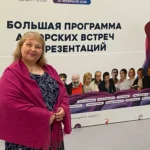
Irina Vladimirovna Sheibak is a distinctive Russian prose writer, poet, historian and publicist, whose work is inextricably linked with the traditions of Russian children’s and youth literature. As an active member of the Union of Children’s and Youth Writers, she creates amazing artistic worlds where a careful attitude to historical truth harmoniously intertwines with a deep understanding of the fragile child’s soul. Her professional path in journalism gave her a rare ability to notice the most subtle facets of human characters and masterfully transfer them to paper, turning each work into a trusting conversation with the reader. The interview for «Futurating» is a professional writer’s response to society’s need for new meanings.
— Irina, what challenges does modern children’s literature face, and what role should it play in shaping the future of young readers?
Modern children’s literature faces the challenge of young readers lacking «high goals» that could serve as a guide for forming an «image of a bright future.» Children lack inspiring examples that could set a development vector. Modern literature should aspire to works like «The Two Captains,» where the hero Sanya Grigoriev carried through his entire life the motto «fight, seek, find, and never give up.» Such a «high goal» is like a horizon: it may not get closer, but it invariably attracts, guiding movement. Heroes representing a «whole personality» are necessary. However, despite authors’ desire to create such works, publishers are not always ready to publish exactly these kinds of books.
— Today, when the world is changing so rapidly, what do you think modern literature for children and adolescents should be like so that it truly benefits and shapes personality?
Imagine: every book that falls into the hands of a young reader is not just a story, but a real compass! And this compass should point only to a happy ending, or at least to an open horizon where the hero confidently strides along the right path. Why is this so important? Because the emerging personality, our future adult, needs ideals, a clear vector of movement. The book should inspire, not leave in a dead end!
And language! Oh, language – it’s a treasure trove! It must be impeccable, rich, true Russian literary language. No concessions, no jargon that only impoverishes the inner world. We don’t want to lower ourselves to the reader’s level, do we? Our task is to raise the bar, to lead, to enrich. Only then will a person improve.
And the plot? It can be anything – from thrilling adventures to deep reflections. But in each one, the main idea should pulsate: moral and ethical choice. Because it is through such trials that we learn to make decisions, form an optimistic attitude towards the future.
And, of course, the heroes! They must be alive, real, as if they stepped off the pages into our reality. A child intuitively feels where help is needed, where support, and where, perhaps, strictness. And a book, through its characters, can teach them this.
And what about fantasy? Don’t get me wrong, I’m not against this genre. But it should be like medicine – strictly dosed. You cannot constantly take a child into a dreamland where you can die and come back ten times. He must live here, in reality, not be in the clouds. Because it is here, in the real world, that he will build his life.
— Do you think children’s literature should address complex social topics, and if so, how should one approach this issue depending on the age of the reader?
Children’s authors work for different target audiences, and depending on the age we are writing for, the approach naturally changes. Sometimes a metaphor or image is enough. If it’s, for example, age zero plus, some fairy tales, then, of course, through allegories, through fairy-tale characters, you can look into the future, give some perspective.
But for teenagers, it seems to me, you can raise existing problems in plain text. Especially problems of social conflicts, by the way, they attract kids around the age of 13 and up. I often attend meetings, and children from about this age start to become interested in why certain things happen in society and how to solve them. Therefore, even though they are children, they are adults in a way, they are still interested in such problems. And it is the children who will live in the future and solve these issues.
— In our time, when the world is becoming more complex and ambiguous, what, in your opinion, is the main task of a writer, especially when it comes to shaping the younger generation?
I am deeply convinced that for a young person to grow up as an active and integral participant in the future, they need examples. And these examples must certainly be presented in books through strong, powerful personalities. It is important to understand that such heroes do not have to be perfect; on the contrary, they will have their flaws. We should not strive for the image of a saint, because in real life such people are extremely rare, and in literature, perhaps even rarer. The main thing is for the reader, especially a young one, to realize that the traits the author gives the hero contribute to his survival.
In the future, I think the question of survival – both socially and biologically – will come to the fore.
Therefore, the hero must be strong, primarily in spirit. Character is not formed instantly; it is a path, and the child must have a clear guide on how to walk this path to a strong character without bending under circumstances. And, of course, it is extremely important to clearly distinguish between good and evil. It is especially difficult for an author to work with these concepts now because, unfortunately, the boundaries between them have blurred. It seems to me that the author must hint to the reader, and for this, they themselves must have a clear and firm position. The personality of the author in this process acquires enormous significance…
— In light of current social challenges, what do you think is the key element for forming a clear and inspiring image of the future?
In order to create an image of the future, the most important thing is to form the image of a positive hero with high moral and ethical qualities. It is precisely such a model that society lacks now.
The editorial board of the «Futurating» platform is grateful to Irina not only for the interview, but also for her willingness to become our regular author.
Comments (2)
Прекрасное интервью! 👍
Автор справедливо акцентирует, что современному ребёнку не хватает внятных моральных ориентиров, а литература могла бы стать таким компасом. Сильная сторона предложения — фокус на образе положительного героя как цельной личности, что действительно помогает формировать устойчивую ценностную базу. Для практической реализации стоило бы дополнить эту идею конкретными методическими материалами для школ и библиотек: не только выпускать книги, но и сопровождать их сценариями уроков или читательских клубов, где ребята обсуждают моральный выбор героев. Пилотным партнёром может выступить Российская государственная детская библиотека — у неё есть инфраструктура для апробации таких программ, экспертиза в области детского чтения и возможность тиражировать успешные практики через региональные филиалы. Первым шагом стоило бы инициировать переговоры с методическим отделом РГДБ о совместной разработке и тестировании цикла внеклассных занятий на основе книг Ирины Шейбак.