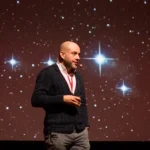
Today, visiting the portal «Futureating,» we have Ivan Karpushkin—a techno-culturologist and project management expert in the creative industries. He is a lecturer in master’s programs at HSE and RANEPA. Ivan specializes in future design and human adaptation to the digital environment, and is known as the former director of the «Laboratory of the Future» at ASI (Agency for Strategic Initiatives). He is one of the founders and experts of the discussion club «Heritage XXI» (or «Heritage 21»). This club brings together scientists, philosophers, and public figures to discuss Russia’s future, issues of techno-culture, and preserving identity in the context of digitalization. Today we will talk about the future—about its individual details and trends, since the topic we touched upon turned out to be more extensive than it seemed.
— Ivan, what key global trends are expected in the period from 2026 to 2030, and how will they affect Russia?
— The climate and demographic megatrends stand out the most, and their intersection generates the greatest transformations. The climate trend points to continued global warming, leading to changes in climate zones, weather patterns, and seasonality. This will alter the established way of life in territories, affecting the localization of industries, logistics, and food security. For example, southern regions will suffer from droughts and, simultaneously, extreme precipitation, exacerbating risks. The demographic trend is characterized by great uncertainty. Population accounting is distorted: estimates of the current global population range from 8.5 to 11.5 billion, and no one can say with certainty which model is correct. Parameters of migration, natural increase or decline in different regions—especially in Asia—are unclear. It is impossible to ignore this factor, but making strict forecasts based on it is extremely difficult.
The intersection of these trends means that regions with high risks for agriculture and food security remain demographically growing, leading to increased migration outflows and social tension. These same zones also concentrate important resources and logistics hubs. There is also a shift of scientific and technological development to the East, with China’s role strengthening in the scientific and technological race. However, the question remains open as to whether it can create truly «major new things» rather than just mastering Western technologies.
— You mentioned the demographic trend. There are forecasts of a population peak by mid-century and subsequent global depopulation, with examples of a sharp decline in birth rates in China. It is also possible that Indonesia and Nigeria will become flagships of growth. What do you think about these assumptions about global depopulation and the emergence of new financial leaders?
— Depopulation is the most likely scenario today. We have not seen a single country or culture that could reverse the demographic trend: the more developed a country becomes, the lower the birth rate. It seems civilization is the antonym of population. This is not just a trend but a policy issue. Stopping depopulation is probably impossible, but it can be flipped by turning the situation around with socially complex measures that will likely require a reconsideration of popular Western cultural values. Whether anyone can do this remains unclear. As for Indonesia, Nigeria, Bangladesh, and other countries—they are indeed growing. Indonesia, for example, is the most populous Islamic country. This growth will continue for some time, but its pace is slowing under the influence of urbanization, as birth rates drop already in the second generation in cities. The only region where active growth will likely persist is Africa, but even there, statistics are the most manipulated. Rural populations are poorly measured, while urban populations are essentially «dying out» if not replenished from rural areas.
— We live in the era of generative AI and rapid technological progress. What are the challenges of accurate forecasting when everything changes so quickly? For example, no one predicted that thousands of people would be on the streets due to AI, or that the structure of professions would change, leading to the «washing out» of junior specialists and the disruption of career trajectories.
— Accurate forecasts never existed and are unlikely to appear, since a forecast is an extrapolation of the known within the framework of an existing language of description. Using a new language in forecasting models is impossible; otherwise, no one would understand it. That technology would displace people from established labor relations has always been talked about; the question is only the form, and that is always a surprise. The balance of power between actors is unpredictable. Since last year, the «washing out» of young specialists—so-called juniors—from a number of fields has been particularly active. Production cycles were built so that juniors were involved in the process, but now they are being replaced by generative tools for economic reasons. This breaks the entire cycle: no juniors—no middles, no middles—no seniors. This is especially noticeable in IT development and creative industries, where virtually all cycles of the creative economy are collapsing. It was expected that models would replace routine operations, and they do, but low-skilled creative work is being replaced faster. Over time, this situation will likely harmonize: the toolkit will reshape fields related to the creative economy, freeing people for other areas.
We do not know to what extent AI will take the lead. Also unknown is what the ratio of human and AI activity will be, but a machine without a human has no meaning, so people will always find a use for themselves. The question is only about the social effects and personal stories that will occur during this harmonization. For some, it will be a disruption of life trajectory; for others, a natural process. The younger a person is, the easier they adapt. Every generation faces similar transformations.
— For quite some time, the idea has been circulating that society needs a «super-idea» to rally the entire nation to move toward a bright future. Of the eight images of the future presented at the last symposium «Creating the Future,» none elicited unanimous positive feedback. Theoretically, what could this super-idea be for Russia, and where should it be sought?
— Russia can only seek a super-idea within itself—within its own history, foundations, and «soul.» An idea cannot come from outside; we cannot base it on economic or technological grounds—they do not suit us. An idea should not be based on lower social relations such as technology and economics. This means that a technocratic or capitalist future (including socialism as a form of capitalist relations) is not the foundation on which to build an image of the future. Purely spiritual or traditional aspects extracted from our ideological archaeology are also unlikely to work, because in that case, dynamism is lost, and we do not see a direction of movement.
We need a language of description in which we can build an image of the future, taking into account the diversity of influencing factors and points of view. Anyone who now gives a concrete answer about the image of the future is being disingenuous because there are «blind spots»—important aspects we cannot account for but which influence the future the most. We need to agree at the level of language, and for that, we need philosophers, but there are not enough of them, and they cannot reach a consensus. This is not only our problem; it is a problem for the entire world.
Ideological camps are collapsing, and nothing comes in their place. An important story about the image of the future is connected to the cultural tradition of self-knowledge, self-study, and self-awareness. We have problems because we have never lived by our own image of the future; we have always delegated it to someone else: from the adoption of Christianity as an external ideology to socialism and Marxism. We have always sought external solutions that would quickly lead us to a bright future. What we should definitely not do is try to repeat this experience. The image of the future must be sought within ourselves.
At the same time, we must adopt the thoroughness and attention to detail with which our competitors study themselves. They study themselves and offer their future to the world, skillfully «packaging» it attractively for everyone. The world’s aspiration toward unipolarity in the 20th century was linked to their ability to make themselves attractive. Even the ideologically strong Soviet Union collapsed in an instant because another image of the future turned out to be more attractive. The key is the ability to «package oneself for oneself and for others.» We have not learned this and must learn.
The image of the future is an abstraction that we must learn to work with at all levels, from ontological to applied and managerial.
Read the continuation of the interview in the next article.
Photos by Lola Shafirova, HSE, from open sources
Comments (0)