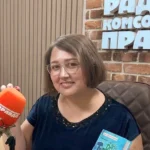
Octavia Kolotilina is a well-known Russian science fiction writer, born on October 14, 1983, in the Moscow suburb of Shchyolkovo. Her work primarily covers the genres of hard science fiction and military science fiction. Among her most notable works are entire novel cycles such as «Octopus,» «Terrranauts,» «Dominia,» and «Abyss for a Hero.»
In her works, Kolotilina does not limit herself to mere entertainment but raises serious, relevant issues. For example, in the novel «Terrranauts,» she deeply explores the problems of ocean pollution and the complexities of coexistence between different intelligent species. Interestingly, Octavia Kolotilina combines her literary work with a scientific career. She gave an exclusive interview to the portal «Futurating,» the topic of which was, of course, the future.
— As a science fiction writer, to what extent do you believe in a future worth living in, and what are you willing to do to make it happen?
— That’s a trick question. I write about a positive future for Russia and the whole world, which in itself is controversial. At present, our world has many vulnerabilities: the rapid development of neural networks could lead to job shortages and systemic crises. The aggressive foreign policy of the USA threatens existing international agreements. Declining birth rates in developed countries and the growing number of migrants could lead to the degradation of culture and civilization as a whole. Artificially created viruses spread and mutate, while even more deadly ones are being created in laboratories. Islands of garbage grow in the oceans, rivers are filled with toxic waste, the number of disasters is increasing, and the climate is changing. Under these conditions, does humanity even have a future, and can it be at all acceptable?
Many science fiction works have already been written in the post-apocalyptic genre, about the demise of civilization for various reasons. It seems to me that science fiction now has a different goal: to see that barely noticeable path along which humanity can reach a new, albeit imperfect, but attractive world. One in which we would like to live and develop. In my «Octopus» cycle, I explore precisely such a future and explain how it became possible, what exactly we need to do for its sake.
— What is the function of fiction, primarily science fiction, but also social, children’s, and even fantasy?
— Each of these types of fiction has its own purpose; I wouldn’t lump them all together. The fantasy genre describes worlds where magic is the main driving force. In fantasy worlds, there is sorcery, magic, spells—all the things found in fairy tales. High-quality works in this genre not only entertain the reader but also make them think about eternal questions of good and evil, attitudes toward the weak and those of different blood, and spark interest in myths, beliefs of ancient peoples, their culture, daily life, and history.
Children’s works must first and foremost be interesting in order to improve the literacy of young readers. Today it’s hard to get a child to put letters into words, and if a book of any content captivates them—honor and praise to its author. Of course, it shouldn’t be a book with prohibited content, but under current legislation, such a book wouldn’t be published anyway.
In a science fiction work, the fiction, no matter how unrealistic it may actually seem (time travel, faster-than-light speeds, immortality, etc.), is always scientifically justified. That is, what is described in science fiction books can, in principle, become reality. Therefore, the main function of science fiction is to predict the paths of humanity’s development and to warn against fatal steps. Also, science fiction awakens the reader’s interest in engineering, medicine, biology, and other disciplines. It instills a natural-scientific worldview, materialism, the habit of verifying information, and logical thinking.
When our famous science fiction writer Alexander Belyaev wrote the novel «Amphibian Man,» there was an explosion of interest in science fiction in the USSR. Children read Belyaev’s novels, became interested in technology, grew up to become engineers, scientists, and inventors. This allowed the Soviet Union to make many breakthroughs in science: launching the first satellite, sending a man into space. Methods for conquering the depths of the ocean were developed. So, science fiction is needed not only for designing a positive future but also for its implementation.
— Will new science fiction competitions influence the emergence of new authors?
— In self-publishing, certain popular genres are currently read and bought; it’s hard for a new author writing science fiction to break through. And getting into a publishing house with science fiction is a three-star challenge. Fortunately, in recent years, the state has been paying more attention to science fiction. The legendary writer Sergei Lukyanenko proposed an initiative, and with his participation, the «Literary Workshop» was organized. Its participants are selected based on the results of an All-Russian competition: only one in five submitted manuscripts makes it to the seminar. The geography of participants is the broadest—from Moscow and St. Petersburg to Simferopol and Krasnoyarsk.
During the seminar, the participants’ texts are analyzed by Sergei Lukyanenko, as well as by leading Russian science fiction writers he invites. At the Second Literary Workshop, in the «Science Fiction and Future Construction» section, my novel «Terrranauts» won, and it was subsequently published by Komsomolskaya Pravda publishing house.
Last year, the Agency for Strategic Initiatives held the «Russia-2050» competition; in the categories «Science Fiction Short Story» and «Science Fiction Short Story for Children,» 15 stories each made it to the finals, including mine: «Cyber Cossacks» and «Aisistent,» the latter winning its category. A collection of these stories will be released soon. So yes, science fiction competitions encourage authors to write and develop in this direction and help them make a name for themselves.
— What do science fiction writers write about most often now?
— Most often, they write post-apocalyptic and cyberpunk, but not all science fiction writers see only negative trends in the future. Techno-optimism is gaining more and more popularity—the confidence that technology can improve people’s lives by perfecting the world around us. Airplanes, artificial organs, prosthetics, mobile internet, social networks, electric cars and autonomous vehicles, virtual and augmented reality, artificial intelligence—scientific and technological progress has given humanity a host of achievements. Millions of scientists around the world work daily on developing technologies.
And right now, science fiction writers are trying to predict which future inventions will radically change our lives. Artificial wombs will allow many more people to have their own biological children, including single men and women who cannot become pregnant for health reasons. Robotic nannies will be able to feed, change, bathe, and put a child to bed, alerting parents to any problems. 3D printing of organs will make it possible to replace any lost organs in the future, and it won’t be as expensive as it is now. Life extension technologies promise to extend human existence to nearly a thousand years. Technology is already being developed to record a person’s dreams on video and even adjust them in real time. The development of interfaces that allow direct interaction between the human brain and a computer opens up new possibilities in medicine and communication. Such technologies could help people with disabilities control prosthetics or communicate using the power of thought.
But the main thing for science fiction is to predict how our society and the psyche of an individual will change with the introduction of a particular invention. It is these aspects that I try to explore in my works.
— Who do you look to in your work, and where do you draw ideas from?
— In my childhood, I devoured the books of Kir Bulychev, the Strugatsky brothers, and foreign masters like Isaac Asimov, Robert Sheckley, and Harry Harrison. I adored Terry Pratchett’s «Discworld» series. Today I read a variety of things, including leading Russian science fiction writers Alexander Gromov, Maria Semenova, and Mikhail Lantsov, as well as Chinese novels by Liu Cixin and Chen Qiufan. I am more guided by my readers; I try to write clearly and explain complex things in simple language.
— Do you believe that words influence the future?
— Absolutely, we first create an image of the future and then move toward it. A science fiction novel is a tool with which we carve something familiar and necessary out of the icy, murky block of the probable. [Now] we need to continue what has already been started: hold science fiction competitions, organize readings at libraries, help publish books and produce science fiction films. Without a clear image of a positive future, it cannot be built; without risk forecasting, they cannot be avoided.
Photos from open sources
Comments (0)