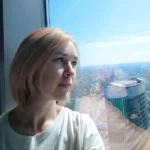
Today we are hosting Tasha Gorinova, head of the science fiction editorial at Mainstream AST and the Nova Fiction project. She writes about herself that she has been «living in book worlds» for 32 years now, ever since she learned to read at the age of 5. By education, she is a philologist and science fiction scholar, having defended her diploma in the history and theory of the fantastic in literature with honors. In 2012, she joined the science fiction department of Eksmo publishing house as an intern, and she stayed in book publishing. She made a dizzying career up to lead editor, launched the fanzon imprint, and ran it for a couple of years. Then she worked for some time as a literary editor and literary agent freelance.
We talked with Tasha not only about science fiction and science fiction writers, but first and foremost about the future and how «our word will echo» in it. We started by finding out: it seems the time of new Russian science fiction is coming. This is evidenced by the emergence of new names in SF, books and events—not only in the context of literature, but also in the country’s development strategy.
— Tasha, what inspires modern Russian science fiction authors [and authors of our portal — ed.] to write about the future, and increasingly about a positive future?
— Perhaps the biggest inspiration right now is that the state is willing to support science fiction (SF) in the broadest sense. The years 2022–2031 have been declared the Decade of Science and Technology in Russia. As part of this project, the International Symposium «Creating the Future» has already been held twice, with representatives from 86 countries participating. For the first time, scientists, engineers, writers, and publishers gathered on one platform to discuss scenarios for a positive future and outline possible ways to solve problems. Among the speakers were authors from our editorial team: Vitaly Chizhkov, Maxim Lykov, Igor Volkov, Yuri Maximov, as well as Serbian writer Goran Skrobonja, whose dilogy «The Florentine Doublet,» co-written with Ivan Nešić, we are currently publishing. Although it’s not exactly science fiction, more like crypto-history, it’s an amazing book—highly recommend it!
Last year, the All-Russian Prize in the field of science fiction was awarded for the first time, and our authors are also on the shortlist. One of the nominees for the prize was Kirill Kutalov with his provocative novel «OVUM» about the search for a personal God, and the laureates were Yuri Maximov with the novel «The Black Xenoarchaeologist» and Daria Konopatova with the comic «Stargazer-256.»
Interestingly, one of the megatrends at the Symposium was called «civilization in orbit,» and we do see that along with successes in this field, interest in science fiction is reviving again. This is evident not only from the wild popularity of Liu Cixin’s trilogy «The Three-Body Problem,» but also from the relatively good sales of young Russian science fiction writers, for example, Igor Volkov’s trilogy «The Touch of the Void.» I think optimism should primarily be linked to the revival of the Golden Age of SF.
— How can we ensure good books don’t drown in the flood of new releases?
— This is a rather complex question, if only because the concepts of a «good book» for business and for culture are different. In that sense, for business, a book is good if it sells in huge print runs, regardless of content—unfortunately, for example, «Fourth Wing» or «Count Averin.» So, defining a book’s «goodness» this way, we can say that the market regulates itself: what interests the mass audience sells, what doesn’t, doesn’t. And in such a situation, it’s enough for publishers to pour advertising budget into targeting, increasing the reach of recognizable new releases. They don’t need creativity.
But if we are talking about a good book from a literary perspective, about a highly artistic book that is not a one-time entertainment but makes a certain contribution to our culture and the formation of the image of the future, like science fiction, then everything is much more complicated. First, the audience for such literature is much narrower; second, authors unknown to the audience appear more often here, and you need to invest heavily and make an effort to make that author recognizable. Therefore, marketing in such a case begins already with the selection of texts and the formation of a recognizable brand under which these young authors are published. This is the path I took when creating the publishing project Nova Fiction.
Nova Fiction is a whole community of fans of quality adult science fiction and fantasy. We publish different books: serious, funny, but most importantly—not stupid, carrying certain ideas that you want to rethink. Over the year of the project’s existence, we have managed to unite science fiction writers from all over the world, as well as passionate bloggers and readers. We have our own book club and even a small prize—a readers’ vote for the best book. And the best proof that we are doing everything right, for me, were the words of readers that Nova Fiction is a beacon in the sea of books, and our series are auto-buys for many.
— What measures for broad coverage of SF new releases would you propose first: social networks, podcasts, collaborations with bloggers, or something else?
— First of all, we need platforms where we can talk about our books to a wide audience. For example, a festival similar to the «Red Square» book fair or the «Wild Mint» music festival, but exclusively about science fiction. At such a festival, we could showcase science fiction in all its forms—hold book presentations and meetings with authors, concerts by science fiction bands, film screenings, art galleries, cosplay shows, a children’s program. Attract scientists, cosmonauts, bloggers, and journalists to have advertising on billboards, in the subway, and on TV. To show that science fiction, even hard SF, is not boring and abstruse at all, but about us here and now, with our reptilian brains, in a world of advanced technology. But all this is possible, of course, only with state support.
Now we have partnered with the «RosCon» science fiction conference, within the framework of which we plan to hold several events in April, and of course we will bring our authors.
— What would be the best use of state grants for the development of science fiction?
— What a tricky question… Ideally, of course, I would like it to go towards supporting writers, research for SF projects, and promotion. For example, organize writer residencies where masters pass on knowledge to young authors, scientists provide advice on scientific matters, and marketers teach how to build a personal brand and communicate with the audience. Unfortunately, in the modern world, you can’t do without the last one anymore. Gone are the days when you could, like Salinger, hide from the world and churn out timeless works, then submit them to a publisher. Today, people are interested in people, especially outstanding, creative people. They are interested in the writer’s kitchen, in participating in the writing process and influencing something, like choosing a character’s name or eye color. For a long time, I argued that a writer’s job is to write, and leave promotion to the specialists, but even in that case, the writer cannot avoid communicating with readers, because in the open world of social media, we all live at arm’s length.
— Why didn’t 2026 become the Year of Science Fiction, as expected? What were the expectations?
— Well, there were certain rumors circulating behind the scenes. It didn’t work out, unfortunately. On the other hand, it’s not for science fiction writers to complain; small celebrations keep popping up on our street here and there. For example, the «Russia-2050» competition from the Agency for Strategic Initiatives, where, by the way, our Igor Volkov became a laureate, or a whole range of events dedicated to the 100th anniversary of the birth of Arkady Natanovich Strugatsky. At one of them, Maxim Lykov spoke, the author of the wonderful novel in the spirit of the Strugatskys, «I Live in October.»
— What, in your opinion, is the main reason for the small number of young science fiction authors? What would happen if SF became fashionable?
— Actually, the story that there are few young science fiction writers today is a myth. Good writers—yes, there are few; average authors—there are quite a lot. Just go to any self-publishing platform to see that. Most often, authors ruin their own talent by seeking cheap popularity. But I would phrase the question differently: what would happen, what would our society be like, if people consciously preferred quality fiction and classics over «pulp reading»? But let each of you answer that question for yourselves.
— How do you see the future of science fiction in 5–10 years?
— I set myself the goal of nurturing at least two or three talented authors of my project to the level of all-Russian fame within five years. And I hope that readers will help me with this. Only together, this way, can we create a better future for ourselves. Because however pompous it may sound, every day, every choice we make influences what world we will find ourselves in tomorrow and what books we will read.
Photo from open sources
Comments (0)