Breakthrough in Regenerative Medicine
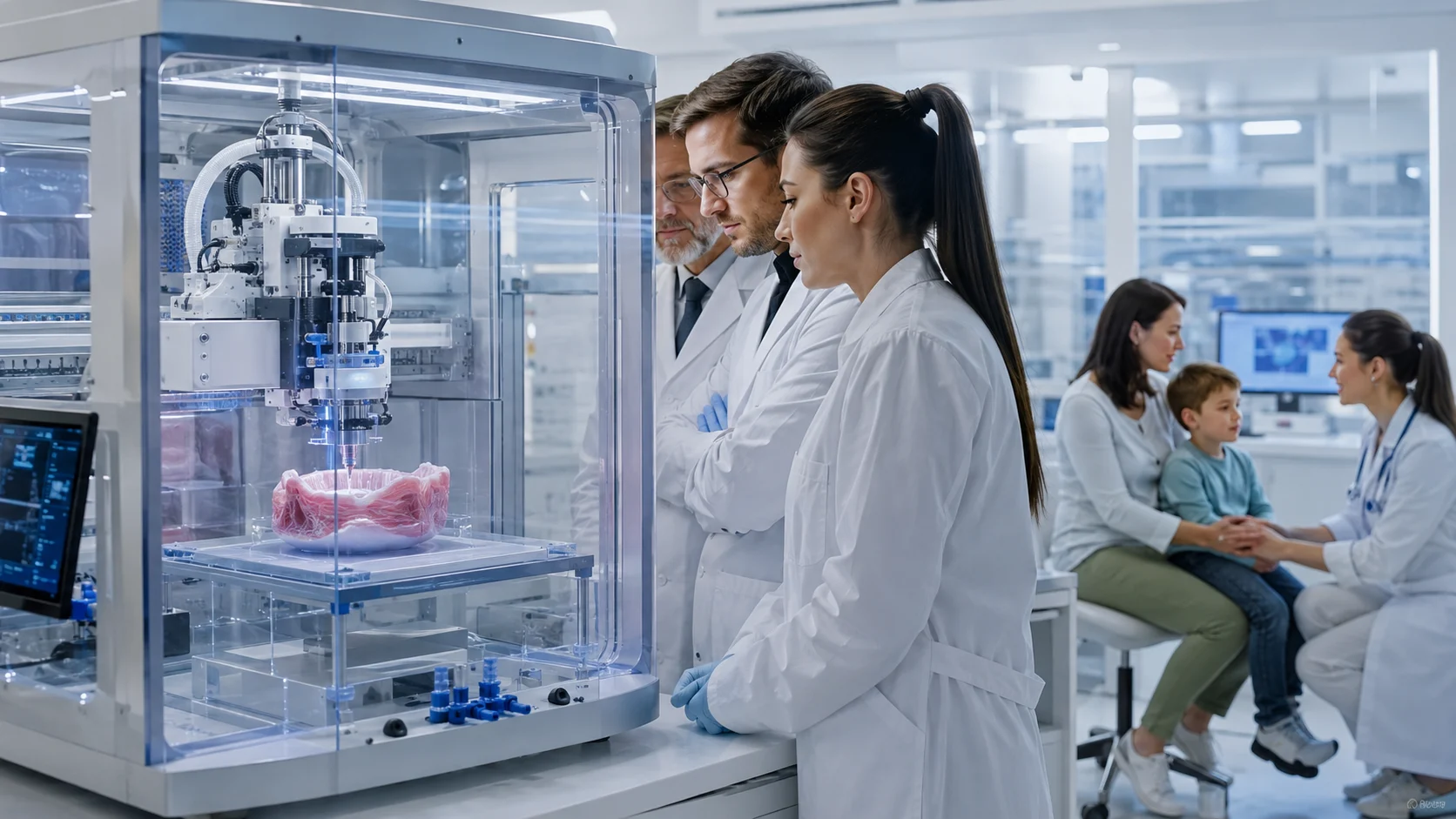
By 2076, the Irkutsk region had made a colossal leap in healthcare, becoming the recognized global capital of regenerative and genetic medicine. Scientists at the Irkutsk Institute for Biosynthesis of Living Tissues announced the successful completion of clinical trials and the start of mass production of a new generation medical complex, the «Organo-Printer-76.» This device, utilizing the principles of laser 4D bioprinting and programmable cell matrices, is capable of growing any damaged or lost organ from the patient’s own (autologous) stem cells within a few hours, fully identical to the original and possessing 100% biocompatibility.
A New Era of Healthcare
This achievement opened the door to a positive future where the concepts of «incurable disease,» «transplant waiting list,» and «organ rejection» became things of the past. The duration of a healthy and active human life increased to unprecedented levels, and old age ceased to be associated with frailty and illness. Medicine in the Irkutsk region became preventive and constructive: genetic defects and disease predispositions were detected and corrected as early as the prenatal stage using high-precision molecular scissors, leaving no chance for pathologies.
Irkutsk — a Global Medical Hub
Irkutsk became the largest medical hub, where hundreds of thousands of patients from around the world flew in each year to undergo a full cellular renewal procedure. The entire healthcare infrastructure of the region is built on the principles of personalized care and absolute comfort. The production of biomaterials is based on environmentally friendly components synthesized in laboratories, eliminating the use of animal or donor material.
The Right to Absolute Health
This breakthrough restored to humanity the fundamental right to absolute health, freeing society from the fear of disease and allowing every citizen to fully realize their creative and intellectual potential over a long, fulfilling life.
Comments (2)
Идея, предложенная автором, действительно завораживает: 4D-биопринтинг органов из собственных клеток пациента способен перевернуть представления о лечении неизлечимых болезней. Однако для такой утопической картины, как мне кажется, критически важно решить вопросы масштабирования — хватит ли ресурсов на всех желающих, и какова цена подобной процедуры? И не возникнут ли при тотальном клеточном обновлении новые риски, связанные с долгосрочным программированием тканей? Эти условия, на мой взгляд, остаются ключевыми для такого светлого образа будущего.
Автор предлагает сместить фокус с борьбы с отторжением органов на использование аутологичных стволовых клеток, что кардинально меняет экономику трансплантологии. В российской практике стоит присмотреться к компании «Биокад»: у них уже есть компетенции в клеточных технологиях и линейка рекомбинантных факторов роста. Они могли бы предоставить биобанки и наработанные протоколы культивирования стволовых культур для первых пилотных проектов по 4D-биопринтингу. Первым конкретным шагом мог бы стать запрос в научно-исследовательский отдел «Биокада» с предложением испытать их клеточные линии в тестовых матрицах для печати фрагментов хряща — это сняло бы вопросы с васкуляризацией на начальном этапе.