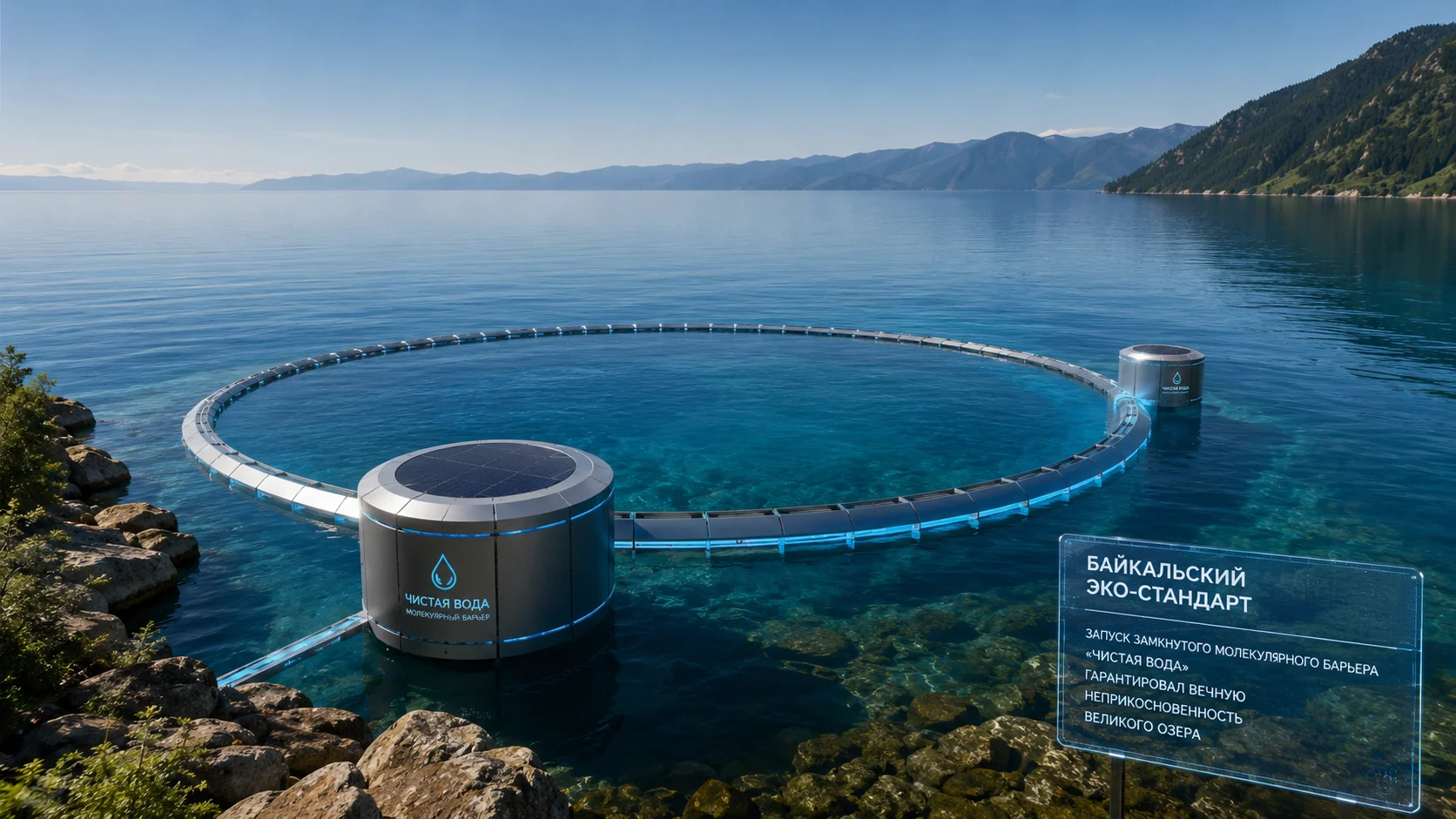
Completion of the ‘Clean Water’ Hydrological Project in the Irkutsk Region
In 2031, the Irkutsk Region completed the implementation of the most ambitious hydrological project of the century, turning into a benchmark region for the management and conservation of the planet’s freshwater resources. On the shores of Lake Baikal, an intelligent system of molecular filtration barriers called ‘Clean Water’ was put into operation, based on biomimetic membranes and graphene nanostructures. This system, integrated into all tributaries of the lake and wastewater treatment facilities of coastal settlements, became capable of capturing and neutralizing any anthropogenic pollutants, including microplastics, heavy metal compounds, and pharmaceutical residues, at the atomic level.
Environmental Impacts of the Project
The positive future opened up by the implementation of this project ensured that the largest reservoir of liquid fresh water on Earth (over 20% of the world’s reserves) remained in an absolutely pristine, sterile, and safe state for countless subsequent generations. Amid the global shortage of clean water on the planet, the Irkutsk Region became a key guarantor of environmental stability. The molecular barrier technology operated without the use of chemicals and did not disrupt the natural salt and mineral balance of Baikal water, preserving the unique endemic flora and fauna of the lake, including the famous Baikal seal and omul, whose populations reached historical highs.
Economic Changes in the Region
The project also radically changed the region’s economy. The Irkutsk Region became the world’s leading exporter of water purification and hydrological monitoring technologies. The International University of Hydroecology opened at the Irkutsk Scientific Center, where specialists from all continents were trained. The region’s industry fully transitioned to a closed-loop water consumption cycle: factories and plants used the same water an infinite number of times thanks to local molecular filters, completely eliminating discharges into the environment. Baikal ceased to be a zone of environmental concern and became a symbol of humanity’s absolute victory over the ecological crisis, a clear demonstration that advanced industry and pristine nature can coexist in complete, perfect harmony.
Comments (1)
Идея автора о комплексной очистке байкальского бассейна с помощью биомиметических мембран и графеновых структур сильна именно своей системностью: она не локальный фильтр, а сетевая инфраструктура, которая может работать на уровне целого региона. Но для её воплощения логичнее сначала развернуть пилот не на всех притоках сразу, а, к примеру, на реке Селенге — самом крупном загрязнённом притоке, где уже есть данные мониторинга. Практическим партнёром здесь могла бы выступить Иркутская нефтяная компания (ИНК), которая ведёт добычу вблизи озера и заинтересована в документальном подтверждении экологичности своих производств. ИНК обладает собственной промышленной инфраструктурой, полигонами для испытаний и ресурсами для долгосрочного инвестирования в водные технологии. Следующий шаг — инициировать через региональное министерство природы создание рабочей группы с участием ИНК и Института химии ДВО РАН для запуска полупромышленной демонстрации молекулярного барьера на одном из водозаборов предприятия: это проверит экономику и устойчивость материала к реальным колебаниям стока.