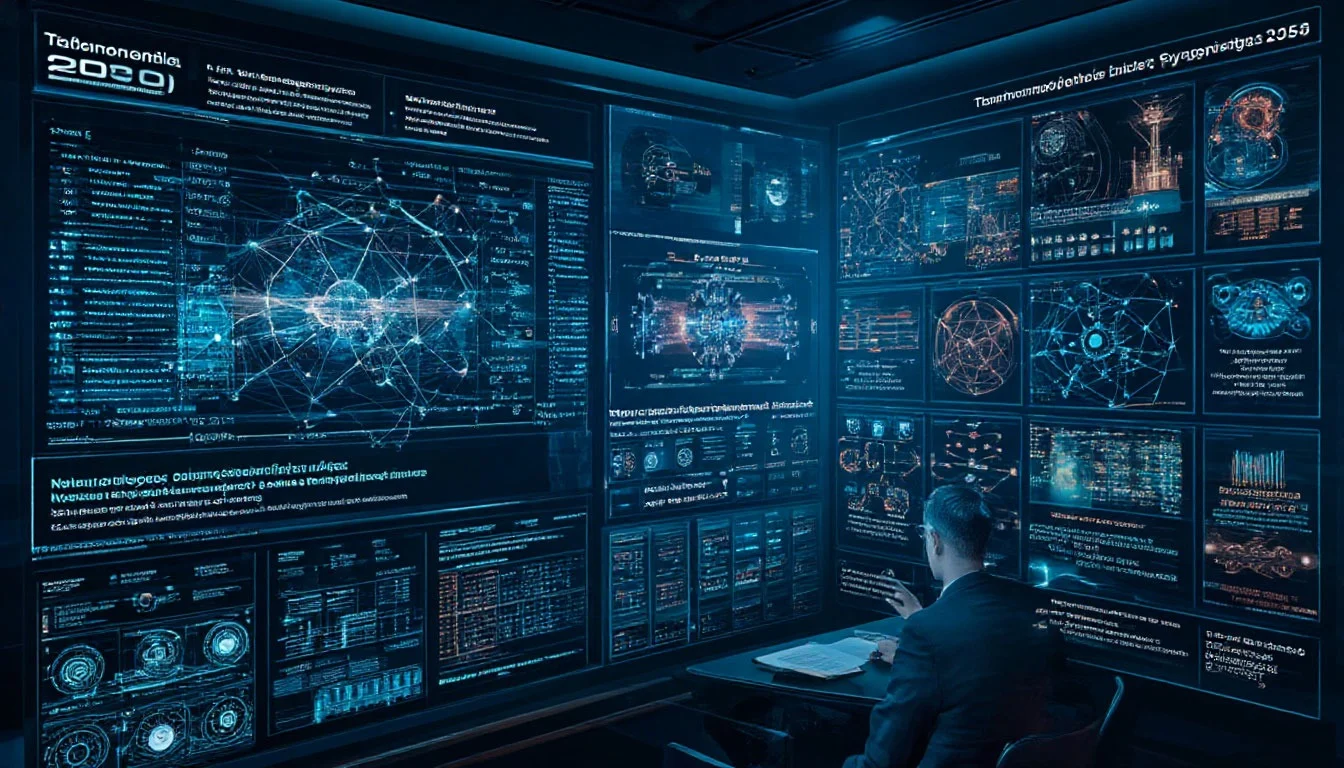



By the mid-21st century, the global economy had finally lost its dependence on capital and entered a regime of strict determinism by physical laws. The era of extensive growth, based on burning accumulated solar energy and scaling silicon lithography, ended by 2037 with a systemic heat dissipation crisis. The technological sovereignty of states in the first quarter of the 21st century was determined not by the volume of gold and foreign exchange reserves, but by the ability of national scientific schools to exploit four basic physical paradigms that set the ultimate efficiency of matter, energy, information, and biology.
1. The Limit of Computation: From Charge Transfer to Topology Control
Moore’s Law fell victim to the Landauer thermal limit and quantum tunneling at transistor dimensions of less than 1 nanometer. Further miniaturization proved physically impossible. The economy of the second half of the century was determined by the transition to neuromorphic architectures, where information was encoded by the spin state or phase configuration of a material (spintronics, memristors, PCM). Computation became thermodynamically reversible. By 2050, artificial general intelligence (AGI) required a computational density achieved exclusively through the control of collective excitations of condensed media. The sovereignty of that time was ensured by owning one’s own production of photonic and spintronic chips, architecturally different from Western graphics accelerators, and by one’s own protocols for training models outside the framework of classical von Neumann logic.
2. Energy Density: Inertial Confinement Fusion and Gravitational Vacuum
Lithium-ion chemistry hit the theoretical ceiling of specific energy capacity dictated by the potential of electrochemical reactions. Electric transport and autonomous industries came to a halt before the impossibility of rapidly accumulating megawatt-scale portions of energy. The basis of the economy became decentralized pocket-scale thermonuclear fusion based on pulsed magnetic plasma compression systems (FRC) and laser inertial confinement. In parallel, the physical limit of chemical batteries was replaced by potential energy storage systems: arrays of solid-state flywheels in vacuum and gravitational lifts that used spent mine shafts to lift multi-ton composites. The cost of generating a kilowatt-hour dropped to zero; the main economic metric became the cost of utilizing excess low-grade heat and the rate of its removal to the environment according to the second law of thermodynamics.
3. Biology as the Programmable Physics of Dissipative Structures
Synthetic biology abolished traditional polymer chemistry. The production of materials ceased to be a process of aggressive impact on matter by high temperature and pressure, turning into controlled growth of ordered structures far from thermodynamic equilibrium. The physical principle consisted in creating artificial dissipative systems according to Ilya Prigogine, where cell metabolism was replaced by external electromagnetic or optical control (optogenetics, DNA origami). The economy abandoned logistics chains of raw materials in favor of transmitting genetic protocols. Factories turned into waste-free bioreactors that grew structural concrete with bone-like properties and self-healing aviation composites. Sovereignty was ensured by a monopoly on basic producer strains and closed protocols for the assembly of macromolecules, eliminating dependence on international biotechnological patents.
4. Space-Time: Quantum Navigation and Entanglement Distillation
The radio frequency spectrum exhausted itself, and satellite navigation (GPS/GLONASS) fell under the blows of electronic warfare and the solar wind of the 2040s. The physics of communication returned to absolute constants. Object positioning was ensured by a network of quantum interferometers based on NV centers in diamonds, measuring the body’s own inertial acceleration with an accuracy of $10^{-18}$ meters, fully autonomous from external signals. Data transmission was ensured by quantum cryptography lines, whose security was guaranteed not by the complexity of algorithms, but by the law of non-conservation of quantum entanglement upon attempted measurement. Entanglement distillation over fiber optic cables beyond 500 km without repeaters created a physical environment of trust. Any intrusion into the cable changed the state of photons, making interception physically detectable.
Retrospective Conclusion
«Technological Sovereignty 2050» turned out to be a doctrine of survival for those who mastered physical reality first. States that by 2035 had not transformed their departments of low-temperature physics, quantum optics, and molecular dynamics into industrial R&D hubs, by 2050 irreversibly lost their subjectivity. Their economies became objects of external management, since all goods they produced had negative marginality relative to products created on new physical principles. The future was already fixed in the equations of Schrödinger, Maxwell, and Boltzmann. The task of historians today is to study exactly how those equations were translated into the language of production cycles, capital investments, and rigid national interests.








Comments (2)
Очень высокая насыщенность статьи идеями! Заслуживает осмысления!
Сильная сторона материала — он выводит экономику из термодинамических пределов, а не из рыночных трендов. Если проверять эту рамку на пилоте, стоит попробовать с Росатомом: его термоядерная и материаловедческая база, реакторные площадки и кадры дали бы полигон для квантовых сенсоров и накопителей. Первый шаг — рабочая группа с МИФИ и профильными КБ, чтобы за полгода оценить эффект NV-магнитометрии на реальном объекте.