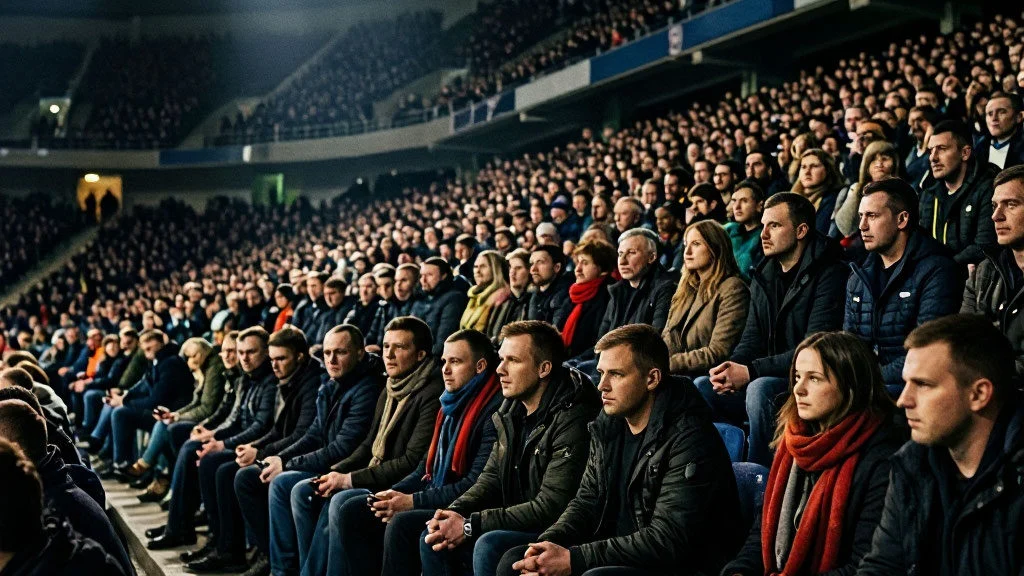

Visual effects long ago stopped competing over polygon counts, and the stadium crowd became the perfect indicator of that maturity. An attempt to calculate the necessary size of a control group using the classic statistical apparatus, such as Z-scores for a confidence interval, looked academic but crashed into the harsh economics of production. The math assumed that each of the fifty thousand digital doubles would have unique internal complexity, but the computational cost of simulating a full head of hair or the micro-response of the skin on the neck for a viewer in the thirtieth row turned out to be completely impractical.
The rationale for abandoning total scanning formed the basis of the new approach and lies in the peculiarities of human perception and the architecture of generative models. We are used to criticizing computer graphics for the uncanny valley effect in close-ups, but a crowd scene fails for a different reason: a lack of entropy. A living crowd is chaotic: someone slouches, someone’s trouser leg has ridden up, one person wipes sweat from his forehead while his neighbor tries to find a place for a dropped program sheet.
A statistical sample of five hundred real people gave the algorithm the correct proportions of ethnicities and ages, that is, the skeleton of the scene, but it is physically incapable of conveying this endless noise of small everyday actions. If a neural network is trained only on this data, it will create an ideal, frighteningly disciplined mass of people where all movements are subject to an invisible metronome.
Five Hundred Anchors of Realism: From Geometry to Physics and Noise
That is why the rationale for the physical presence of even five hundred extras sounds different today than it did ten years ago. They are needed not as a source of geometry for copying, but as suppliers of primary noise and gravity. A real person sitting under heavy studio lighting breathes differently from a digital double; the fabric of his shirt wrinkles under the weight of his own body according to the laws of real-world physics, creating unique folds that a procedural shader will imitate forever but never achieve authenticity.
These five hundred anchors set a physical benchmark for how light sinks into skin pores and how a sneaker sole deforms when weight shifts. Generative networks here acted merely as bottomless multipliers of that base realism. The algorithm took a real highlight on the cheekbone of one of the scanned men and smeared it across forty thousand virtual faces, preserving the correct physics of reflection from moist skin but changing the very shape of the skull. It took the real asymmetry of a living person’s shoulders and transferred it to the crowd, getting rid of computer-generated soldierly uniformity.
Statistics at the Code Level
In this context, the statistician’s requirement to ensure a parameter error of two percent was fulfilled automatically at the level of the generation controller’s software code, which simply monitored that the ratio of brunettes to blondes matched the population census.
Deceiving the Vestibular System
The five hundred physical scans themselves work not for statistics but to deceive the viewer’s vestibular system: they provide that barely perceptible imperfection of silhouettes that convinces the brain that it is looking at forty-nine thousand living souls rather than a perfectly distributed data array.








Comments (1)
Автор не гонится за тотальным сканированием, а берёт шум и физику с малой живой группы — как гипотеза это выглядит рабоче и хорошо объясняет, почему массовку выдают именно мелкие несовершенства, а не полигонаж. Если проверять идею, логично идти к студии Main Road Post: там есть конвейер фотограмметрии, опыт массовых сцен и собственные рендер-мощности, то есть и данные, и площадка для эксперимента. Первый шаг — собрать техсовет с VFX-супервайзером и продюсером и запустить пилот на одной сцене: отсканировать сотню статистов, прогнать через генеративную модель и сравнить стоимость и результат с полным CG-рендером толпы.