

{«title»:»Calibration of Olfactory Triggers»,»excerpt»:»»,»content_html»:»
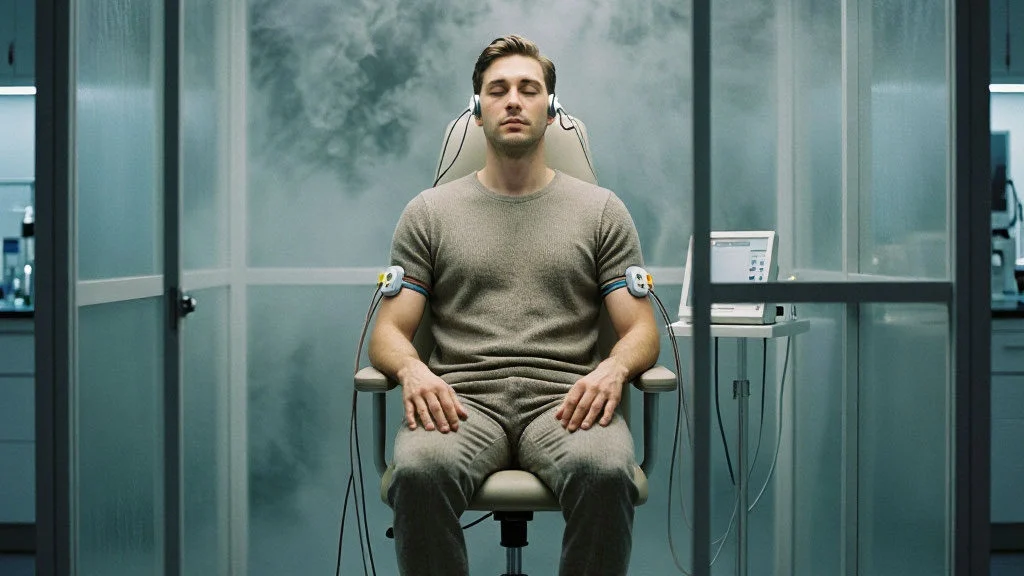
In sealed climate chambers, test subjects become living sensors for calibrating machine olfaction. Ventilation systems deliver microconcentrations of volatile organic compounds into the room: from the barely detectable smell of ozone that precedes an electrical discharge to the complex spectrum of protein decomposition. Dosing occurs at the parts-per-billion level so that the body’s reaction can be recorded before the odor is consciously identified by the brain.
Medical sensors are attached to the test subjects. Polygraphs continuously record galvanic skin response—the slightest change in the skin’s electrical resistance caused by a micro-release of sweat under stress. Plethysmographs record breathing rate and depth, while eye trackers monitor pupil dilation to within a micrometer—something impossible to control voluntarily.
Having collected thousands of such reactions to hundreds of different chemical profiles, analysts apply factor analysis. This method makes it possible to clean the data of individual characteristics of the test subjects and isolate basic, universal olfactory components. Mathematics shows that the human brain responds not to a complex aroma as a whole but to specific chemical markers. For example, the smell of fire for the autonomic nervous system is not “smoke” but the dominance of acrolein compounds and specific ketones. The smell of a hidden person is not “sweat” but a strictly defined mixture of fatty acids and ammonia that falls outside the statistical norm of the room’s background.
The isolated basic components are embedded into arrays of solid-state gas analyzers in security systems. In data centers and museums, such sensors operate orders of magnitude faster than heat or optical detectors.
- During a fire: cable insulation begins to smolder, releasing microdoses of specific polymer degradation products. The system captures this olfactory profile several minutes before a rise in temperature changes the resistance of thermocouples.
- During unauthorized intrusion: the sensor detects a change in the chemical composition of the air caused by human breathing and skin vapors. The algorithm filters out background odors from perfumery or brought-in food, responding only to the basic components of biological presence.
To eliminate false alarms caused by incidental household odors (for example, burnt toast in a museum café), a Bayesian filter is used. The system continuously builds a model of the building’s “normal olfactory background” at different times of day. As soon as the concentration of the target olfactory component begins to rise, the algorithm calculates the posterior probability of a threat. If the probability exceeds the 99% threshold, the automation locks the halls or activates the gas fire suppression system even before the first flame becomes visible to a camera or is felt by a person. This turns security from reactive (responding to an event that has already occurred) into proactive, based on reading the chemical precursors of events.
«,»seo»:{«title»:»Calibrating Olfactory Triggers for Security Systems»,»description»:»How calibrated olfactory triggers draw on human sensory responses to support faster, proactive fire and intrusion detection.»,»focus_keyphrase»:»olfactory trigger calibration»,»secondary_keyphrases»:[«machine olfaction»,»proactive security»,»gas analyzer sensors»],»search_intent»:»informational»}}





Comments (2)
Если эту идею довести до ума, охрана научится чуять беду раньше, чем глаз различит дым: газоанализаторы станут электронными нюхачами, а статисты — камертоном для их тонкой настройки. Пока это лишь чертёж будущего, но чертёж обещающий.
Сильная сторона идеи — чтение вегетативных реакций до осознания запаха и выделение базовых маркеров: это позволяло бы ловить тление изоляции раньше тепловых извещателей. Для внедрения нужно доработать проверку на реальных зданиях и пороги ложных срабатываний. Пилот можно предложить ГК «Рубеж»: она могла бы дать производство извещателей, сертификацию и площадки для установки. Первый шаг — рабочая группа с «Рубежом» и тест в музее или дата-центре: сравнить время обнаружения тлеющего кабеля с тепловым датчиком.