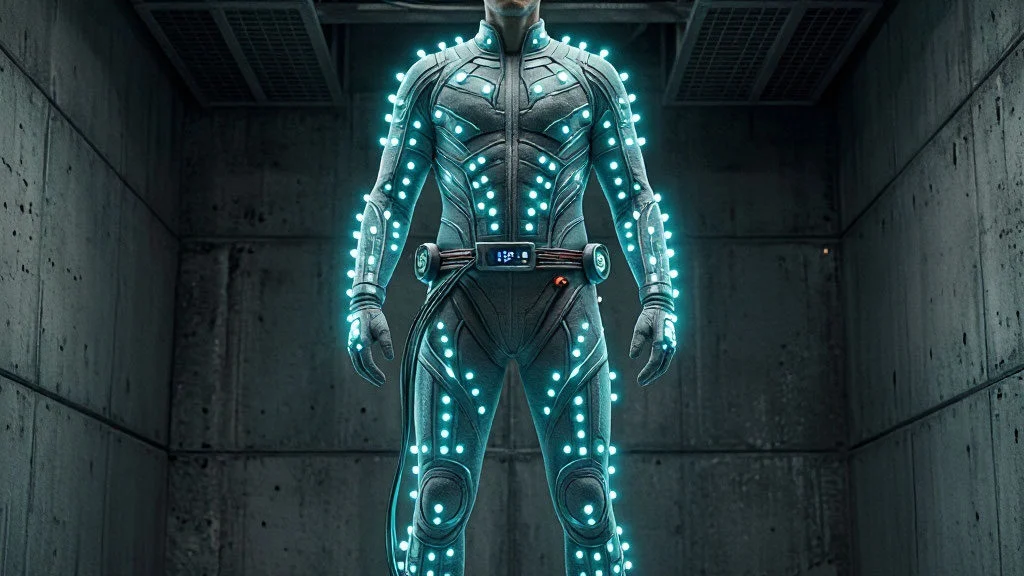


In enclosed simulation halls, test subjects in form-fitting suits threaded with a network of tiny exciters act as living measuring instruments. They are bombarded by streams of ice-cold water from industrial nozzles, shock waves from pneumatic cannons, and directed airflows simulating vehicles passing at enormous speed. This is not an endurance test but the collection of primary data on the limits of human physiology.
Each suit is studded with strain gauges and gyroscopes that record the slightest changes in weight distribution and muscle tension. The system looks for the breaking point — the critical moment when an external impact shifts from discomfort into threat. When a crowd-pressure simulator presses a person with a force of fifteen newtons, they can remain standing. At twenty-two newtons, their center of gravity shifts involuntarily, and they take an instinctive step to the side, trying to restore balance. It is this micro-vector of retreat, recorded by sensors in the soles of the boots, that becomes the key metric.
Based on thousands of such micro-incidents, analysts build probability density functions. For each type of impact, a pain threshold is calculated, which varies among people along a Gaussian curve. The mathematics identifies not only the average value but also hard boundaries: values at which ninety-five percent of people reflexively cover their face with their hands or recoil. In parallel, the dynamic zone of personal space is calculated. In a static state, it has a radius of about half a meter, but the density function shows how this bubble rapidly contracts if a person hears the rising sound of a shock wave — instinct makes them tolerate a neighbor’s closeness for the sake of reaction speed.
This data is transferred directly into consumer electronics. VR system developers use the resulting curves to tune vibrotactile vests. If an arrow flies at the character in the virtual world, the vest does not simply vibrate but delivers a short, sharp impulse whose strength corresponds to the point on the graph that causes an unconditional instinctive dodge. This makes the user jerk in reality, completely erasing the boundary between the digital and the physical.
The most complex application concerns self-driving cars. In a critical situation when the car must make a sharp maneuver to avoid a collision, an ordinary sound signal is not enough — the passenger’s brain may ignore it. The autopilot uses a tactile interface. If the sensors determine that danger has arisen on the right, the seat on the corresponding side delivers a series of jolts increasing in amplitude. The strength of these impulses is calculated based on that very data about crowd pressure and wind. The algorithm chooses a force guaranteed to activate the passenger’s protective reflex, forcing them to instinctively lean away from the dangerous door and shift their center of gravity toward the interior of the cabin even before they have time to realize the threat. Thus the statistics of human fears are transformed into a physical barrier protecting life in an automated world.


Comments (2)
Идея калибровать рефлексы под VR и автопилот звучит сильно: если собрать такую базу, тактильная обратная связь станет точнее. Но не превратит ли это обычную поездку в постоянный стресс? Тут важна дозировка.
Если идею доводить до прототипа, первым партнёром стоит попробовать «Моторику»: у них есть носимая электроника с тактильными датчиками и сообщество пользователей, привыкших читать сигналы телом, — готовая база для калибровочных сессий. Их инженеры могли бы дать сенсорную начинку и методику безопасных пороговых нагрузок. Практический шаг: собрать с ними рабочую группу и провести пилот на 20–30 добровольцах, сверив реакцию на виброимпульс в жилете и толчок в кресле.