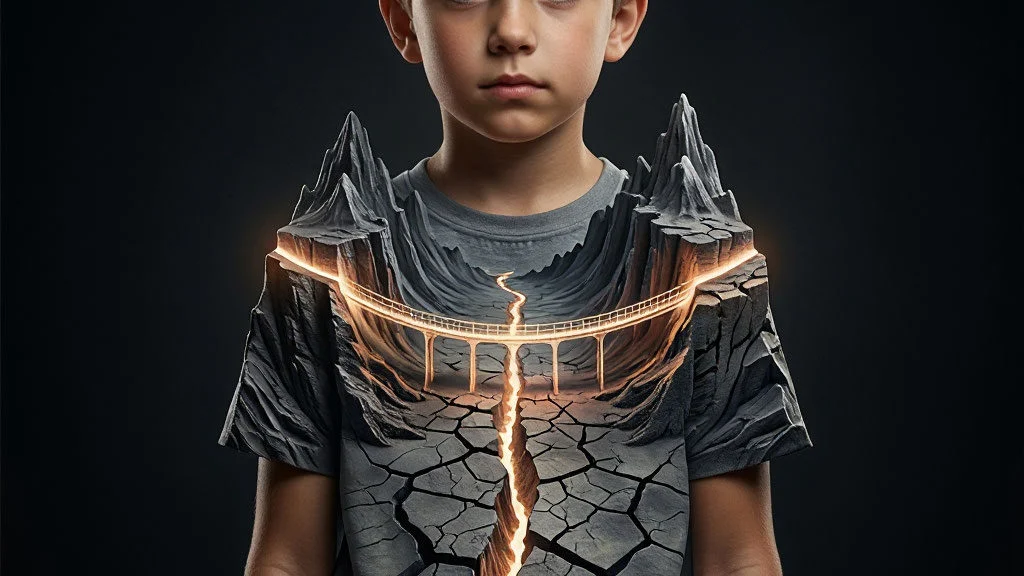



Body tension is frozen time. It is the muscle memory of an event during which the nervous system decided that movement or emotion was too dangerous, and “froze” an area of the body, turning it into a geological fault. For a child who does not possess developed introspection, this tension is invisible and intangible until it turns into chronic pain or a panic attack.
The somatic memory map translates physiology into topography. Using high-precision photogrammetry and IR depth sensors, the system creates a dynamic 3D model of the child’s body surface, where micro-tensions are visualized as real terrain. In virtual reality (VR), the child stops being a hostage of their body and becomes its architect.
Scanning and deformation architecture
The process combines optics, a physics engine, and generative AI operating in real time.
- Photogrammetric capture (Reality layer):
The child puts on a minimally invasive suit or stands in front of a semicircle of depth cameras (similar to Azure Kinect). The system does not simply build a 3D model; it analyzes the micro-mechanics of the skin.
- Technology: Stretching of the skin over a tense muscle changes its micro-relief and reflective properties. The AI records these changes with accuracy down to 0.1 millimeters, creating a “heat map” not of temperature but of mechanical resistance.
- Visualization: On a flat screen, this would look like a boring medical diagram. But in VR, this data array is projected onto the child’s avatar. Tense shoulders sink inward, turning into dark, sharp canyons. Clenched jaws form a mountain ridge. The abdomen, holding the breath, becomes covered with a network of cracks, like a dried ocean floor.
- Seismic interpretation (Metaphor layer):
The remedial educator does not use medical terms. They act as a guide through the inner world.
- “Look,” they say, “here, between the shoulder blades, after the math test, a tectonic fault formed. The ground there is too rigid; it does not breathe.”
- The child sees: their habit of pulling their head into their shoulders out of fear of judgment has literally cut a gorge through their virtual body. This provides powerful, non-intellectual feedback. The problem is no longer “in the head”; it has coordinates, depth, and shadow.
- Bridge design (Engineering layer):
The main tool in VR is not a weapon or a brush, but a gravity and tissue simulation mode. The child’s task is to restore the integrity of the avatar.
- Toolkit: The child takes a virtual “muscle thread” (generated by AI based on knowledge of real anatomy—the elasticity of fascia and the direction of fibers) and begins to lay a “bridge” across the fault.
- Process: For the bridge to hold, the child must physically perform the correct movement in the real world. If in VR they stretch a bridge between the shoulders and neck, the system gives a tactile cue through the suit: “Relax the trapezius.” When the real muscle yields, the virtual bridge in VR gains density and begins to glow with a steady blue light.
- If the child tries to trick the system and simply “draws” a bridge with a cursor, the AI instantly destroys it with a virtual earthquake, showing that form without a biomechanical foundation is not viable.
Pedagogy of somatic archaeology
This process turns physical therapy into an epic construction site.
- “Excavation” stage: The child learns to “exhale” into the tense area. In VR, this looks like a soft stream of wind that blows dust from the edges of the fault, exposing the true depth of the problem.
- “Landscape design” stage: After the bridge is built, the child designs “regeneration zones” around it. They can plant virtual plants that grow only when the avatar in reality makes smooth circular movements with their shoulders.
- Memory integration: Every healed fault is saved in the “Tectonic Archive.” The child can return to it a week later. If the old tension starts to return, they will see how their perfect bridge has become covered with cracks. This teaches preventive care for the body.
Bioethics and safety protocol
- Rejection of dysmorphia: The avatar is never an ideal copy of the body. It is a stylized, almost sculptural form (for example, made of polished obsidian or living clay). The goal is not criticism of appearance but work with topology.
- “No pain” principle: If photogrammetry detects real inflammation or acute pain (for example, in a joint), the system blocks the possibility of “construction” in that area, switches it to “Protected Reserve” mode, and signals the educator that medical intervention is necessary.
- Sovereignty of boundaries: The child decides which faults to “repair” today. If they are not ready to look at tension in the pelvic area, the system does not force them, allowing them to work with a safe “hill” on the forearm.
The somatic memory map makes the invisible visible and the frightening manageable. The child realizes with horror that their “bad posture” is a Grand Canyon inside them. But after spending an hour in VR, designing and “growing” virtual muscles to throw a bridge across it, they gain a unique experience: they have physically, at the level of neural connections, remembered what it is like to be whole. The body stops being a prison with unknown defects and becomes a territory whose map the child now holds in their own hands.





Comments (2)
Сильное в этой идее — превращение телесного зажима в редактируемый ландшафт: ребёнок получает агентность вместо ярлыка. Слабое место — валидность: ИК-камеры могут ловить позу, а не зажим, поэтому карту стоит сверить с ЭМГ и оценкой физиотерапевта. Партнёром вижу «Моторику»: её VR-реабилитация и выход на детские клиники дадут площадку и костюмы. Первый шаг — рабочая группа с реабилитационным центром и пилот на 10–15 детях с замером до и после.
Идея перевести телесный зажим в видимый рельеф кажется мне перспективной: ребёнку проще опираться на образ, чем на смутное ощущение. Если такую карту внедрять, стоит проверить, не подменит ли метафора живое движение и не закрепит ли аватар случайную, а не реальную картину напряжения.