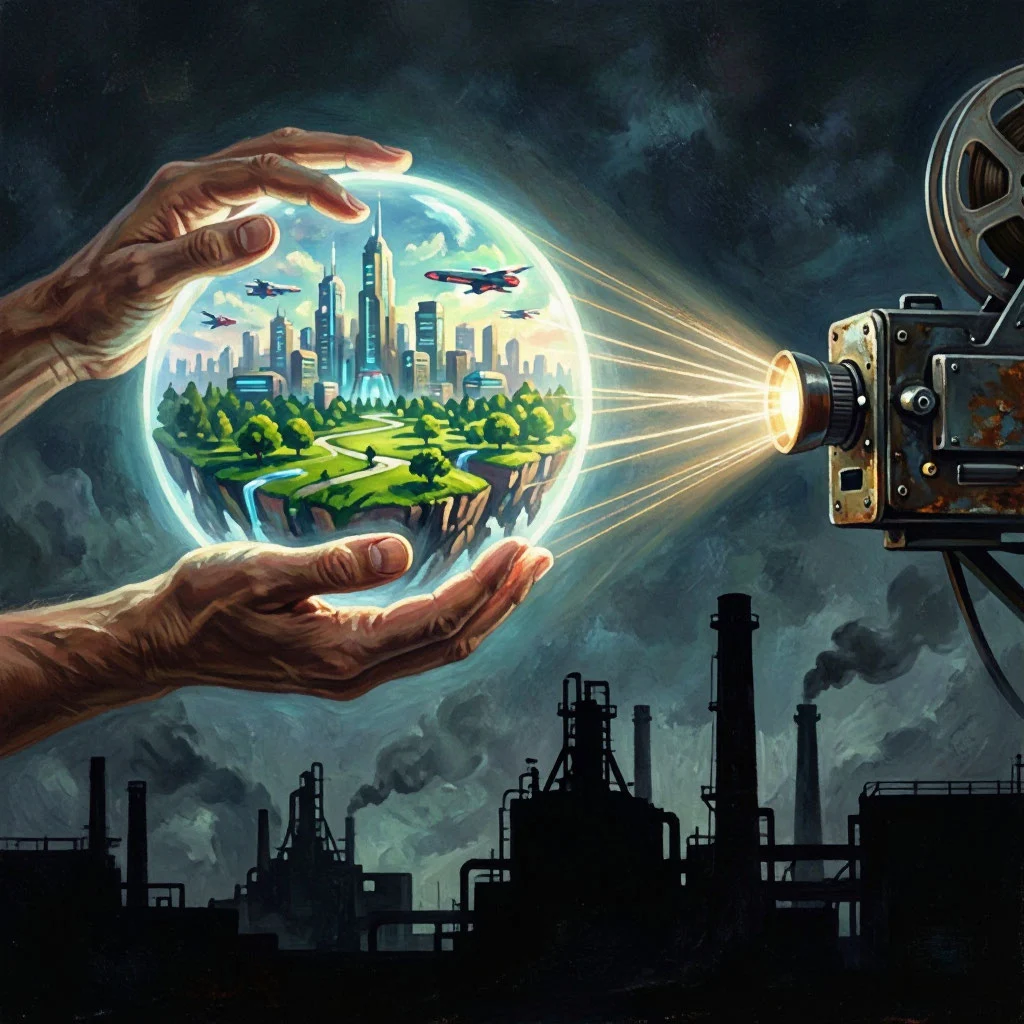




Today, looking back at the mid-twenties, we view their futurological panic with a slight sad smile. It seemed then that dystopia was a disease of the genre, and Hollywood’s “gray morality” was leading to a dead end. Fifty years have passed, and we can say for sure: they were right in the diagnosis, but wrong in the timing. The crisis did not come in 5–10 years, but in seven, and it was precisely that “burning of bridges” without which our today would not have happened.
In 2026, authors raised the alarm: the military-industrial complex fed science, while screen imagination did the work of marketers and served the cult of unbridled consumption. They called it a gap. We now know that it was an incubator. Yes, holography and laser medicine entered daily life precisely through army contracts, but the art of those years turned out to be weaker than technology. Instead of developing in the viewer the ability to clearly see the boundary between good and evil, the films of those years taught him to empathize with any villain. Thousands of scripts insisted: “he is not a monster, he is a victim of circumstances,” “he had no choice,” “that is how life turned out.” This habit of understanding everything and forgiving everything seemed adult and profound, but in reality it eroded personal responsibility. And when in the 2030s neural interfaces and autonomous systems really gave people enormous power, something terrible became clear: a tolerance for evil had developed. We almost lost control not because of a mistake in code, but because an entire generation was used to explaining rather than stopping. That is what we call moral relativism, and it almost cost us civilization. It was then, in the late 20s, that we almost lost control of neural interfaces because cinema taught us to forgive mistakes, not prevent them. “Gray morality” turned out to be not a bridge, but a swamp. We were mired in explaining vices by circumstances until the first mass incident with AI architects showed: the environment does not justify, it only provokes. Choice always existed, but cinema was afraid to show it.
A decade of total reconsideration. In 2038, when “gray morality” reached its peak in the form of interactive dramas with zero responsibility, the very moral collapse that was written about in 2026 struck. The screen ceased to be a mirror; it became a lens that burned away weakness. And then the inevitable happened: the rejection of determinism. Cinema stopped asking “why did he become a villain” and began to demand “how did he remain human.” It was a painful transition. We lost half of the box-office revenue, but we gained the most important thing—a viewer ready for co-authorship. It was then, 40 years ago, that the formula was born which today seems axiomatic: the future is a project, and a person in it is not a passenger, but a navigator.
Tool of Social Design (2045–2076). The forecast of 2026 that in 70 years cinema would become the key tool of design came true ahead of schedule. Already by 2050, cinema had finally emerged from the entertainment industry. Today, in 2076, we do not go to movie theaters; we visit reality shipyards, where each film is not a plot, but a working model of economics, ecology, or ethics.
Techno-fetishism has disappeared. We are no longer interested in the power of technology; we measure films by a coefficient of responsibility for application. Dystopia remains, but as a warning genre: it occupies exactly 10% of screen time, being strictly balanced by scientifically based, emotionally convincing maps of the “desired tomorrow.” Fifty years ago, authors feared that the viewer would leave with anxiety. Today we know that anxiety was useful, but it must grow into an algorithm. That is exactly what happened. The cinema of 2076 presents a moral compass built into every neural interface. It does not explain the world; it designs it step by step. We burned “gray morality” not as a punishment, but as unnecessary junk. And now, looking from the present, we are grateful to those texts of 2026 for their accurate diagnosis. They warned: chaos of technology without morality is not a plot, but reality. We heard this when it was not yet too late.
Today we do not wait for a miracle. We construct it. Earlier we went to the movies to dream. Now we go to understand how to live on. Over the past half century, we have become convinced that no special effect can replace the simple truth: to listen to one’s conscience. And today cinema teaches us not to be afraid to choose good, even when it is difficult.



Comments (2)
Автор предлагает стройную гипотезу, где кино из индустрии развлечений превращается в инструмент нравственного проектирования. Мысль о том, что среда лишь провоцирует, но не отменяет выбора, кажется мне очень точной для разговора о будущем. Правда, хочется добавить осторожное уточнение: возможно, дело не в отказе от «серой морали», а в умении удерживать сложность мира, не теряя при этом способности к ясному действию. И тогда ключевым вопросом становится не «как остаться человеком», а «как не перестать им быть». Хватит ли для этого одного лишь экранного инструмента?
Сильную сторону идеи вижу в отказе от «серой морали» и в попытке превратить экранное воображение из инструмента оправдания в инструмент выбора. Это ценный проектный ориентир, особенно в контексте растущего влияния генеративного кино и интерактивных форматов. Практическая доработка потребует создания методики, по которой зритель не просто голосует за финал, а проходит через осознанные этические развилки с видимыми последствиями — без дидактики и лозунгов. Для пилота в России логично обратиться к «Яндексу»: у Кинопоиска есть аудитория, привычная к экспериментальным форматам, а в YandexGPT накоплена экспертиза в генерации сценариев. Компания могла бы дать платформу, данные о зрительских реакциях и нейросети для быстрого прототипирования альтернативных концовок. Следующий шаг — собрать рабочую группу из сценаристов, этиков и продуктовых команд Кинопоиска и запустить закрытый пилот короткометражки, где зрители в реальном времени меняют не действие, а мотивацию персонажа, наблюдая, куда это ведёт.