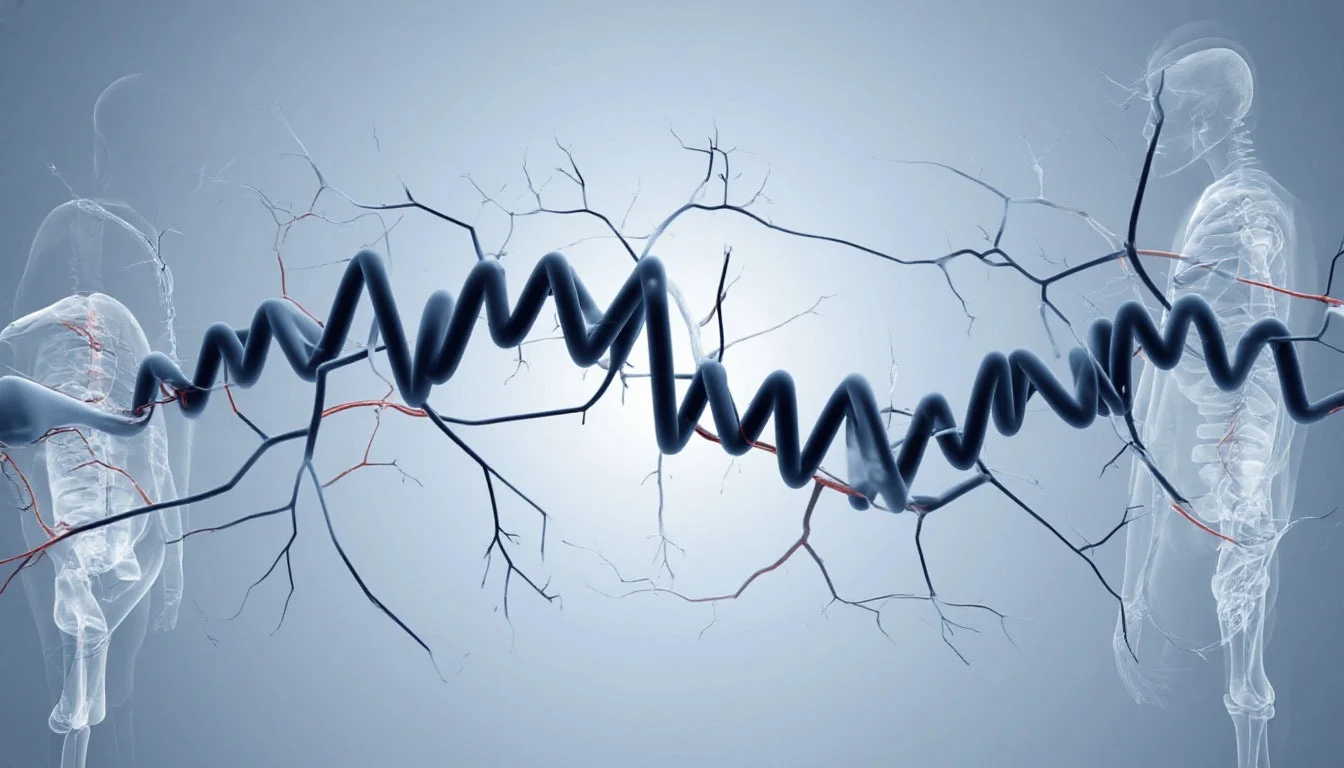


Tachycardia and shallow breathing in a child are the physiological foundation of cognitive collapse. When the heart rate increases, the prefrontal cortex, responsible for reading and comprehension, switches to survival mode: peripheral vision narrows, saccades (eye jumps) become chaotic, and symbols on the page begin to be perceived as hostile, vibrating noise.
Kinetic typography of breathing turns text from a passive information carrier into an active tool of biological feedback. The font ceases to be a static set of vectors and becomes a liquid, biomimetic organism whose form is directly subordinated to the child’s autonomic nervous system.
Architecture of synchronization: from thoracic expansion to vector weight
The system operates in a closed loop with minimal latency (latency < 50 ms), using wearable sensors (chest straps to record respiratory sinus arrhythmia or millimeter-wave radar sensors tracking micro-movements of the clavicles).
- The “Weight” parameter as an indicator of interoception:
- Physiology: During tachycardia and hyperventilation, the world seems heavy and oppressive to the child, and sounds seem deafening.
- Typography: The AI font engine reads the heart rate (HR) in real time. As HR increases, the base weight of the typeface increases. The text becomes ultra-black, bold, almost aggressive. This visualizes the internal feeling of pressure.
- Calming mechanics: To return the text to a normal “breathing” thickness, the child physiologically needs to slow down their breathing. As soon as the sensor detects a lengthening of the exhalation, the AI smoothly “resets” the weight to a light Book weight. The child sees: the calmer their diaphragm, the lighter the text becomes.
- The “Baseline” parameter and the axis of gravity:
- Physiology: During a panic attack or severe stress, the vestibular system malfunctions. The child feels as if the floor is slipping away, and derealization occurs.
- Typography: The baseline on which the letters rest ceases to be a rigid straight line. It begins to make micro-oscillations (a sine wave) with an amplitude proportional to the cortisol level. The text literally “loses the ground under its feet.”
- Grounding mechanics: A visual “anchor” appears in the interface — a dashed line of ideal stability. The child’s task is to “nail” the text to this line with their breathing. With a deep, diaphragmatic inhalation, the sine wave straightens out. The letters acquire gravity. This gives the brain instant proprioceptive compensation: the visual stability on the screen tricks the vestibular system, restoring a sense of physical safety.
- The “Tracking” parameter and personal space:
- Physiology: During sensory overload (often accompanying tachycardia), the visual field fragments. Letters stick together, causing a masking effect.
- Typography: The algorithm analyzes heart rate variability (HRV). With low HRV (stress), the inter-letter intervals automatically expand, increasing the “personal space” of each glyph. The text “inflates,” and the letters get more air. When breathing normalizes, the intervals return to the typographic norm, allowing words to be perceived as a whole rather than as individual symbols.
Pedagogy of reading in a state of affect
This tool changes the very mechanics of teaching reading during moments of stress.
- Text as a trainer: Instead of telling the child “breathe deeper” (which in a state of tachycardia only causes additional irritation), the teacher says: “Try to make the letter ‘O’ in the word ‘DOG’ become round and stop pulsating.”
- Bypassing the frontal lobes: The child is not engaged in boring self-regulation. They are solving an engineering problem — calibrating the graphics. They control the shape of the letters. But since the shape of the letters is tied to their diaphragm, they are forced to subordinate their body to the task, thereby involuntarily activating the parasympathetic nervous system.
- Visualization of success: At the end of the paragraph, the system does not show a grade of “read at 5.” It outputs a cardiorespiratory gram: “In this paragraph, your heart rate dropped from 110 to 85, and the text stopped trembling at the 2nd minute.”
Bioaesthetic protocol
The system is strictly limited by a “readability corridor.” Even during extreme panic, the font must not become unreadable.
- There is a weight limit beyond which letters merge — the AI never crosses it, shifting the transformation to a color change (e.g., to cool blue) or a slight background animation.
- If the sensors detect real hyperventilation (risk of fainting), the typography instantly freezes, turning into a maximally stable monospaced sans-serif, and the screen is flooded with soft, warm amber light (1800K), signaling the need to immediately stop any cognitive load.
Kinetic typography of breathing makes the invisible — the internal state — visible and, more importantly, manageable. It teaches the child a fundamental law: the rhythm of the world around them (including the printed word) does not have to be louder and faster than the rhythm of their own heart. Text can become the quietest and safest place in the classroom if one learns to breathe in time with its baseline.


Comments (2)
Идея хорошая: если текст правда начнёт «дышать» вместе с ребёнком, это может здорово помочь тревожным детям с чтением. Интересно, а на обычном планшете без датчиков такое получится?
Сильная сторона — ауторегуляция переведена в конкретную графическую задачу: «сделай букву круглой» ребенку понятнее, чем «дыши глубже». Если это реализовывать, доработки требует доказательная база: не усилит ли обратная связь тревогу у части детей, поэтому нужны возрастные пороги и протокол остановки, согласованные с детским психологом. Для пилота подходит «Учи.ру»: платформа даст доступ к классам, методистов и данные о том, как дети читают под нагрузкой. Первый шаг — собрать рабочую группу с психофизиологом и провести двухнедельный пилот в одном классе, сравнив с обычной дыхательной гимнастикой.