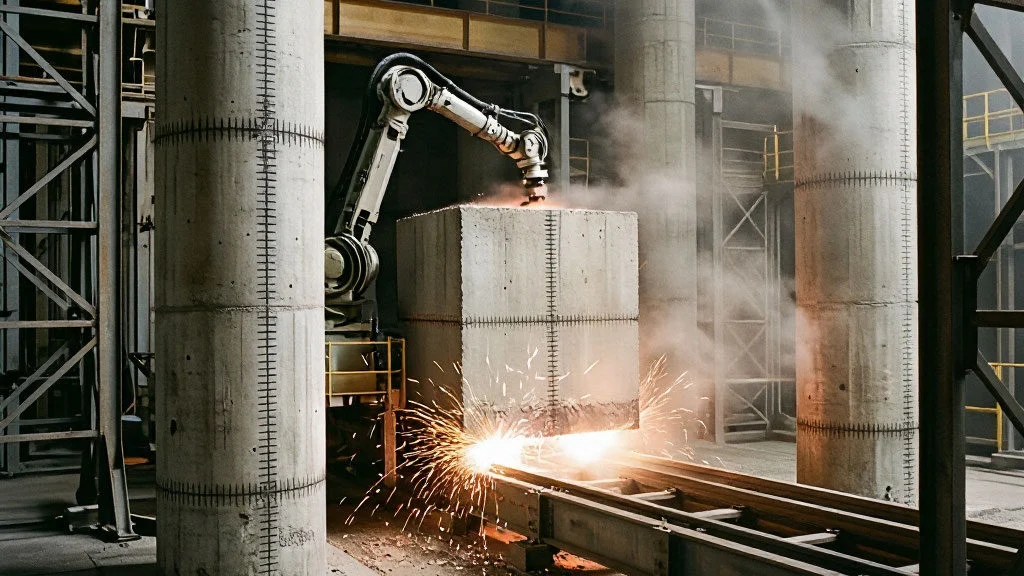

Traditional engineering aims to reduce entropy: creating order from chaos, assembling complex systems from simple elements. The Institute of “Negative Engineering” works in a mirror paradigm. Its task is to manage physical and economic entropy during the dismantling of obsolete technological paradigms. This is not building demolition or waste disposal, but high-level engineering where the final product is clean territory, materials returned to circulation, and the absence of social shock.
1. The Philosophy of “Technological Thanatotheism”
The Institute views any large infrastructure (a nuclear power plant, a pipeline, a satellite constellation) as a living organism that must pass through a controlled death. The professor acts as a “technological priest” who conducts the ritual of the system’s safe transition to a state of zero danger.
The main mistake of the modern economy is ignoring the cost of decommissioning. Nuclear power plants are built in 5–10 years, while the process of their safe disposal takes 50–100 years and costs more than the plant itself. The Institute of Negative Engineering changes this math by designing the death of an object at the stage of its conception.
2. Laboratory Architecture and Methodology
The professor’s team consists not of builders, but of “reverse architects,” physicist-analysts, and systems economists.
- Reverse Spec: Instead of writing how to assemble an object, the group writes an algorithm for its dissolution. For a nuclear power plant, this is not simply a plan to fill it with concrete, but a calculation of the chemical composition of solutions that over 20 years initiate accelerated corrosion of the rebar, allowing the structure to then be safely disassembled by robots.
- Material Re-entry: The group calculates how to turn 100,000 tons of concrete and steel from old infrastructure into a clean resource. For example, radioactively contaminated concrete from a nuclear power plant is crushed and used as radiation shielding for new thermonuclear reactors, closing the cycle. GPS satellites do not burn up in the atmosphere; they are captured by orbital tugs for remelting at space factories.
- Economic Inversion: The professor proves to a government or corporation that dismantling today is more profitable than maintaining tomorrow. The team builds a model in which the cost of owning old infrastructure (including environmental fines and the risks of cascading failures) exceeds the cost of its high-tech dismantling.
3. Cases: From Concrete to Orbit
- Decommissioning Soviet Nuclear Infrastructure: The Institute develops modular robotic complexes for work in high-radiation fields where human presence is impossible. The professor supervises the creation of digital twins of reactors. An AI simulator calculates thousands of scenarios of structural collapse, allowing dismantling with millimeter precision and minimizing emissions. The task is to turn “nuclear dumps” into certified sites for the construction of new cities or agricultural complexes in 30 years instead of 100.
- The Civilized Death of GPS: Global navigation systems are vulnerable to interference and become obsolete. The Institute designs a protocol for “orbital euthanasia.” When quantum navigation systems (based on cold atoms and entanglement) reach maturity, old GPS satellites should not simply be switched off. The professor’s team calculates impulses to transfer them to “graveyard orbits” or a precise atmospheric entry trajectory over the Pacific Ocean so that toxic fuel does not poison the biosphere. In parallel, the group develops interface standards so that aircraft and ships can switch to the new signal without a single day of navigation loss.
- Dismantling Carbon Energy: This is not just closing mines. It is landscape reengineering. The Institute designs the conversion of mine shafts into gravity energy storage, and depleted seams into reservoirs for storing hydrogen or carbon dioxide.
4. The Professor’s Role: Managing Social Gravity
The main danger of dismantling is not radiation, but people. Closing a plant leaves a city without work. Abandoning GPS paralyzes logistics.
The professor of “negative engineering” manages the complexity of human systems. He does not write a closure order. He designs a “transition architecture”:
- Economic Replacement: Ten years before the closure of old infrastructure, the institute launches new production on its base (for example, a battery recycling plant is built on the territory of a closing refinery), retraining personnel.
- Infrastructure Prosthesis: When the old system is withdrawn, a temporary, cheaper or modular technology instantly takes its place, assuming the load while the main new system passes through the final tuning stage.
5. The Institute’s Economics
The Institute operates on a “guaranteed dismantling” model. A corporation or state pays not for construction, but for a “Clean Slate Bond.” Money is deposited into a fund today, and the professor and his team manage these funds for 50 years, investing them in technologies that will make future dismantling cheaper.
Ultimately, “negative engineering” is the highest form of an engineer’s responsibility. Almost anyone can create a technology, but only a true architect of systems knows how to return to the planet the resources that this technology used, leaving behind neither radiation nor social ashes.



Comments (1)
Сильная сторона идеи в том, что автор переносит стоимость вывода из эксплуатации в момент проектирования — там экономика и инженерия действительно начинают говорить одно и то же. Если это реализовывать, первым партнёром напрашивается ФГУП «НО РАО»: реальные площадки, данные по обращению с РАО и экспертиза, без которых обратная спецификация останется теорией. Первый шаг — рабочая группа с НО РАО и Росатомом и прогон на цифровом двойнике выводимого блока расчёта «владение против демонтажа», чтобы увидеть, где модель ломается.