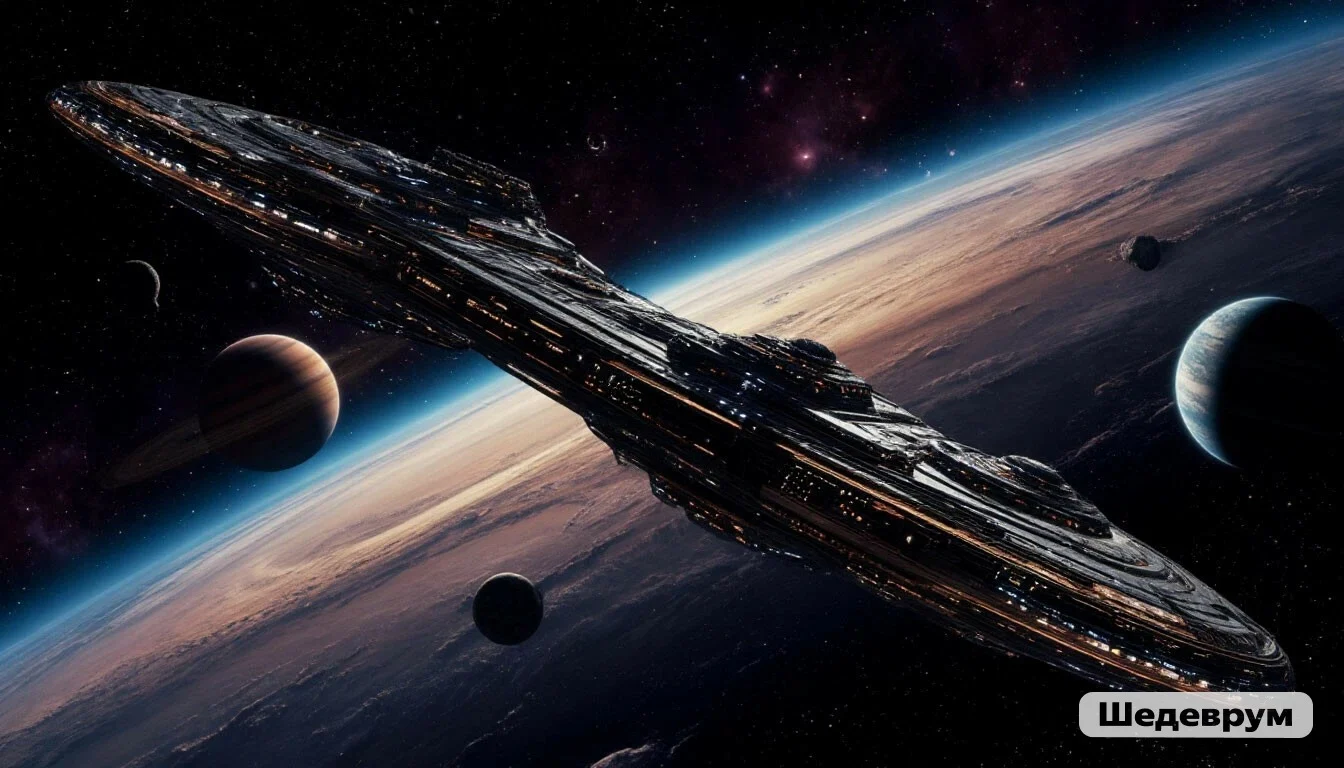
In 2326, the galaxy breathes in unison with our thoughts, and rocketry has completely rejected the crude matter of the past. Spaceship hulls are no longer made of titanium or carbon nanotubes — they are now woven from stabilized dark matter, that invisible web that has held the stars together for billions of years. This substance makes up eighty-five percent of the mass-energy of the Universe, and humanity has learned to tame it, turning it into an ideal shell for space travel.
Take, for example, the ship «Yaroslavl-14», which hovers above the orbit of Proxima Centauri awaiting its next hyperjump. Its hull possesses absolute invisibility that cannot be broken even by the most advanced means of detection. Neither radars, nor neutrino scanners, nor gravitational lenses can detect its presence in space. Dark matter simply does not interact with the electromagnetic spectrum, does not emit thermal radiation, and practically does not curve the space around it. We stabilize it with powerful zero-point energy fields, confining particles in quantum cells the size of a single atom. The hull is formed right during flight, when swarms of nanobots extract «building blocks» from vacuum fluctuations, materializing them according to a given template.
Such hulls give ships true immortality in the face of cosmic threats. Radiation streams from exploding supernovae pass through the shell without causing any harm to systems or crew. A meteorite impact or enemy kinetic weapon strike is simply not registered — the hull is capable of phase-shifting at the right moment, becoming completely ephemeral and letting the obstacle pass through. In hyperspace tunnels, such invulnerability allows maneuvering near event horizons of black holes, where ordinary materials would instantly evaporate. The crew inside such a ship exists in a cozy cocoon of artificial light generated by bioluminescent symbionts integrated into the bulkheads.
And, interestingly, such ships slow down time inside themselves, which allows partially overcoming the time paradox — the shift is minimal, but Earth’s scientists are already exploring its potential.
Image generated by Shedevrum



Comments (0)