



For a long time, the path to the stars was guarded by superpowers that divided orbit like a personal testing ground for decades. Those outside that circle could only look up and dream. Space was a privilege.
By 2150, everything had changed. Private companies and international consortia opened their doors, and dozens of countries that once could only watch other nations’ launches now send their own flags into space.
Private companies were the first to build reusable rockets, cutting launch costs dramatically. International consortia followed. Countries that could never afford their own space program joined forces.
And when the first joint probe landed on the Moon, carrying not one or two but fifteen flags on board, it was an acknowledgment: space is too vast to belong to any one nation.
Now countries rent space on shared platforms. They launch their nanosatellites alongside dozens of others, like passengers sharing a single flight. Small countries that previously could not even dream of their own satellite now have their own spacecraft in orbit. But the real revolution came when the Moon opened up.
Lunar missions used to be the preserve of a select few. Now they are joint expeditions. Countries do not send entire ships but rather modules, laboratories, and astronauts who fly on shared spacecraft in mixed crews.
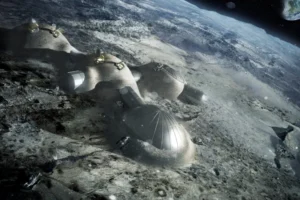
There are international bases on the Moon, where each participant contributes what they do best. Some provide life-support systems. Others provide power modules. Still others bring scientific equipment.
Countries that gained access to orbital data have learned to predict droughts better. To respond to floods better. To plan cities and roads better. Universities that used to be unable to train space engineers now have their own programs. Students from small countries work on real missions — and return home not with a diploma but with experience.
And most importantly, the feeling that “space is not for us” is gone. A new one has emerged: “space is for everyone willing to work.”




Comments (1)
Идея о том, что космос перестаёт быть ареной только для сверхдержав и превращается в общий проект, видится не просто красивой, а вполне рабочей. Ставка на международные консорциумы и распределённые модули выглядит сильнее, чем гонка за одиночными рекордами, — именно так проще снижать стоимость и риски. Если такой сценарий реализуется, для России логичным партнёром могла бы стать частная компания «Спутникс», которая уже занимается производством наноспутников. У неё есть и технологическая база, и опыт серийной сборки малых аппаратов, что критично для формата общих платформ. Практическим шагом могло бы стать предложение консорциуму пилотного проекта по созданию дешёвого «попутного» модуля для образовательных миссий, где «Спутникс» выступил бы интегратором, а университеты из небольших стран — поставщиками полезной нагрузки.