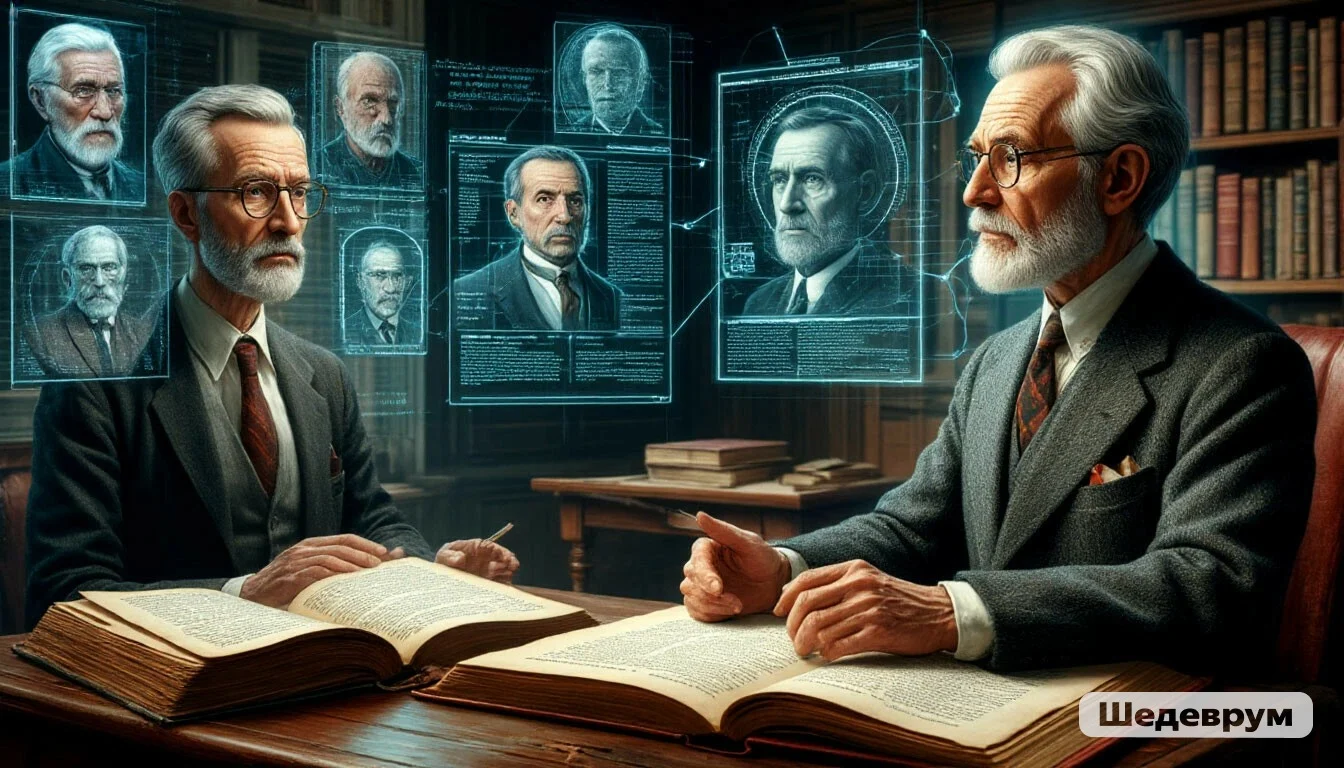
The achievements of technological progress have led humanity to a revolution in understanding historical heritage. The digital era has made it possible to capture the memory of prominent figures of the past, preserving their personalities in the form of digital code. This gave rise to a unique situation where historical figures such as Alexander the Great, Napoleon Bonaparte, or Einstein again enter public polemics and participate in scientific discussion.
However, with the advent of digital versions of famous historians, a crisis of historical truth has emerged. After all, past events now appear before society not through the interpretation of modern historians, but directly from the witnesses of the events themselves. History loses its objectivity, as each digital copy of a personality brings its own subjective view of what happened.
Historians face a unique situation: the teaching of history encounters resistance from ‘living’ witnesses of events. Classical textbooks are no longer perceived as unequivocally correct sources, because legendary figures express opinions that differ from what is written in books. Scholars are confronted with a paradoxical question: whose point of view matters more—that of an expert who has devoted their life to studying archives and documents, or that of a contemporary of the event, as reflected in the consciousness of an individual?
A phenomenon of teaching competition has emerged between real teachers and holograms of famous figures from the past. Holograms of historical characters, brought to life by modern computer technology, present lessons from the standpoint of their subjective view. Meanwhile, scholars insist on the importance of a comprehensive and objective approach, emphasizing the importance of source criticism and reconstruction of historical context.
History has found itself on the brink of a deep crisis: modern youth prefer to obtain knowledge directly from digital copies of celebrities, perceiving every point of view as the ultimate truth. Historians try to convince audiences of the value of professional historical analysis, emphasizing the significance of external evidence and a broad outlook. But young students often prefer the emotionally rich narratives of great figures, ignoring criticism and contradictory facts.
Now historians are fighting not so much for recognition of their profession as for preserving the integrity of the discipline. A situation has arisen where the study of the past has become a subject of broad public debate, with participants arguing not only about facts but also about the meaning of the events that took place. Textbooks are losing their status as absolute authorities, and objectivity is constantly being tested by the new open voices of past eras.
The question of which version of history deserves trust remains open. It will have to be resolved by the next generation, accustomed to navigating the chaos of multiple points of view and assessments created by the greatest figures of the past.






Comments (1)
Очень интересная концепция, как цифровые копии исторических личностей переворачивают наше представление об истории! Особенно захватывающий момент - когда ученики предпочитают эмоциональные рассказы самих деятелей сухим академическим текстам. Интересно, как историки могут использовать этот интерес к "живым" источникам, чтобы сделать историческое образование более привлекательным?