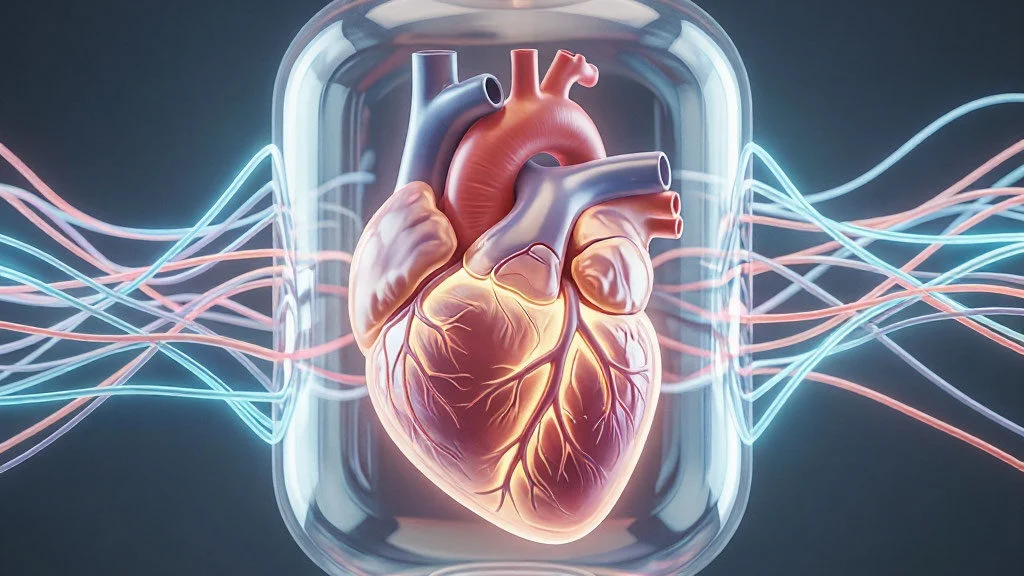

Quantum organ cloning on demand abandons the biological logic of growth in favor of informational duplication of matter. The technology eliminates the main problem of transplant medicine — time. There is no longer any need to wait for a suitable donor, fear tissue rejection, or store organs in cryochambers. An organ is created from an information snapshot at the moment it becomes needed.
Technological cycle: from cell to organ in 118 seconds
The process completely rules out cell division (mitosis), which in nature takes weeks and months. Instead, it uses direct assembly of matter at the subatomic level.
1. Quantum scanning (0–4 seconds)
The veterinarian takes one healthy cell (for example, a hepatocyte from an area of the liver unaffected by a tumor). The cell is placed in an isolated replicator chamber.
An array of quantum sensors (based on NV centers) reads not just DNA but the full quantum state of each molecule of the cell: the position of every carbon, nitrogen, and phosphorus atom, electron spin, and the state of hydrogen bonds. An absolute digital twin is created — an «archive file» of the healthy organ.
2. Unfolding and calculation (5–12 seconds)
The artificial intelligence analyzes the file. Since the animal needs the organ here and now, the AI calculates the final architecture. If a 40 kg dog needs a kidney, the algorithm builds out the required number of nephrons and volume of cortical substance in the model, relying on the basic template from one cell, so that the organ fits perfectly into its intended bed.
3. Quantum assembly (13–115 seconds)
This is the heart of the technology. An absolute vacuum is created in the replicator chamber. A stream of calibrated photons and ions is directed to the assembly point.
The principle of quantum entanglement and tunneling is used. Matter is not «printed» layer by layer, as on a 3D printer. It is assembled simultaneously throughout the entire volume. Atoms literally «manifest» at the required coordinates from the quantum field, arranging themselves into DNA spirals, mitochondrial membranes, and myocardial muscle fibers.
To create vascularization (vessels), the replicator leaves temporary quantum channels in the structure of the future organ; after implantation, these instantly fill with the host’s blood, «growing into» the host’s system before the surgeon’s eyes.
4. Terminal differentiation (116–118 seconds)
In the final seconds of assembly, a short pulse of directed radiation is delivered to the organ. This replaces the body’s chemical signals that in nature make cells «understand» what they are meant to be. Kidney cells receive the command to begin filtration, myocardial cells — to synchronize their rhythm. The organ emerges from the replicator biologically dormant but fully functional.
Veterinary practice and advantages
1. Emergency cardiology
During a heart attack in a shepherd dog (Raina), time is measured in seconds. The veterinarian takes a biopsy of healthy heart tissue through a micro-port. After 118 seconds, the veterinarian holds in their hands a fragment of myocardium that is already beating in unison with the dog’s heart, since it was assembled according to her own quantum map. It is implanted through the same micro-port, connected to the vessels, and the rhythm is restored instantly. There is no need for a whole-heart transplant.
2. Solving the size problem
Donor incompatibility no longer exists. For a Chihuahua, the replicator will create a kidney the size of a grape; for a Great Dane, an organ weighing a kilogram. The material will always be genetically identical to the patient, which completely eliminates graft-versus-host reaction and the need for immunosuppressants.
3. Neurointegration
If part of the pituitary gland or a brain area responsible for hormone production is damaged, the replicator creates a tissue fragment with already configured receptors. As soon as it is connected to the circulatory system, it begins producing thyroxine or cortisol in the required volume, reading the body’s needs through quantum synchronization.
Risks and systemic limitations
1. Quantum decoherence and «drift»
If even the slightest magnetic field fluctuation or vibration occurs during the 118-second assembly, an atomic defect may arise in the organ’s structure. This will not lead to cancer, but it could cause, for example, a microscopic leak in a kidney filter or a failure in the heart’s conduction system. Every replicator requires stabilization at the level of fundamental physics.
2. The problem of aging
The organ is created young. If it is implanted into a 12-year-old dog with general bodily wear, this ideal fragment may come into conflict with the surrounding old tissue. A «biological dissonance» arises when the new organ works at 100% capacity, but the old vessels cannot handle such a volume of blood.
3. The ethical boundary of replication
The technology of quantum cell scanning theoretically makes it possible to preserve an «archive file» of an animal before death. This raises the question: if we can print a new body from the snapshot of a single cell, where is the boundary between saving an organ and attempting to resurrect the personality you mentioned earlier? Quantum organ cloning is a direct path to creating spare parts for the entire organism.







Comments (1)
Если считать это проектом, уточню: 118 секунд — окно до декогеренции, а не производительность, поэтому пилот должен проверять воспроизводимость квантового слепка и допуск по дефектам, а не сразу имплантацию. Для пилота подойдёт «Мираторг»: ветслужба, поголовье и клинические данные дадут площадку и обратную связь по отторжению. Первый шаг — рабочая группа с их ветслужбой и сборка фрагмента почки ex vivo с протоколом контроля дефектов. Что возьмёте для валидации слепка до имплантации — культуру клеток или изолированный орган?