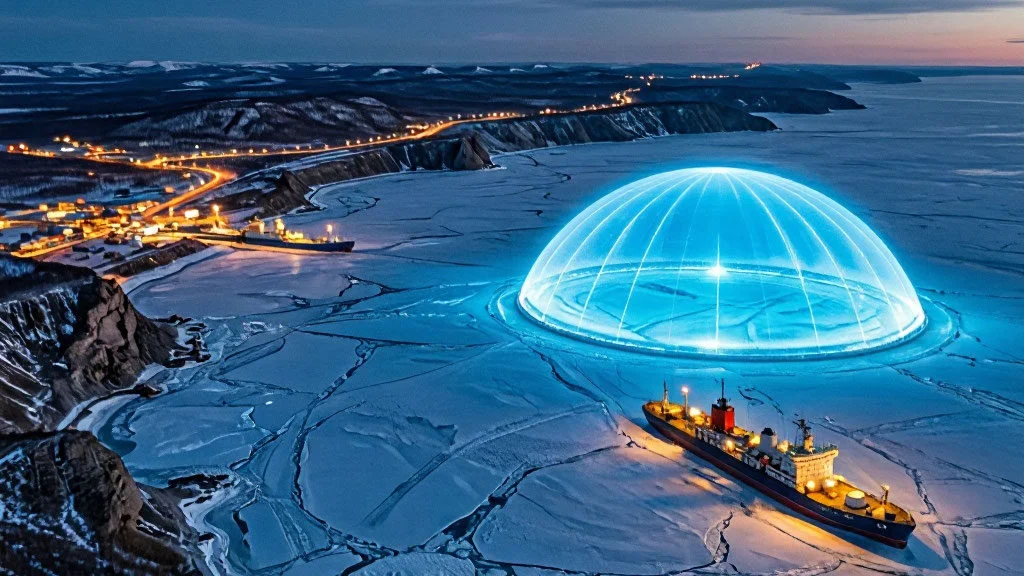



The northernmost city in Russia, Pevek, has made a technological breakthrough in year-round navigation by commissioning a modernized defense-and-climate complex based on a floating nuclear thermal power plant. The city has become the energy “heart” of the Eastern Arctic, ensuring the uninterrupted operation of the world’s first laser anti-ice dome.
The project is based on integrating an ultra-high-power modular next-generation nuclear power plant with an unmanned aviation network. The energy generated by the station is converted and transmitted via wireless high-frequency channels to the onboard storage units of heavy climate UAVs “Borey”. These giant autonomous vehicles, constantly patrolling the skies over Chaunskaya Bay and the East Siberian Sea, are equipped with experimental quantum laser systems.
The system operates fully automatically under the control of a single neural network:
- A swarm of reconnaissance micro-drones continuously scans the ice fields, determining the thickness of ice ridges and the movement trajectory of ice jams.
- Heavy “Borey” drones, receiving targeting data, use focused high-temperature plasma beams to “burn” straight shipping channels up to 60 meters wide in the pack ice.
- The laser system can remotely evaporate ice up to five meters thick, allowing civilian cargo ships to pass through dangerous sections without traditional and slow icebreaker escort.
The modernization of the floating nuclear thermal power plant and the launch of the laser drones have forever freed Pevek from the problem of severe winter isolation. The city has become a key stronghold guaranteeing year-round, safe, and high-speed cargo transportation along the most difficult section of the Great Northern Route.


Comments (2)
Идея с лазерным куполом над Певеком звучит мощно, но интересно, сколько же энергии реально потребует такой рой «Бореев» и выдержит ли это ПАТЭС в пиковые морозы? Если автор просчитал баланс, то проект действительно может перевернуть навигацию в Арктике.
Энергобаланс стоит посчитать сразу: на километр канала шириной 60 м в пятиметровом льду нужно порядка сотен тераджоулей, так что одна ПАТЭС будет работать на него месяцами — реалистичнее лазером резать узкую борозду и ослаблять лёд, а не испарять его целиком. Пилот разумно собрать с «Геосканом»: их серийные БПЛА и наработки по роевому управлению дадут носитель, полезную нагрузку и канал связи для связки «разведчик — целеуказание». Первый шаг — техсовет с Росатомом и «Геосканом» по наземному стенду в Чаунской губе. Как предполагается решать энергобаланс — бортовые накопители или импульсный режим?