

Who the Stand-Ins Are
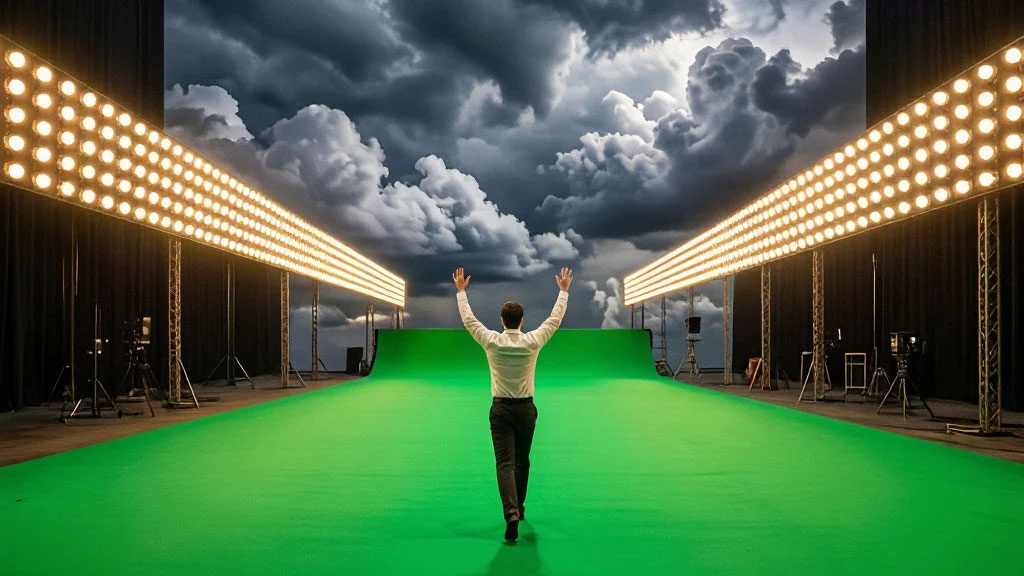
Inside huge soundstages, where glowing walls made of thousands of lamps stood instead of the usual sets, special people worked. They were called stand-ins. While the real actors rested before going on set, these extras stepped into the center of the hall onto a bright green background. They did not need to act roles or say words. Their only task was to make barely noticeable movements and break the perfect picture with their living bodies.
How the Virtual World Broke Through the Human
The light walls created a complete illusion of another world: behind the person’s back, clouds could drift or a futuristic train could race by. But this picture was false; it was drawn by a computer right on top of the green screen. A complex mechanism tracked the position of the cameras and instantly redrew the landscape. Sometimes this mechanism made mistakes. In such moments, the virtual sky seeped through the living person. The edge of a cloud would suddenly appear on a shirt sleeve, and a train wheel would start riding along a living leg. It was a depth failure, an error in the overlay of worlds.
Provoking Failures and Collecting Data
The stand-ins deliberately provoked these failures. They sharply raised their arms up, forcing the system to recalculate the upper boundaries of the frame. They took a step back, checking the far zone. A special tracking program recorded each such failure with precision to a fraction of a second. It recorded at exactly which point in space the hologram broke through flesh. The collected data went to a calculation worker. He collected all the failure points and drew an overall picture of the errors. On his diagrams, the hall was colored in different colors. Warm tones showed the places where the system failed most often. If a bright red spot accumulated at chest level, it meant the sensors were incorrectly reading the average height of people. If a stripe stretched along the floor, the issue was camera shake during movement.
Rigorous Analysis of Causes
To understand the exact cause of the trouble, a rigorous analysis of causes was used. The calculation worker compared groups of data with one another. He looked at whether the number of breakthroughs depended on what the person was wearing. It turned out that white clothing created enormous difficulties. Light from the glowing walls reflected off the fabric, fell onto the green floor, and blinded the smart cameras, creating a pale haze around the extra that the machine could not separate from the background. Then came a height check. It turned out that very tall people constantly caused picture jolts because their heads went into the upper area where the cameras looked at an awkward angle and began to see the world crookedly.
| Sign on the diagram | Established cause |
|---|---|
| Bright red spot at chest level | Sensors incorrectly read the average height of people |
| Stripe along the floor | Camera shake during movement |
| Pale haze around the extra | White clothing reflected light, and the machine could not separate it from the background |
| Picture jolts | Tall height: heads went into the upper area, where cameras saw the world crookedly |
Engineers’ Fixes and the Result
This precise information was passed to the craftsmen who adjusted the very machine that drew the worlds. Now they knew where to strike. The engineers tweaked the system’s internal rules specifically for white fabrics so that it would ignore spurious glare. They shifted the viewing boundaries for tall people, correcting the optical distortion of the lenses. Here the stand-ins acted as living testers. They found those very millimeters of our physical world that still refused to obey the laws of the drawn reality. With their simple movements, they pointed the engineers to weak spots, allowing holes in space to be patched before the main character entered the frame. Thus thousands of tiny human inaccuracies turned into a flawless picture on the screen.



Comments (1)
Самое ценное здесь — сама рамка: сбой трекинга ловят не в лаборатории, а телом статиста, и так получают данные, которых синтетика не даст. Если доводить это до площадки, нужны LED-объём и сильная команда по компьютерному зрению — например, Яндекс с его алгоритмами трекинга и Кинопоиском как источником реальных сценариев. Первый шаг — рабочая группа с оператором виртуальной сцены и пилот на две недели: 10–15 статистов разного роста и в разной одежде, карта провалов, передача в разработку.