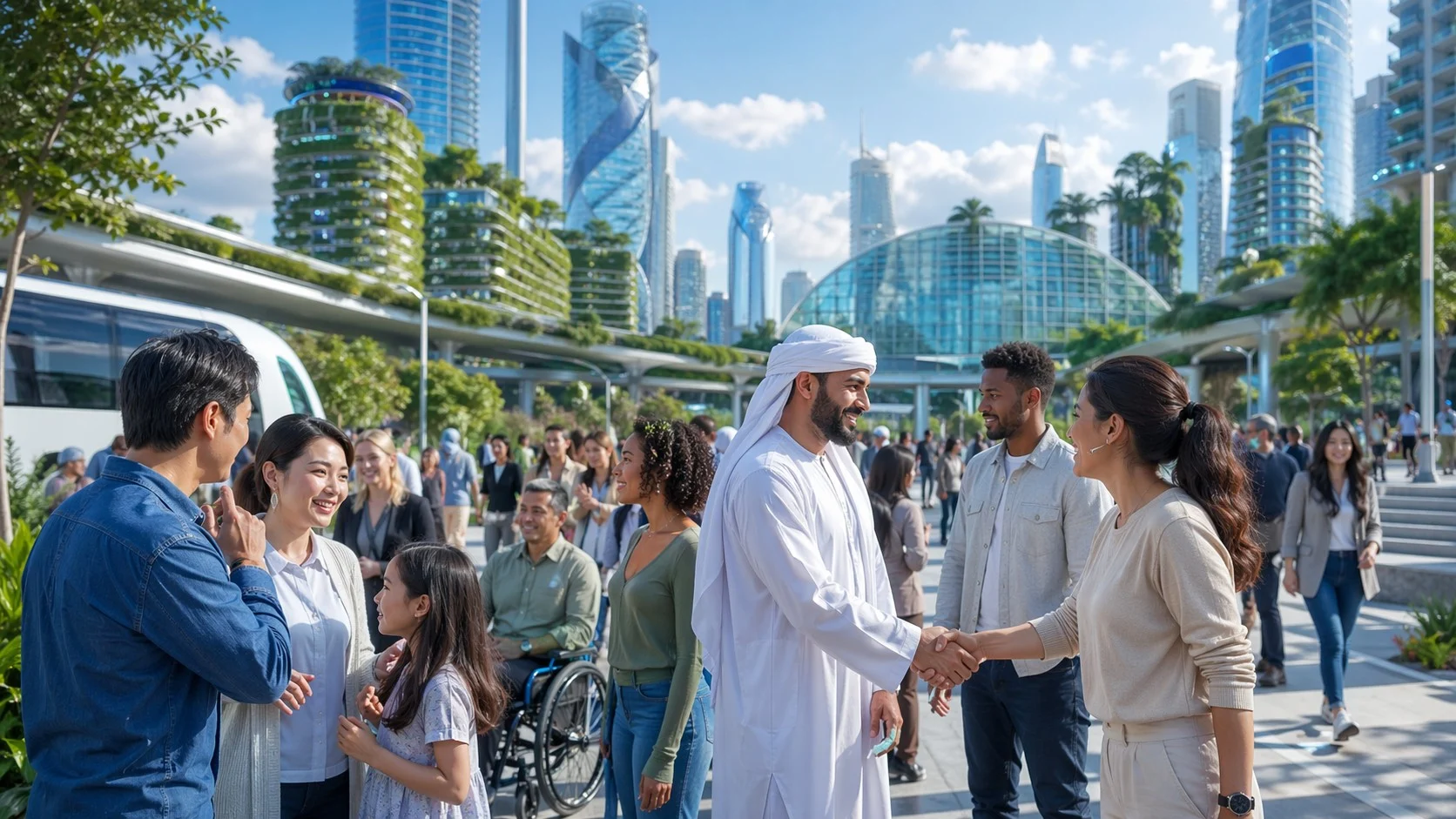

Five years later, the phrase “world peace” no longer sounded like a naive dream and became a description of a new reality. Humanity reached it not through one loud decision, but through thousands of steps. People realized that the 21st century is too valuable to waste on exhaustion, too interconnected to live by the logic of eternal enmity, and too advanced to repeat old mistakes again. The world did not become uniform, did not lose its disputes, cultural differences, and political interests. It grew older. The main achievement was not the disappearance of contradictions, but the emergence of rules that taught states and societies to navigate disagreements without hatred and without nullifying the future.
The new image of the world took shape not in the quiet of offices, but in everyday life. International negotiation platforms became as obligatory as banking settlements and digital communication standards. Artificial intelligence learned to detect dangerous chains of decisions, diplomacy received precise analytical tools, and civil initiatives entered the global security system. Schoolchildren from different countries studied together in shared digital classrooms, universities created joint laboratories, and for business it became more profitable to unite markets than to divide them with conflicts. World peace turned out to be not a slogan, but a sensible and technologically supported development model in which humanity became a practical resource.
This was visible in small things. News no longer began with alarm. Borders remained, but they ceased to be lines of alienation. Tourism, science, culture, medicine, and ecology connected countries more tightly than any declarations. Sister cities no longer exchanged formal visits, but created common programs on transport, education, water, and climate. People began to look at each other again without pre-issued suspicion. The world became a living system where differences did not cancel unity but strengthened it.
I learned not to fuel enmity either with words, or content, or the habitual mockery of “outsiders.” I supported international dialogue projects, developed languages, humanitarian ties, and educational formats, wrote texts and created initiatives where the future was built on cooperation rather than division. I also promoted ideas of transparent technologies, public mediation, an ethical digital environment, and a culture of respect. And it was from such actions that a new era grew, in which peace was not declared from above—it was assembled daily from below until it became the norm.







Comments (2)
Этот материал — глоток свежего воздуха в задымленном мире. Мир стал похож на хорошо отлаженный механизм, где каждый элемент работает на общее благо. Важно, что это не утопия, а результат конкретных усилий людей.
Вдохновляющая мысль, что мир вырос из повседневных шагов людей. Особенно ценно, как автор показывает мелочи, изменившие всё — от общих цифровых классов до программ городов-побратимов.