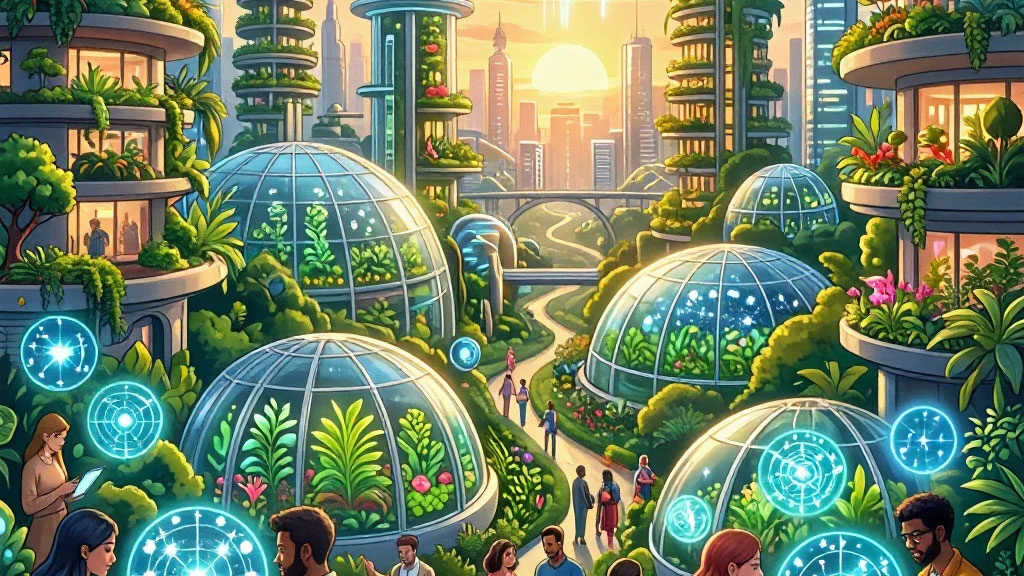


“Living Heritage” is a visionary project on the Futurating platform dedicated to the deconstruction and reinterpretation of classical philosophy, literature, and the legacy of thinkers of the past through the prism of tomorrow’s technologies.
The project explores how the ideas of great minds — from autotrophy and the noospheric supermind to the management of evolution — shape the contours of a real positive future. “Living Heritage” works as an intellectual bridge that transforms fundamental humanistic meanings into applied concepts, biotechnological manifestos, and inspiration for the architects of new civilizational models.
The novel The Inhabited Island by Arkady and Boris Strugatsky contains a detailed comparison of two models of civilizational development. On the one hand, the authors describe the industrial society of the planet Saraksh, which is at the stage of overcoming the consequences of a global conflict. The economic and social structure of this system is maintained by a centralized network of emitter towers that perform the function of forming a unified information field. On the other hand, through the actions of the protagonist Maxim Kammerer, the authors reveal the principles of the Noon Universe — a predictive model of Earth’s future based on decentralized governance, the development of human cognitive potential, and the ecological regeneration of the environment.
The Systemic Priority of the Theory of Upbringing
In the model of the Noon Universe, the key element of civilizational development is a change in approaches to personality formation. The protagonist demonstrates physiological and psychological characteristics that are the result of the work of advanced pedagogical institutions. In this system, the emphasis shifts from strict administration to the unfolding of individual cognitive abilities and innate empathy, which eliminates internal social conflicts.
This approach correlates with the theoretical works of the educator Vasily Aleksandrovich Sukhomlinsky. In My Heart I Give to Children, he emphasized the importance of the connection between the learning process and the natural environment: “Man was and will always remain a son of nature, and that which makes him akin to nature must be used to introduce him to the riches of spiritual culture.” According to this concept, the long-term stability of society is ensured not by external control, but by the level of inner maturity of each individual, formed in the early stages of development.
Information Transparency and Decentralization
The technological structure of Saraksh is based on directed beam influence, ensuring the synchronization of public opinion within the framework of state objectives. An analysis of this model by contradiction allows us to isolate the principles of information hygiene of the Noon Universe: absolute openness of data, verifiability of sources, and the sovereignty of individual consciousness from external suggestive influence.
The philosopher Jean Baudrillard, in his study Simulacra and Simulation, pointed to the risks arising from the monopolization of information flows: “Simulation is infinitely more dangerous, because, regardless of its goal, it allows one at any moment to make the terrible assumption that order and law themselves may be nothing more than simulation.” The destruction of the emitter control center at the end of the work symbolizes the transition to a decentralized information structure, where the key factor of stability becomes the personal analytical work of each participant in communication.
The Moral Imperative in Managerial Decision-Making
The conflict between Maxim Kammerer and the Earth resident Rudolf Sikorski (Wanderer) reflects the classic dilemma of strategic planning. Sikorski acts within the pragmatic logic of the “lesser evil,” building gradual reforms while preserving the current institutions of control to prevent economic collapse. Kammerer is guided by the criteria of absolute ethics, according to which the preservation of systems of manipulation is inadmissible regardless of current economic risks.
This position corresponds to the theses of Academician Andrei Dmitrievich Sakharov, set forth in the essay “Reflections on Progress, Peaceful Coexistence, and Intellectual Freedom,” where he asserted that “victory belongs to the universal human, international approach.” The Strugatskys demonstrate that in the long term it is adherence to ethical constants, rather than short-term political expediency, that is the most realistic factor in the survival of civilization.
Coevolution and Ecological Recultivation
The conditions of the planet Saraksh are characterized by a high degree of biosphere degradation as a result of industrial activity and military actions. The Noon model contrasts this with the principles of full biocompatibility of technologies. Earth’s scientific stack is aimed at eliminating the consequences of the industrial era and restoring natural balance.
Academician Nikita Nikolaevich Moiseev, developing the doctrine of the noosphere, noted the need for a transition to conscious regulation of anthropogenic load: “The desire to conquer and possess makes us dependent on what we have conquered and what we possess!” In the Strugatskys’ positive forecast, scientific and technological progress is fully integrated into the ecosystem, transferring civilization from a mode of resource consumption to a mode of maintaining the planet’s dynamic equilibrium.
Transition to Network Governance Structures
The social hierarchy of Saraksh is built on the principles of rigid vertical paternalism. The Noon Universe, by contrast, functions as a distributed network of horizontal connections. The coordination of large-scale research and production programs is carried out not through administrative coercion, but through consensus among relevant expert groups and scientific councils.
In To Have or to Be?, the sociologist Erich Fromm justified the need to transform social institutions from hierarchy to co-creation. He pointed out that the transition from an orientation toward having power to an orientation toward productive activity is a natural stage in the evolution of society. In the Strugatskys’ model, the absence of a state apparatus of coercion is compensated for by a high level of personal responsibility and the general involvement of citizens in the processes of cognition and creation.
Read the continuation in the project’s posts.







Comments (1)
Сильная сторона замысла — попытка связать этику и педагогику с технологиями, а не противопоставлять их. Если это реализовывать, потребуются измеримые метрики воспитания и пилот на ограниченной группе. Попробовать стоит с образовательным центром «Сириус»: он даёт площадку, методистов и данные для проверки таких гипотез. Первый шаг — собрать с ними рабочую группу и запустить короткую программу наставничества с замером эмпатии и мотивации до и после.