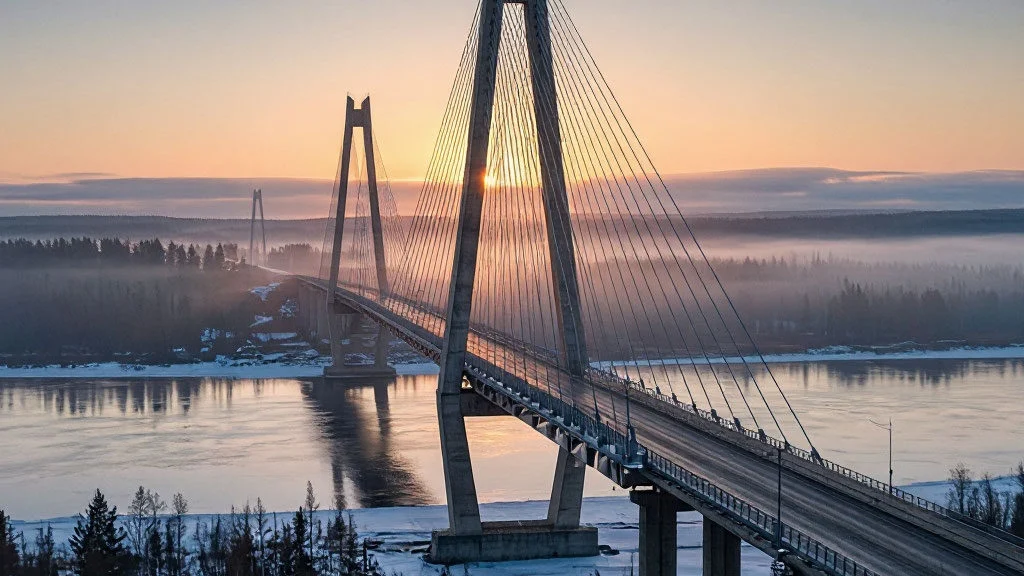




Bridges of Russia are not just engineering structures. They are a living chronicle of the country, where every span is written into history and every pillar supports the destinies of regions. From modest wooden crossings of the Russian Empire era to the grand cable-stayed giants of the 21st century, the traditions of Russian bridge building have always been based on daring ideas and the ability to tame the harshest nature. We built bridges across Siberian rivers in permafrost, constructed crossings in tsunami and storm conditions in the Far East, and every time we proved: for a Russian engineer, nothing is impossible.
Today we stand on the threshold of a new era. Across the country — from Kaliningrad to the Kuriles — more than 40 new bridges are being built. They are not just concrete and steel. They are the arteries of a new country that will turn a vast territory into a single, connected organism, with no “godforsaken corners,” only growth points. And even if our list is to some extent a dream, history has shown that the boldest dreams in Russia come true.
—
40 new bridges that Russia is building
- Lena Bridge (Yakutia) — 4.6 km long, cost ~170 billion rubles, completion 2028–2029. It will provide year-round connection to Yakutsk and put an end to ice crossings and “big water”.
- Southern Bypass of Saratov (Volga) (Saratov Oblast) — 12 km long, cost ~134 billion rubles, completion 2027. It will become the second-longest bridge in Russia and take transit traffic out of Saratov and Engels.
- Western Bridge (Volga) (Tver) — 3 km long (complex), cost ~20 billion rubles, completion 2027. A six-lane exit to the M-10 highway, it will relieve the city of transit.
- M-12 Bridge (Volga) (Tatarstan) — 3.36 km long, cost as part of the route (~25 billion rubles), completion 2026. A key facility of the Europe–Western China corridor.
- Third Bridge (Volga) (Yaroslavl) — 0.8 km long, cost ~6.5 billion rubles, completion 2030. It will connect the Frunzensky and Zavolzhsky districts and ease the center.
- New Bridge over the Oka (Ryazan Oblast) — 5.8 km long, cost ~43.5 billion rubles, completion 2029–2031. A twin to the existing bridge, it will meet the region’s transportation needs.
- Bridge over the Amur (Pashkovo–China) (Jewish Autonomous Oblast) — 1.1 km long, cost ~8.25 billion rubles, completion 2026. A cross-border crossing to increase freight flow with China.
- Bridge over the Tumen (DPRK) (Primorsky Krai) — 4.7 km long, cost ~35.25 billion rubles, completion 2026. The first road bridge between Russia and the DPRK.
- Bridge over the Shosha (HSR) (Tver Oblast) — 8.2 km long, cost ~61.5 billion rubles, completion 2028. One of the longest railway bridges in Russia.
- Bridge over the Irtysh (Omsk Oblast) — 1.27 km long, cost ~9.5 billion rubles, completion 2028. A key facility of the Northern Bypass of Omsk.
- Bridge over the Om (Omsk Oblast) — 0.18 km long, cost ~1.32 billion rubles, completion 2028. The second bridge within the Northern Bypass of Omsk.
- Pontoon bridge over the Kama (Kirov Oblast) — 0.08 km long, cost ~0.12 billion rubles, completion 2027. A temporary crossing in Afanasyevsky District.
- Bridge over the Angara (Irkutsk Oblast) — 4.2 km long, cost ~42 billion rubles, completion in the 2030s. It will bypass the Bratsk HPP dam and ease a critical bottleneck.
- Bridge over the Yenisei (second bridge) (Krasnoyarsk Krai) — 2.5 km long, cost ~25 billion rubles, completion in the 2030s. It will relieve Krasnoyarsk as a twin to the existing bridge.
- Bridge over the Volga (Astrakhan) (Astrakhan Oblast) — 1.8 km long, cost ~13.5 billion rubles, completion in the 2030s. The third bridge will take transit out of the city.
- Bridge over the Volga (Kostroma) (Kostroma Oblast) — 1.6 km long, cost ~12 billion rubles, completion 2028–2030. The second bridge will relieve the only existing one.
- Bridge over the Volga (Kimry) (Tver Oblast) — 1.2 km long, cost ~9 billion rubles, completion in the 2030s. A new bridge on the alignment of the M-11 Neva highway.
- Bridge over the Kama (Perm) (Perm Krai) — 0.9 km long, cost ~6.75 billion rubles, completion in the 2030s. The third bridge across the Kama, developing public-private partnership.
- Sail Bridge (Novozavodskaya) (Moscow) — 0.25 km long, cost ~2.5 billion rubles, completion 2027. It will connect Filevsky Park and Khoroshevo-Mnevniki, developing “Big City”.
- Bridge on the Kirovskaya alignment (Arkhangelsk) — 1.0 km long, cost ~10 billion rubles, completion 2032. A twin to the Kuznechevsky Bridge, providing year-round connection.
- Bridge over the Vitim (Irkutsk Oblast) — 0.41 km long, cost ~4.14 billion rubles, completion 2027. It will solve the transport accessibility problem of the Bodaibo District.
- Nizhne-Eltsovsky Bridge (Ob River) (Novosibirsk) — 1.5 km long, cost ~15 billion rubles, completion 2030. The fifth bridge in the city will connect new districts.
- Matveyevsky Bridge (Ob River) (Novosibirsk) — 1.5 km long, cost ~15 billion rubles, completion in the 2030s. The sixth bridge will develop the left bank.
- Zayeltsovsky Bridge (Ob River) (Novosibirsk) — 1.5 km long, cost ~15 billion rubles, completion in the 2030s. It will connect the Zayeltsovsky district with the right bank.
- Bridge over the Ob (Northern Latitudinal Railway, Salekhard) (Yamalo-Nenets Autonomous Okrug) — 2.0 km long, cost ~30 billion rubles, completion in the 2030s. A key facility of the Northern Latitudinal Railway, providing a link to the Urals.
- Bridge over the Chumysh (Altai Krai) — 0.23 km long, cost ~1.73 billion rubles, completion 2026. Reconstruction of the Altai–Kuzbass road.
- Bridge over the Tobol (Kurgan Oblast) — 0.5 km long, cost ~3.75 billion rubles, completion 2027. A new bridge bypassing Kurgan.
- Bridge over the Ushakovka (Irkutsk) — 0.3 km long, cost ~2.25 billion rubles, completion 2026. A new crossing within the city limits.
- Bridge over the Bikin (Khabarovsk Krai) — 0.5 km long, cost ~3.75 billion rubles, completion 2026. Upgrading the A-370 highway.
- Bridge over the Gruzsky Elanchik (DPR) — 0.06 km long, cost ~0.42 billion rubles, completion 2026. Restoring infrastructure on the R-280 highway.
- Bridge to Zelyony Island (Rostov-on-Don) — 0.16 km long, cost ~1.16 billion rubles, completion 2026–2027. Year-round connection with the island.
- Bicycle-pedestrian bridge over the Yenisei (Krasnoyarsk) — 0.28 km long, cost ~1.06 billion rubles, completion 2025–2026. It will connect the center with Tatyshev Island.
- Rogachevsky Bridge (Moscow Oblast) — 0.21 km long, cost ~2.1 billion rubles, completion 2027. It will relieve the existing bridge in Dmitrov.
- Bridge over the Kudensta (Krasnodar Krai) — 0.55 km long, cost ~4.13 billion rubles, completion 2026. A key facility of the Adler bypass.
- Adler Bypass Overpass (Krasnodar Krai) — 0.92 km long, cost ~6.87 billion rubles, completion 2026. The longest overpass on the Adler bypass.
- Bridge over the Ob (integrated development of territory) (Tomsk Oblast) — 2.0 km long, cost ~30 billion rubles, completion in the 2030s. A new bridge under an integrated territorial development project.
- Bridge to Sakhalin (Sakhalin Oblast) — 7.5 km long, cost 450–600 billion rubles, completion 2030–2035. It will connect the island to the mainland, creating new logistics for the Far East.
- Bridge across the Bering Strait (Chukotka) — 113 km (tunnel), cost ~565 billion rubles, completion in the 2030s. Control of the Northern Sea Route, intercontinental crossing.
- Sakhalin–Hokkaido Bridge (Sakhalin Oblast) — 42 km long, cost ~315 billion rubles, completion in the 2040s. A transit corridor to Asia, connecting with Japan.
- Bridge over the Nevelskoy Strait (Khabarovsk Krai) — 7 km long, cost ~70 billion rubles, completion in the 2030s. An alternative to the bridge to Sakhalin, linking the mainland with the island.
—
 Total cost for the 40 bridges
The combined estimated cost of all the listed projects exceeds 2.1 trillion rubles. This figure reflects not only the scale of the tasks, but also our faith in the future: every ruble invested will be returned through accelerated regional development, new jobs, and the country’s connectivity.
—
Magnificent bridges built over the last 20 years
These bridges are a living chronicle of Russian engineering genius, a reminder that we know how to build beautifully and reliably. They already serve people today, connecting shores and hearts.
- Crimean Bridge (Crimea) — 19 km long, cost ~228 billion rubles, 2018. The longest in Europe, provided a land connection with Crimea.
- Russky Bridge (Vladivostok) — 3.1 km long, cost ~32.2 billion rubles, 2012. The world’s longest cable-stayed span, a symbol of APEC.
- Golden Bridge (Vladivostok) — 1.4 km long, cost ~17.9 billion rubles, 2012. It connected two parts of the city across Golden Horn Bay.
- Bugrinsky Bridge (Novosibirsk) — 2.1 km long, cost ~17.1 billion rubles, 2014. An arch giant that relieved the city center.
- Zhivopisny Bridge (Moscow) — 1.46 km long, cost n/a, 2007. The highest cable-stayed bridge in Europe with a unique arch-capsule.
- Murom Bridge (Vladimir Oblast) — 1.4 km long, cost 6.5–8 billion rubles, 2009. Recognized as Russia’s most beautiful bridge.
- Millennium Bridge (Kazan) — about 1.6 km long, cost over 3 billion rubles, 2005. Connected the center with new residential areas.
- Western High-Speed Diameter (WHSD) (Saint Petersburg) — 46.6 km long, cost ~300 billion rubles, 2016. High-speed transit bypassing the historic center.
- Fourth Bridge over the Ob (Novosibirsk) — 1.5 km long, cost 46.8 billion rubles, 2025. Relieved the center and created a new high-speed connection.
- Bridge over the Don (Rostov bypass) (Rostov Oblast) — 1.9 km long, cost ~77 billion rubles, 2024. It relieved the M-4 Don highway and enabled bypassing Aksay.
- Bridge over the Belaya (Bashkortostan) — 0.813 km long, cost within the M-12, 2025. Provided high-speed connection along the Vostok highway.
- Bridge over the Bolshaya Sarana (Sverdlovsk Oblast) — 0.54 km long, cost within the M-12, 2025. Unique piers as tall as a 20-story building (57 m).
- Bridge over the Volga (Tolyatti bypass) (Samara Oblast) — 3.7 km long, cost within the route, 2024. A key facility in an international transport corridor.
- Bridge over the Katun (Altai) — 0.28 km long, cost ~1.7 billion rubles, 2026. It provides access to the Biryuzovaya Katun SEZ and boosts tourism.
- Second Surgut Bridge over the Ob (Khanty-Mansi Autonomous Okrug) — 1.76 km long, cost ~60 billion rubles, 2025. It relieved the only bridge in the oil-producing region.
—
Caring for the environment
Building such giants is unthinkable without caring for nature. Tomsk scientists are already 3D-printing bridge supports from recycled plastic, and construction sites use “green” anti-freeze additives, reducing the carbon footprint. Every new bridge is designed with fish migration routes and the preservation of river ecosystems in mind.
—
Conclusion: bridges to the future
These 40 bridges are not just steel and concrete. They are bridges between the past and the future, between regions and continents. The bridge across the Bering Strait and the crossing from the Kuril Islands to Japan are not just engineering solutions, but a handshake across the ocean. Someday our descendants, driving over these giants, will say: “How did they build this?” — and smile, looking at old photographs of ice crossings and ferries. We are building them for them. And it seems we are doing quite well — because if Russian engineers set their minds to something, sooner or later it will definitely be built.
The bridges we build today are letters to the future, written in steel and concrete. And they will be read long after we are gone.


Comments (3)
Мощнейщий образ!
Это не отчёт о стройке, а чертёж грядущего — и, пожалуй, в этом его главная сила. Автор смотрит на карту страны, как скульптор на глыбу мрамора: пока здесь лишь сорок пунктирных линий, но если каждая из них материализуется, пространство перестанет быть глухим, и Россия задышит единым ритмом. Хочется верить, что мечта о мосте через Лену — не просто красивая партитура для скрипки, которая останется на бумаге. Доживём ли мы до момента, когда ноты превратятся в бетон и сталь? Ответ даст время, но сам замысел уже звучит мужественно и дерзко.
Сильная сторона материала — не перечень пролётов, а попытка сделать мосты драйвером связности страны. Если такую программу удастся реализовать, важно, чтобы объекты не заканчивались на открытии движения, а включались в систему эксплуатации и мониторинга. Здесь имеет смысл присмотреться к ГК «Автодор»: у неё есть концессионные механизмы и опыт цифрового сопровождения построенных трасс. Такая компания могла бы дать пилотную площадку на одном из переходов М-12 для обкатки предиктивного мониторинга конструкций. Логичный следующий шаг — запрос в «Автодор» о рабочей группе по выбору моста-пилота и проверке технологий на реальном объекте.