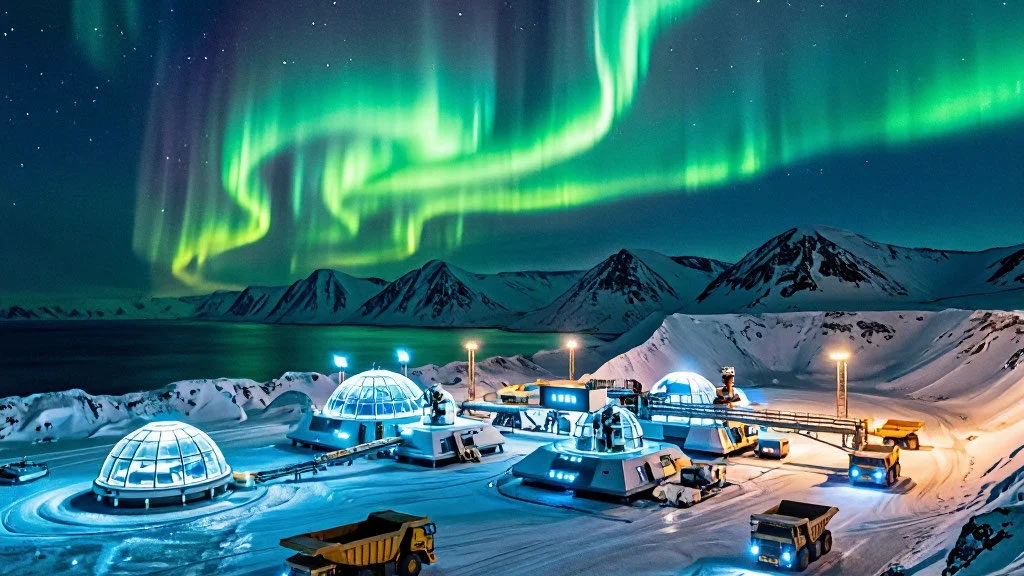



By 2076, Murmansk Oblast is making a fundamental economic maneuver, completely moving away from the old business model of ‘extract and ship out’. The region is turning into a high-tech closed-cycle industrial hub, providing an unprecedented level of economic autonomy. The Kola Peninsula is becoming a key supplier of not just raw materials, but of the most complex innovative materials, critically important for the development of robotics, the space industry, quantum computers, and the microelectronics of the future.
Unmanned intelligent mining
Mineral extraction in the Khibiny and other key deposits of the region has been fully converted to the concept of ‘green and safe subsurface management’. Heavy and dangerous human labor underground is a thing of the past. Mines, quarries, and processing plants have turned into fully autonomous cyber-physical systems, controlled by artificial intelligence from a single situation center in Murmansk. Robotic tunneling complexes and unmanned quarry transport operate with jewelry precision, minimizing landscape destruction and completely eliminating industrial injuries.
Deep processing and supermaterial factories
The main economic breakthrough of the region is tied to the creation of deep processing clusters right at the extraction site. By 2076, Murmansk Oblast possesses monopoly competencies in the production of the purest rare earth metals, lithium components, and super-strong alloys. Instead of exporting concentrates, the region produces finished solid-state batteries for the Arctic fleet, composites for space stations, and superconductors. All industry operates on the principle of zero waste: waste from some factories becomes valuable raw material for others, which makes it possible to forever solve the problem of industrial dumps and tailings ponds.
Polar sovereign agritech
The economic autonomy of the region is reinforced by complete food security in the sphere of high-tech nutrition. The Kola Bay and inland water bodies have become the base for the world’s largest digital aquaculture cluster. Robotic closed-cycle marine farms, controlled by AI, provide the macroregion year-round with valuable fish species and seafood, independent of climatic whims. At the same time, vertical automated city farms have been deployed in cities, fully covering the population’s needs for fresh greens, berries, and vegetables using clean polar energy. Murmansk Oblast has proven: new industrialization can make the Arctic region economically independent, super-profitable, and environmentally impeccable.


Comments (3)
Спор об энергии и рынках можно перевести в практическое русло: если запускать не всё сразу, а пилотный кластер на местной генерации с гарантированным госзаказом и партнёрствами по сбыту, идея станет проверяемой поэтапно, без ставки на мгновенную автономию.
Автор предлагает смелый образ, но если это реализовать, неясно, где взять энергию для автономных шахт и сити-ферм; монополия на редкоземы без устойчивых рынков сбыта хрупка; полная роботизация упрётся в кадры и инфраструктуру. Плюс — безотходная логика радует. Готов обсудить.
Сценарий убедителен там, где опирается на существующий передел: сырьевая база на Кольском есть, не хватает глубокой переработки. Если такую идею реализовывать, первым партнером логично пробовать ФосАгро с площадкой «Апатит» в Кировске: у компании уже добыча, обогащение, кадры и геология Хибин — это готовая пилотная база для извлечения редкоземельных элементов из апатита. Шаг — собрать рабочую группу с Кольским научным центром РАН и оценить пилот по РЗМ.