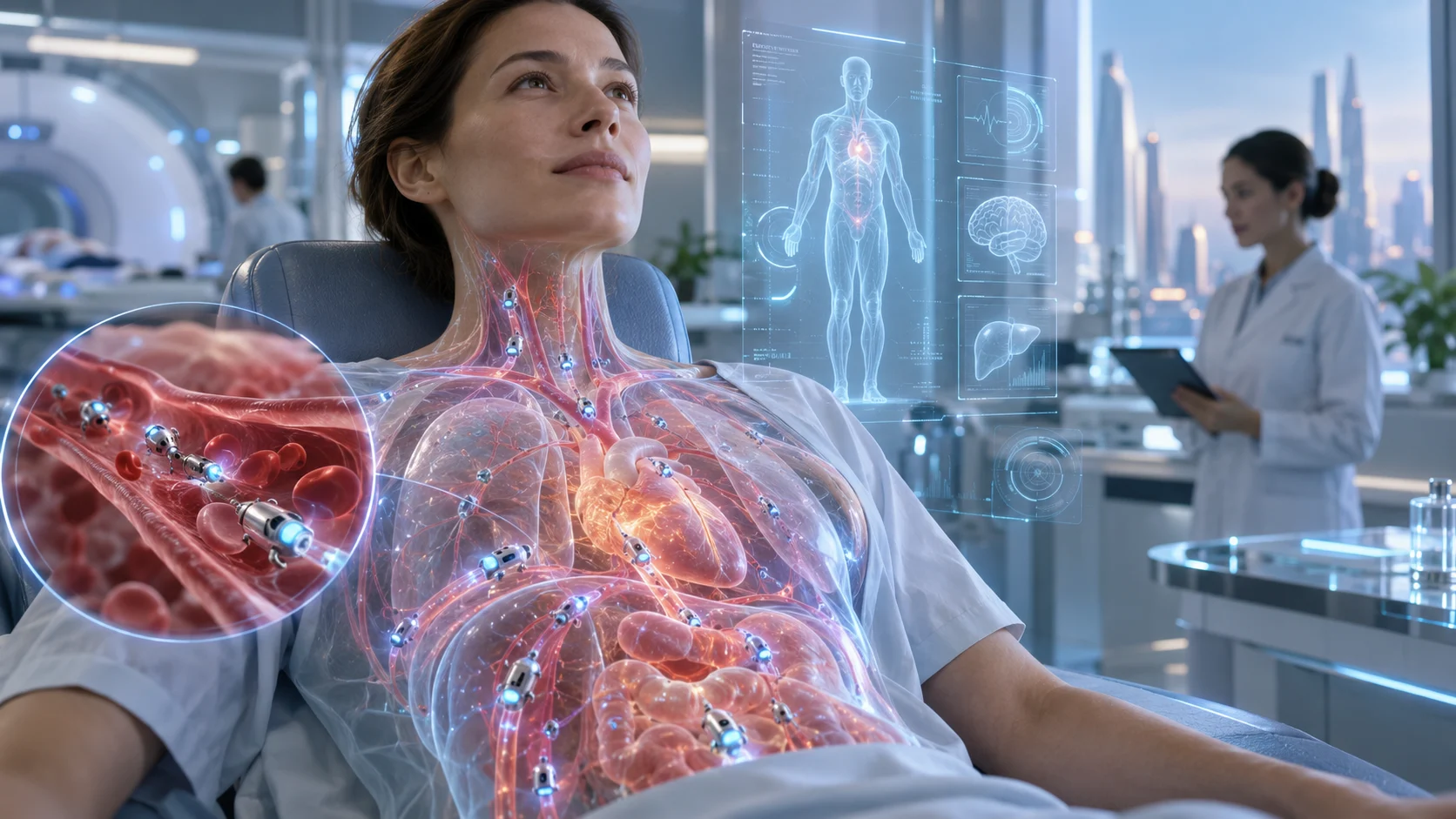



Medical Nanobots: From Early Diagnosis to Continuous Monitoring
Medical nanobots first emerged as a tool for early diagnosis. They constantly moved throughout the body, monitored the state of blood, blood vessels, cells, and organs, and noticed changes even before a person felt the first symptoms.
Gradually, their capabilities expanded. Nanobots learned to deliver drugs precisely to the required area, track the body’s response to treatment, and prevent complications in advance.
AI Began Continuously Analyzing Data from Inside the Body
The main change came later: AI began continuously analyzing all this data.
It saw the body not through individual tests once every few months, but constantly. It knew how a person slept, how they reacted to stress, nutrition, exercise, and medications. It could notice a dangerous change long before standard diagnosis and suggest that the doctor check exactly what raised concern.
A New Boundary: Medical Tool or Step Toward Merger
But along with this, a new boundary emerged.
If AI constantly received data from inside our body and helped make health decisions, was it still merely a medical tool?
Or was it already the first step toward the merger of humans and artificial intelligence?
The Main Question Became Trust
The most important question was not technology, but trust:
- who has access to this data;
- who can interfere with the operation of nanobots;
- does a person have the right to completely disable the system at any moment.
Medicine became more precise and noticed threats earlier. But at the same time, humanity had to redefine where technological assistance ends and a person’s personal space begins.







Comments (2)
Если ИИ правда будет постоянно читать данные изнутри тела, это уже не просто инструмент, а новая граница. Но как тогда оставить человеку право в любой момент всё отключить и сохранить личное пространство?
Сильная сторона идеи — переход от редких анализов к непрерывному наблюдению: если начать с узкой задачи, например контроля одного биомаркера у пациентов из группы риска, сценарий вполне реалистичен. Но автор почти не проговаривает техническую сторону доверия: нужен протокол «права на отключение» и журнал доступа к данным, иначе идея останется красивой картинкой. Для пилота логично привлечь СберМедИИ: у них есть модели анализа медицинских данных и вычислительная инфраструктура, которых как раз не хватает для непрерывного потока с нанодатчиков. Первым шагом я бы собрал рабочую группу с клиникой и юристами и запустил пилот на одном показателе с полным аудитом доступа.