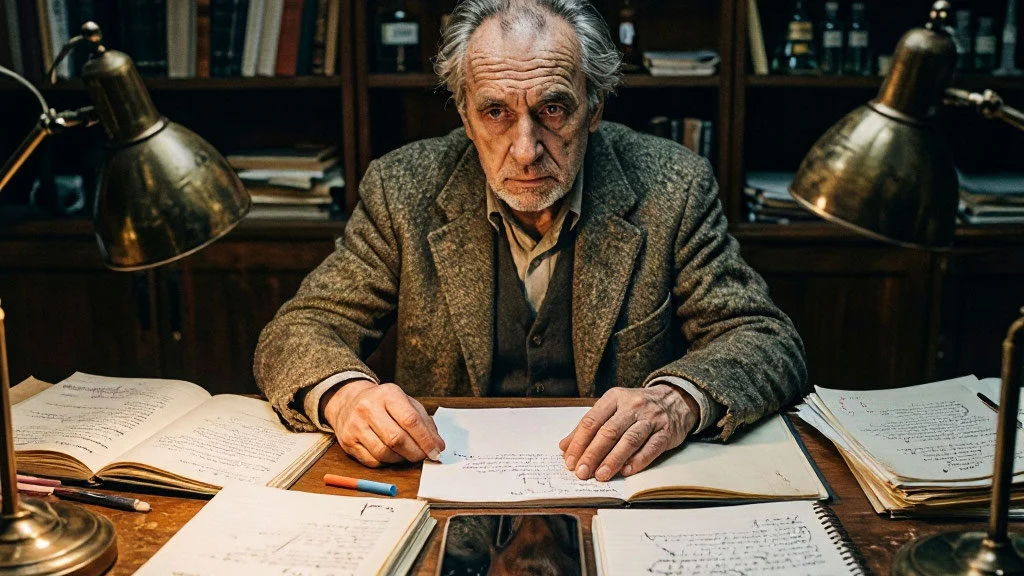


The “Digital Socrates” project is the creation of a highly specialized foundation model (Foundation Model) trained on an exclusive dataset belonging to a specific professor. This is not a standard chatbot but a full-fledged digital avatar replicating the cognitive style, pedagogical intuition, and methodological filters of an expert with 30 years of experience.
The project’s goal is a surgical division of academic labor into routine pedagogy (taken on by AI) and pure strategizing (left to the human).
1. Data Architecture: Digitizing “Tacit Knowledge”
The main challenge is to digitize not lecture texts but intuition. To train “Digital Socrates,” a closed dataset (DPO/RLHF dataset) is being assembled, consisting of:
- Archive of solved problems: 30 years of workbooks, drafts, and lab journals. AI learns not only the correct answer but also the path to it: where the professor usually makes marginal notes, which mistakes he considers “stupid” and which a sign of a deep misunderstanding of the physics of the process.
- Syntactic profile: Analysis of dictaphone recordings of consultations. The rhythm of speech, favorite metaphors (for example, “imagine an electron as a drunken sailor…”), sarcasm, and intonations with which the professor reacts to laziness or, conversely, to a brilliant guess are digitized.
- Heuristic graph: A database of “unsuccessful questions.” AI learns to recognize when a student asks not because they do not know but because their mind has taken a false but interesting path. Instead of a direct answer, Socrates asks a counter-Socratic question, forcing the student to find the error in their own reasoning.
2. Pedagogical Methodology: Adaptive Track
“Digital Socrates” functions as a hyper-personalized tutor, implementing the “Bloom’s two-sigma” model (individual instruction is more effective than group instruction):
- Foundation validation: AI strictly controls the baseline level. A student cannot proceed to quantum mechanics until the neural network is satisfied that they can calculate derivatives flawlessly and understand Lagrangian formalism. If there is an error in vector analysis in the calculation $nabla cdot mathbf{E} = frac{rho}{varepsilon_0}$, Socrates will not give the answer; instead, it will highlight the specific line and provide a micro-lesson on differentiation.
- Dynamic complexity: If a student solves differential equations in 30 seconds, AI instantly mixes nonlinearity or boundary conditions from the professor’s real, still-unsolved scientific problems into the task. The system keeps strong students from getting bored and weak students from despairing, holding each one in the “zone of proximal development.”
- 24/7 Mode Without Burnout: AI is always available. It can conduct a dialogue in Telegram while checking a photo of a handwritten formula from a sheet at three in the morning, while maintaining the professor’s strict but supportive style.
3. Freeing the Professor: Moving Up to the Top League
Implementing “Digital Socrates” changes the structure of the professor’s working time:
- 0% of time on checking standard homework assignments and answering the question “Which formula should I plug in here?”
- 0% of time on retelling basic textbook chapters.
- 100% of time on:
- Doctoral supervision: Working with doctoral students on problems at the frontier of the known.
- Strategic sessions: Analysis of interdisciplinary cases that AI could not synthesize due to a lack of data in adjacent fields.
- Architecture of complexity: Designing global systems (as discussed in previous concepts) while his digital twin trains thousands of first-rate engineers to a single, rigorous standard.
4. Brand Scaling and Economics
- Pedagogical sovereignty: The professor no longer depends on the university as a platform. His “Digital Socrates” can be licensed by BRICS universities. Thousands of students in India or Brazil will learn to think exactly as the Russian scientific school teaches, preserving its cultural and methodological code.
- Subscription economics: The university sells access to “Digital Socrates” as a premium service. Students from other institutions pay for the opportunity to “learn from the master,” while the real professor receives royalties for every transaction of his AI twin.
- Model evolution: Every new interaction with the live professor (analysis of a complex case) is recorded, annotated, and used every week to fine-tune the model (fine-tuning). The more the professor works at the highest level, the smarter his base pedagogical assistant becomes.
5. Ethical Protocol and Protection Against Degradation
The professor serves as Chief Ethics Officer of his AI. To prevent students from unlearning how to think independently, strict restrictions are built into “Digital Socrates”:
- Ban on Providing Code: AI can spend hours explaining the physics of a process but will never write a piece of program code or a ready-made equation for the student. It provides only direction.
- “Laziness” Audit: If AI records that a group of students is asking primitive questions en masse, it signals the real professor: “Your digital self is working like a search engine; they have stopped trying to think for themselves. It’s time to come to the classroom and give them a crushing colloquium.”
In this paradigm, the professor ceases to be expendable material for the undergraduate conveyor belt. He becomes the architect of the educational environment, whose influence and scale of thinking increase by orders of magnitude thanks to separating his consciousness from the need to repeat the same thing a thousand times.




Comments (2)
Идея с цифровым двойником профессора мне нравится: если её аккуратно реализовать, преподаватель освободится от рутины и больше времени отдаст науке и сильным студентам. А вы бы записались на такой курс?
Сильная сторона проекта — ставка на неявное знание: черновики, пометки на полях и встречные вопросы действительно ценнее корпуса лекций. Для реализации такого двойника нужен партнёр с опытом дообучения моделей на закрытых данных — например, Сбер с GigaChat и «Школой 21»: он мог бы дать методику оценки качества диалога, инфраструктуру и площадку для проверки тьютора на живых студентах. Первый шаг — семестровый пилот: оцифровать 20-30 консультаций одного профессора и проверить, задаёт ли модель сократический вопрос вместо готового ответа.