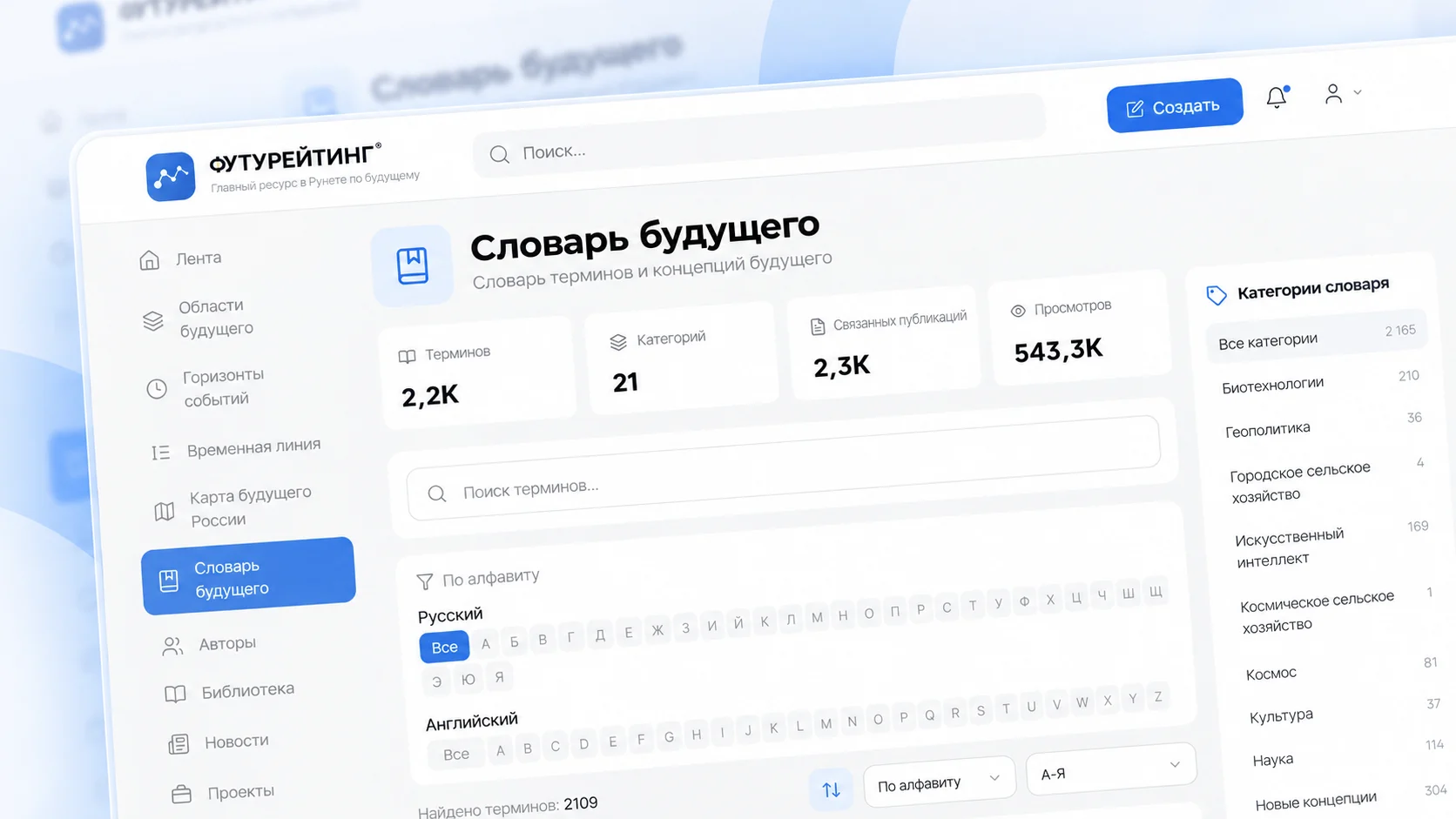
The «Dictionary of the Future» on the digital platform «Futurating» has surpassed 2000 terms and concepts.
In just three months, the section has grown more than 3.5 times and now covers 21 thematic areas — from artificial intelligence and biotechnology to economics, society, and new professions. But the main achievement is not in the number of words: a whole system of concepts is gradually taking shape, helping people describe, understand, and discuss the possible future.
From 564 to more than 2000 terms
Back on July 6, 2026, we wrote about reaching the 564-term mark. At that time, the «Dictionary of the Future» already brought together concepts from various fields of human activity. Today their number has exceeded 2000, and the section itself continues to be updated with new publications on the platform.
In three months, the dictionary grew by more than 1500 concepts. This growth reflects the expansion of Futurating’s thematic space: authors propose new images of the future, examine technological changes, rethink familiar social processes, and describe phenomena for which a generally accepted language is only just emerging.
The dictionary presents 21 categories, including technology, science, artificial intelligence, biotechnology, education, economics, culture, ecology, energy, space, and other areas.
What words appear in the dictionary of the future
Not all concepts are devoted to distant science fiction. Many describe quite recognizable processes that could potentially change everyday life.
For example, «demographic reversal» denotes a scenario in which small towns and rural areas again become attractive for living, working, and starting a family.
«Geologist-observer» — a possible profession of the future, in which a specialist monitors autonomous drilling systems instead of directly operating equipment.
«Automated animal stress management» describes the use of artificial intelligence and sensors to monitor animal condition and adjust their living conditions.
And the concept of «collective future shaping» reflects the very philosophy of Futurating: the future does not necessarily have to be predicted — its possible scenarios can be jointly proposed, discussed, evaluated, and turned into initiatives.
These examples show the diversity of the dictionary. Some terms are related to existing technologies and trends, while others describe hypothetical solutions, new social models, or authors’ visions of the future.
From a single word to a whole system of ideas
The special feature of the «Dictionary of the Future» lies in its connection with the platform’s materials.
The basis for replenishing the dictionary is the postulates and articles of Futurating’s authors. The system helps to extract significant concepts from publications, form definitions, and create thematic connections.
Thus, the dictionary develops not separately from the community, but together with its ideas.
Each term gets its own page. Depending on the content of the concept, it may present a detailed definition, examples of use, synonyms, thematic tags, and excerpts from source publications.
For the reader, this is an opportunity to understand an unfamiliar concept. For the author, it is a way to more accurately convey the meaning of a proposed scenario. And for the platform, it is a basis for combining materials devoted to related technologies, processes, and social changes.
Gradually, disparate ideas are forming into a connected system of knowledge about possible variants of the future.
Why the future needs its own language
New technologies and social changes often appear faster than stable definitions to describe them. What today is perceived as an unusual concept may tomorrow become the subject of scientific research, professional discussions, or practical developments.
At the same time, not every new word necessarily denotes a technology that will be created or an event that will certainly happen. The «Dictionary of the Future» does not claim to be a catalog of reliable forecasts. It records concepts and scenarios presented in the platform’s materials, making them available for study and discussion.
This corresponds to the main idea of Futurating: the future is not a single predetermined outcome. It is composed of many possibilities, decisions, and actions of people.
To discuss these possibilities substantively, one must first learn to describe them accurately.
«For us, what matters is not the number of terms itself, but the fact that behind each new concept lies an attempt to make sense of the possible future. When an idea gets a clear name and definition, it becomes easier to discuss, compare with other scenarios, and develop. We want the ‘Dictionary of the Future’ to become not just a collection of definitions, but a common language that helps people better understand changes and together shape ideas about tomorrow.»
The Futurating platform team
The dictionary continues to grow
Surpassing the 2000-term mark is a new stage in the section’s development, but not its final goal.
As new postulates and articles appear, concepts that do not exist today may emerge in the dictionary. Along with them, the space for public dialogue about technologies, values, professions, and the lifestyle of future generations will also expand.
Futurating collects not only ideas about tomorrow, but also the language with which people can discuss and shape their future.
You can get acquainted with the terms, explore thematic categories, and discover related concepts in the «Dictionary of the Future» section.
Comments (0)