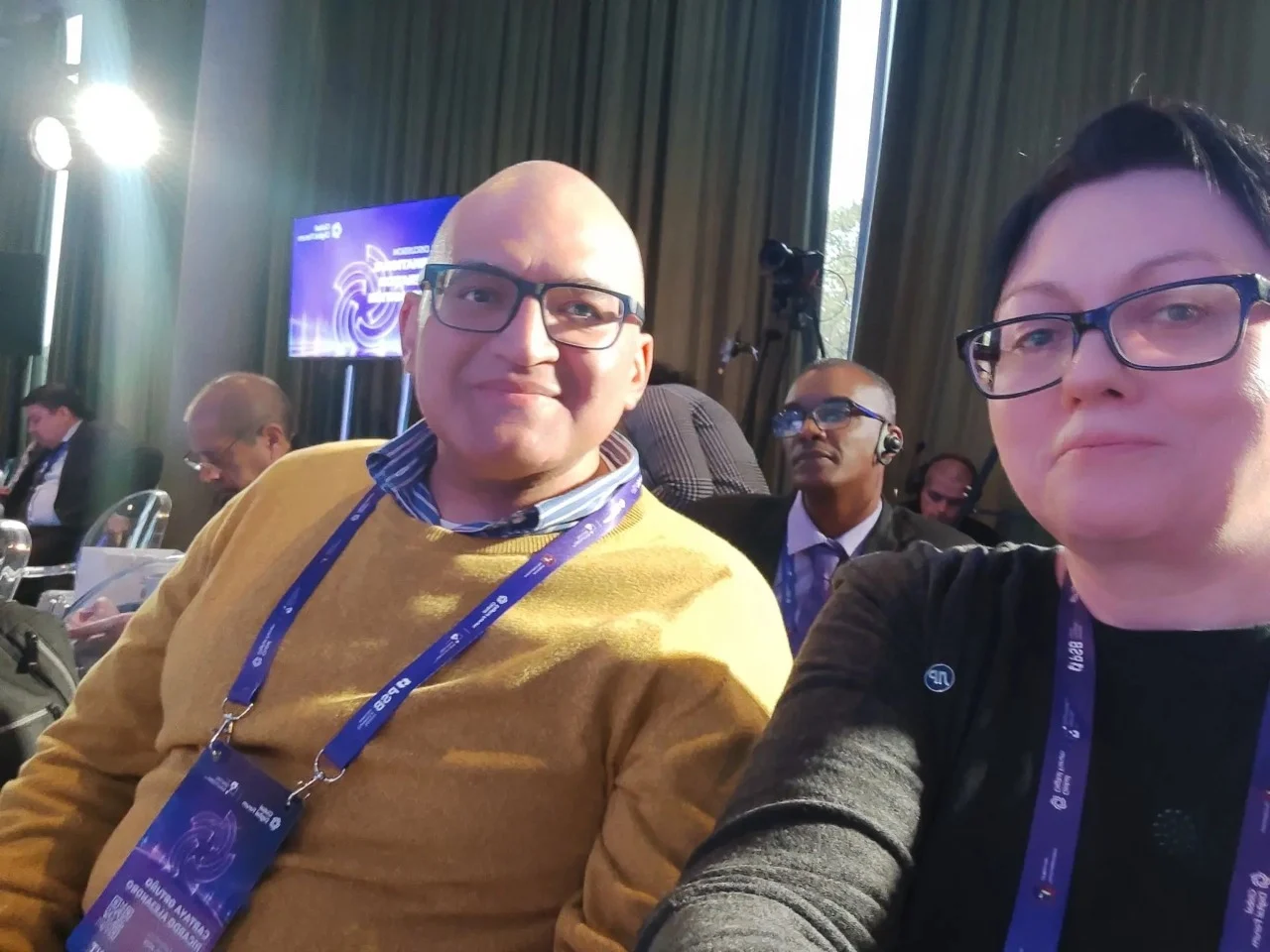
From October 8 to 10, 2026, Moscow hosted the II Global Digital Forum (GDF-2026), bringing together representatives from more than 100 countries.
The international event, organized at the Mechta complex in Gorky Park, was dedicated to digital transformation, the development of artificial intelligence and the formation of principles of technological cooperation. The forum was attended by science fiction writer, futurist and General Director of ANO ‘Obraz Budushchego’ (Image of the Future) Elena Kuleshova, representing the Futurating digital platform.
From the Agent Economy to the Ethics of Artificial Intelligence
The forum’s business program covered three main thematic tracks: ‘Humans and Technology’, ‘Digitalization and Industries’, ‘Media and Creativity’.
One of the most notable topics was the agentic economy — a model of interaction between people and digital systems in which AI agents can independently perform increasingly complex tasks. Participants discussed how the development of such technologies will change the economy, organizational management and everyday life.
Special attention was paid to AI safety, the ethical boundaries of autonomy for digital systems and responsibility for the decisions they make.
As AI capabilities expand, society faces a fundamental question: which decisions can be entrusted to algorithms, and which should remain exclusively with humans?
Digital Sovereignty and the Future of the Global Internet
Another important focus of the forum was the discussion of international internet governance.
Experts examined the risks of fragmentation of the global network into separate technological spaces with different rules, standards and infrastructure. The focus was on finding a balance between the digital sovereignty of individual states and preserving the possibilities for international interaction.
This discussion is directly linked to the problem of digital colonialism — the dependence of countries and societies on a limited circle of technological platforms, infrastructure and data governance mechanisms.
The issue is not only access to modern technologies, but also the ability to independently determine the directions of their development, participate in shaping international rules and preserve cultural and informational independence.
Elena Kuleshova: The Future Must Remain a Human Choice
Commenting on the forum’s technological agenda, General Director of ANO ‘Obraz Budushchego’ Elena Kuleshova emphasized the importance of human goal-setting in the era of autonomous intelligent systems.
The Global Digital Forum clearly showed that we stand on the threshold of changes that until recently were described mainly in science fiction. The agentic economy, smart cities, the ethics of autonomous systems — these are no longer abstract forecasts, but practical tasks of technological development.
For me, it is fundamentally important that artificial intelligence is capable of analyzing huge arrays of information, identifying patterns and helping make decisions, but it must not replace humans in determining the desired future.
It is human values, will and goal-setting that must form the basis of technological development. On the Futurating platform, we proceed from the premise that the future must not only be predicted, but above all jointly understood, discussed and shaped. And in this process, the decisive role belongs to humans.
Elena Kuleshova, General Director of ANO ‘Obraz Budushchego’
Who Will Become the Author of the Digital Future?
An important place in the GDF-2026 program was occupied by the transformation of creative industries under the influence of generative artificial intelligence.
In particular, the panel discussion ‘Who Is the Author of a Game World?’ examined the use of neural networks in creating visual content, scripts, software code and virtual spaces. The development of these tools raises new questions about authorship, intellectual property and the value of human creative intent.
Technologies expand human capabilities, but at the same time force us to rethink the role of humans in creating the future.
For the Futurating digital platform, this topic is of particular importance. If algorithms help analyze scenarios and find new connections between ideas, then determining the desired image of the future remains a matter of public discussion.
It is precisely the opportunity to propose one’s own idea, compare it with other people’s visions and jointly seek ways to implement it that turns the conversation about the future from abstract forecasting into a substantive public dialogue.
More details about the event are available on the official website of the II Global Digital Forum.
Comments (1)
Сначала этика, потом - технология! Иначе - не выживем как вид. К сожалению, в области ИИ этика вообще отсутствует сегодня. ИИ уже широко используется в военном деле. Правил типа 3-х законов робототехники никаких не установлено, что очень опасно. Лучшее развитие событий - принятие мировых законов об этике ИИ.