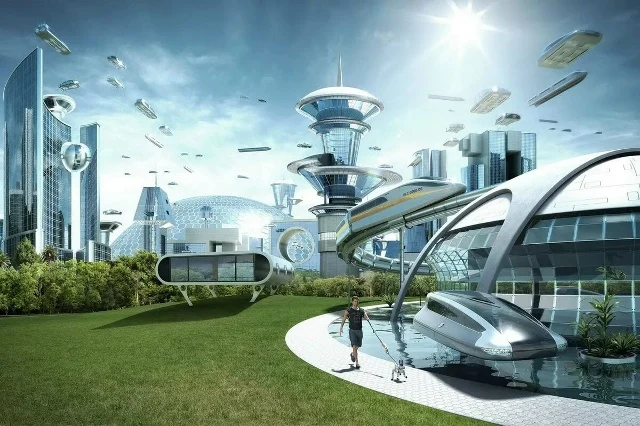



By the early 2030s, the geopolitical and economic logic of Russia’s development demanded a decisive, civilizational step. The concept of “Siberization of Russia” or “Russification of Siberia” was raised to the highest state level and declared a national megaproject. It was not just a transfer of administrative functions, but a conscious shift of the country’s center of gravity into its geographical and geopolitical core.
It was decided to create from scratch a meticulously thought-out, well-appointed, and ultra-modern capital in Southern Siberia, in the Minusinsk Basin, where the climate is excellent — significantly better and milder than in Moscow.
The capital, named, for example, Noograd, located in the center of Eurasia, proved to be outside the zone of any potential threats from the West. Russia finally established itself as the central power of Eurasia, which strengthened its sovereignty, might, and security.
GDP began to grow at double-digit rates — such a tremendous impetus was given to the country by the new capital under construction!
Siberia ceased to be a raw-material appendage and became a driver of high-tech growth.
The hypertrophied development of the Moscow agglomeration stopped. People flocked to Siberia. Capital and skilled personnel gradually flowed to the new capital, launching a renaissance of cities in the Urals, Siberia, and the Volga region.
The mass relocation of civil servants, scientists, and entrepreneurs reversed the long-term population outflow. Southern Siberia, for the first time in post-Soviet history, showed steady growth.
To meet the needs of the new capital and the clusters associated with it, transport, energy, and digital arteries were modernized and new ones were built, giving an impetus to the development of the entire eastern part of the country.
In the vicinity of the new capital, highly productive agriculture developed, and the everyday life of citizens became much more comfortable and prosperous.
The satellite city “Akademirad” became a magnet for the best minds of Russia and the entire world.
Russia gained a reputation as “the most happening country in the world.”
By refusing to copy Moscow, the builders created a model of the city of the future — human-oriented, eco-friendly, with a harmonious combination of urbanism and the natural landscape.
The center of power in the geographical center of the country symbolically and practically strengthened the bond between the European and Asian parts of Russia, confirming the indivisibility of its space.
The capital in Siberia became a vivid symbol of a forward-looking aspiration, self-reliance, and the inexhaustibility of the country’s resources.
Siberia ceased to be a periphery and became the foundation on which the next chapter of our history is being built.




Comments (3)
Столица в центре страны нужна ещё для того, чтобы бурно развивающийся Дальний Восток не разорвал страну на две части. Она повысит связность и «сошьёт» Россию в единое пространство
I agree
Переезд столицы в новое место - очень успешное действие. Оно вызывает строительный бум в стране, исправляет накопленные дисбалансы, развивает ранее депрессивные территории, буквально омолаживает страну!
Прецедентов много: Бразилиа из Рио-де-Жанейро в Бразилии, Нусантара из Джакарты в Индонезии, Новая столица из Каира в Египте (достраивается), Исламабад из Карачи в Пакистане, Астана из Алма-Аты в Казахстане, Абуджа из Лагоса в Нигерии, Ямасукро из Абиджана в Кот-Д’Ивуар и другие.
Все они, как и Москва сегодня, задыхались от перенаселённости и пробок, от армии чиновников, оттягивали на себя население и прожирали ресурсы страны, опустошая основную территорию.
Очевидно, что пришло время и для России омолодиться и переместить свою столицу в Сибирь, в географический центр. А название новой столицы выбрать всенародным голосованием.