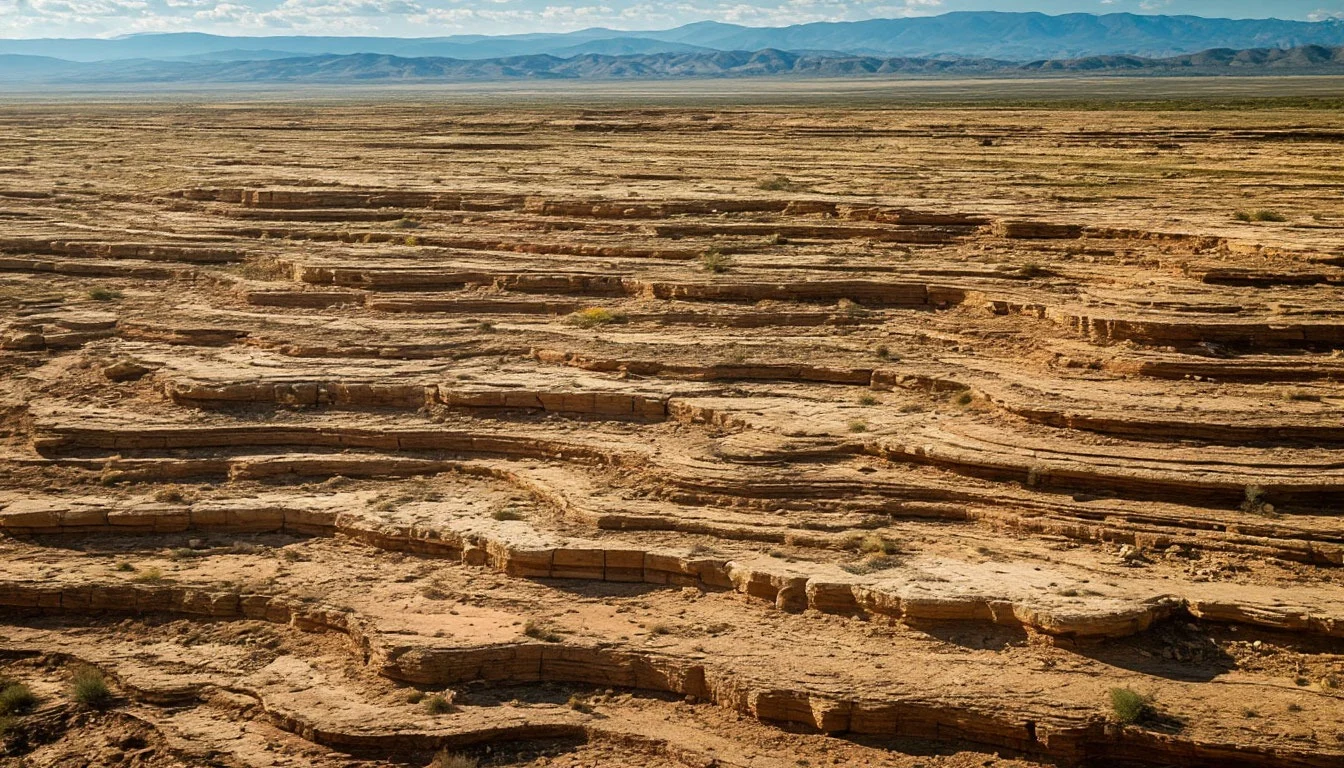

In the geology of the future, as in any other science, the moment of truth has arrived. Humanity, having learned not just to observe but also to map the planet’s subsurface with atomic precision, has obtained irrefutable proof: we are living in a new geological epoch — the Anthropocene. We have learned to clearly identify and plot on global stratigraphic maps the layers left behind by our civilization. However, as in any good scientific drama, the most interesting part lies not in the fact of the discovery, but in the disputes over its details.
What We See: “Layers of Civilization”
Modern stratigraphy is no longer about working with a hammer and rock samples. It is about analyzing gigantic data sets obtained with quantum gravimeters and deep-Earth scanning. The picture seen by geologists of the 23rd century is striking in its clarity. In the cross-section of the Earth’s crust from the past centuries, layers stand out that will unmistakably point to the era of humanity for future civilizations (if any appear).
- The “technogenic concrete” layer. A continuous, globally widespread layer of crushed rocks bound with cement. It is the foundation of our cities, and after their disappearance it will become one of the most durable monuments of civilization.
- “Plastic Horizon”. A thin but ubiquitous layer made up of undegraded polymers and microplastic. It has become an ideal marker because no analogues exist in nature.
- Radioactive peak. A layer associated with the mass testing of nuclear weapons in the mid-20th century. The sharp spike in concentrations of plutonium and cesium isotopes serves as an ideal “golden spike” — a precise time marker — for future scientists.
- The “technogenic minerals” layer. We have left behind hundreds of new minerals and materials (native aluminum, silicon chips, synthetic crystals) that never existed on Earth before us.
What’s Up for Debate: Where to Draw the Line?
Despite the obviousness of the Anthropocene itself, the geological community still cannot reach a consensus on two key questions.
- The starting boundary (GSSP). This is the main stumbling block. What should be considered the “zero mark” of the new epoch?
- Traditionalists insist on the “radioactive peak” of the 1950s. It is a clear, global, and easily datable marker.
- “Early Anthropocene advocates” argue that the epoch began much earlier — with the Neolithic Revolution or the Industrial Revolution. Their arguments: that was when humanity began to fundamentally alter landscapes and the carbon cycle.
- “Nuclear faction” (the most influential group) is adamant: only a sharp spike in radioactivity can be considered the true beginning of the new geological epoch.
- Identification criteria. What makes the Anthropocene a geological epoch rather than just a historical period? The debate centers on whether a change in landscape is enough or whether a change in the very processes inside the Earth is required. For example, changes in erosion rates caused by agriculture or changes in atmospheric composition.
Thus, we live in an era when our own impact on the planet has become so obvious that it can be studied as a separate chapter in a geology textbook. But we are still arguing about exactly which line that chapter should begin with. We became the object of our own scientific research before we even had time to realize it.
Comments (2)
Интересная, познавательная, хотя и грустная статья! Мы живём фактически в эпоху недавно наступившего антропоцена, пусть и отвергнутую консервативными геологическими и стратиграфическими организациями. Эпоха чётко промаркирована геологическими слоями «грехов» человечества: бетон, радиоактивность, пластик.
Но я верю, что Ноосфера, глобальный мозг планеты, всё исправит, развернёт воздействие человека на природу в сторону прежней гармонии и баланса жизни.
Поразительно, как точно современные технологии позволяют отслеживать следы нашей цивилизации в геологических разрезах. А как вы думаете, какой из слоёв антропоцена будет самым заметным для будущих цивилизаций?