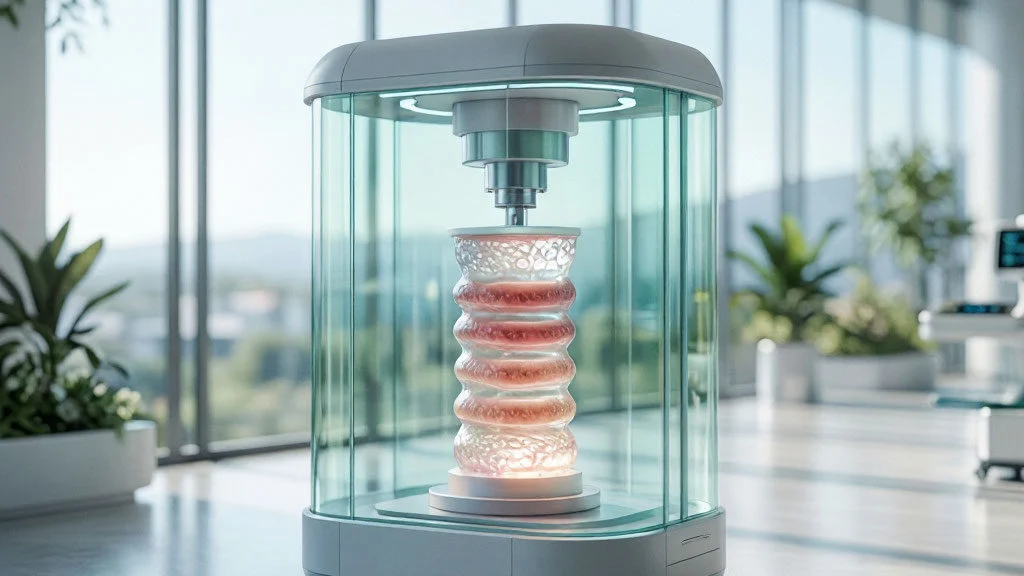

In 2515, the global healthcare system and the planet’s leading surgical centers finally recorded a complete and official abandonment of the classic practice of organ donation. The historical need for a constant search for compatible transplants, multi-year waiting lists, extremely complex operations, and heavy immunosuppressive therapy has gone forever into the past. The basic standard of modern regenerative surgery has become the concept of decentralized organs, which are now printed directly at the point of need using exclusively the patient’s own biological materials.
This technology is implemented everywhere through compact household medical capsules, which today are mandatory in every residential area, at workplaces, in educational institutions, and at major transport hubs on Earth. The entire process of generating, structuring, and growing a new fully functional organ takes no more than one hour. The device takes a minimal sample of the patient’s epithelial cells, automatically reprograms them into induced stem cells, and layer by layer recreates a healthy liver, lungs, kidneys, or heart on its built-in high-precision molecular bioprinter. All printing processes are carried out on the basis of the open-source code of global medical databases, which fully guarantees the absence of patent or licensing fees and ensures absolute economic accessibility of the technology for every citizen.
The decentralization of bioprinting has completely eliminated the shortage of medical resources and permanently destroyed the black market for donor organs. New organs created from the patient’s own cells have absolute, one hundred percent biocompatibility with the body, which completely rules out the risk of postoperative rejection and the need for lengthy drug rehabilitation. Open-source medical capsules have made the prompt renewal of worn-out body systems as simple, familiar, and accessible a procedure as a routine checkup, guaranteeing every person the maintenance of ideal health throughout their long life.





Comments (1)
Самое ценное в сценарии — печать из клеток самого пациента: уходит проблема отторжения. Но час на полноценное сердце нереалистичен, узкое место — васкуляризация толстых тканей, поэтому стартовать логично с щитовидной железы, кожи, хряща. Пилот реально собрать с 3D Bioprinting Solutions (группа «Инвитро»): магнитная биопечать и наработки по тканевым конструктам. Первый шаг — рабочая группа с производителем, Минздравом и Росздравнадзором под протокол персонализированных клеточных продуктов.