




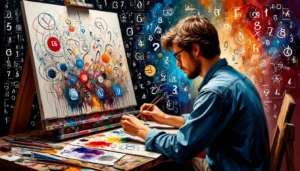
By 2100, neurotechnologies have finally erased the boundary between thought and creation. Art now requires only desire. It all started with a simple question: why should there be so many barriers between what we feel and what we create? The answer was new brain-computer interfaces that learned to read not just commands, but intentions. Not “raise your hand,” but “I want this line to be smooth.” Not “press a key,” but “this note should sound like this.”
A person who could not move their fingers now writes symphonies. Someone who never held a brush creates paintings. Someone whose body is frozen in stillness dances in virtual space — and viewers see this dance because it is real in the sense that matters: it conveys feeling.
Now neurotechnologies allow art to be transmitted directly, bypassing damaged sensory organs. A visual image is transmitted to the visual cortex — and a person “sees” a picture even if their eyes never worked. Sound goes straight to the auditory center — and music plays inside, pure and undistorted.
With neurotechnologies, genres that were previously impossible have emerged.
“Emotional Landscapes” — works that convey not an image but a state. The viewer does not look at a painting — they experience the moment the artist lived through.
“Shared Dreams” — several people connect into a single creative network and create a work together, without words, without gestures — only through intention.
“Living Archives” — people record their inner experiences as art, leaving future generations not just memories, but an experience that can be relived.
And when at an exhibition there stands a person in a wheelchair, and next to them a viewer who listens to their painting through a neural interface, and both cry from the same image — at that moment not only does the physical boundary disappear, but the very idea that there are people who cannot be part of art disappears. Because art is not about the body, it is about the soul. And the soul, it turns out, always finds a way to speak.


Comments (3)
Это ж какая нужна мощь и ясность мысли, чёткость намерения, чтобы творить искусство в своём сознании и передавать эти импульсы считывающему устройству!? Надо этому ещё учиться и учиться.
Очень сильная идея — что творчество можно освободить от тела и передавать сразу ощущения. Звучит пока как фантастика, но если такие интерфейсы реально доведут до ума, это изменит всё: и доступность искусства, и сами жанры. Интересно, а «совместные сны» не сотрут грань между личным опытом и чужим? Было бы любопытно на такое посмотреть.
Сама идея упирается не в качество сенсоров, а в интерпретацию сигнала: чтобы передать «намерение сделать линию плавной», нужно сначала построить карту субъективных эстетических паттернов конкретного человека — это и сложнее, и интереснее, чем считывать моторные команды. Если доводить замысел до практической реализации, логично было бы привлечь «Моторику» — у неё уже есть реальный опыт встраивания нейроинтерфейсов в носимые устройства и работа с пациентами, что даёт и доступ к профильным реабилитационным площадкам, и аппаратную базу для прототипов. Первым шагом могла бы стать пилотная группа из художников с особенностями моторики, где мы проверили бы, различает ли алгоритм художественный замысел в условиях низкого качества сигнала. Остаётся открытым вопрос: как унифицировать такие системы, чтобы впечатление от «эмоционального пейзажа» было воспроизводимо при переходе от одного пользователя к другому?