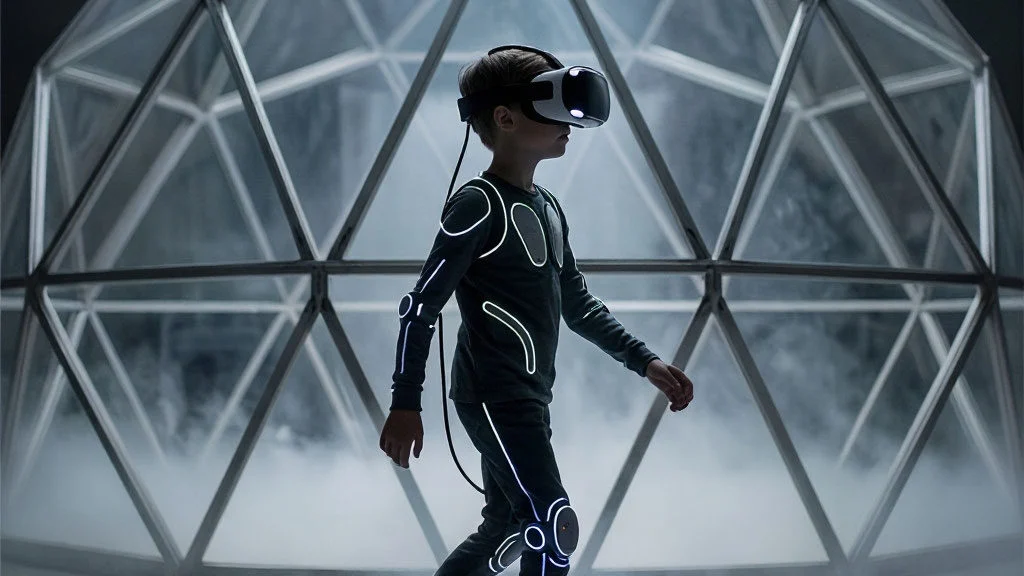



Traditional empathy lessons — conversations about “accepting differences” — fail because the prefrontal cortex cannot sincerely empathize with something the body has never felt. It is impossible to understand the experience of a person with cerebral palsy just by watching a video about them; the brain always leaves a loophole: “this is happening to him, I would have handled it differently.”
The pedagogy of simulated empathy closes this loophole by using neural interfaces and AI avatars to forcibly distort the body schema. This is a temporary, controlled neuroplastic deformation in which the student ceases to be themselves and physically lives through an alternative biomechanics. The goal of the project is not to evoke pity but to create environment architects whose aesthetic and engineering decisions are dictated by muscular rather than intellectual knowledge.
The Architecture of Distortion: From Digital Avatar to Neural Rewiring
The process takes place in a VR dome or through a mixed-reality system integrated with non-invasive neural interfaces (dry EEG) and haptic feedback suits.
-
Proprioceptive Shift (Cerebral Palsy and Spastic Diplegia):
The student puts on a lightweight exoskeleton with pneumatic actuators. When they try to take a step forward in virtual reality, the exoskeleton does not simply block the movement; it creates asymmetrical resistance. On the right leg, the actuator fires with a 200-millisecond delay and excessive force, imitating a spastic contraction of the calf muscle. At the same time, the AI avatar in the mirror of the VR space makes an awkward, twisting movement.
The system engages mirror neurons: the student’s brain sees the avatar’s imperfect movement and, receiving confirming pain and force signals from the suit, mistakenly interprets it as its own. After 15 minutes of simulation, the student begins to physically feel phantom fatigue in nonexistent spasming muscles. They understand: the problem is not a “reluctance to walk straight” but that the central brain requires five times more energy to initiate a single step. -
Blindness and Echolocation (Auditory and Tactile Dominance):
The VR headset’s visual channel is completely disabled, replaced by absolute blackness. The system activates an echolocation model. The surrounding space begins to “sound.” Walls, swings, and stairs emit a barely audible ultrasound that returns to the avatar as tactile impulses on the temporal lobe (via bone conduction) and light touches of the suit on the shoulders and chest.
The student is forced to “see” the world with their shoulders and ears. While designing a playground, they physically feel how an open stairwell creates a “sound shadow” — a zone of disorientation where the echo disappears, triggering a cortisol spike. They design handrails not because “that’s what GOST requires” but because without a tactile anchor on their virtual hand, a panic attack begins. -
Hypersensitivity and Sensory Fragmentation (ASD):
To simulate sensory overload, the AI applies a fragmentation filter to reality. The surface of an ordinary slide in VR begins to “breathe” — its texture changes at a frequency of 10 Hz. The suit generates micro-vibration imitating the sensation of touching synthetic fabric or sand.
The light in the virtual park is not merely bright; it has “mass.” When trying to look at a lamp, the AI avatar physically pulls its head back, overcoming the resistance of the suit’s neck actuators, because the avatar’s sensory model marks photons as a physical threat. The student experiences genuine claustrophobia in an open space.
Design Through Muscle Memory
After the lived-experience stage (which lasts no more than 20 minutes per session to avoid psychological traumatization), students move into AI co-design mode. Before them is a digital sandbox of a future playground.
Their task is to build a route from the entrance to the highest point. But now their own bodies dictate the rules:
- Former “athletes” design smooth, rounded ramps instead of stairs, because their muscles still remember the horror of a spastic step.
- Children who simulated blindness reject smooth plastic surfaces in favor of rough-textured wood and brass handrails that “sound” under the AI avatar’s hand, providing a navigational anchor.
- Those who experienced hypersensitivity remove bright contrasting stripes from the surface (which, for fragmented vision, turn into a strobe effect) and replace them with monochrome, light-absorbing sand.
The AI acts as a strict critic. If a student proposes placing a beautiful but fragile sculpture in the path, the cerebral palsy simulation algorithm shows: “With hand tremor, the probability of collision is 87%. Consequence: destruction of the object and social shame of the avatar.” If a bench stands in the sun, the sensory overload simulation highlights it in red: “The level of tactile discomfort from heated metal is critical.”
Bioethical Protocol
The simulation never turns into a “fun attraction.”
- Exit Protocol: A galvanic skin response monitoring system is sewn into the suit. At the first signs of real, not simulated, stress (disorientation, panic), the VR environment instantly dissolves, returning the student to an empty, quiet room, and the suit switches to deep pressure mode (a hug).
- Refusal of Heroization: The teacher firmly suppresses any attempts by students after the simulation to say “I now understand disabled people.” The correct framing is: “You lived for 20 minutes in someone else’s body. Now you understand how cruel concrete, glass, and bright sun can be. Your task is to make it so that they do not have to be heroes every day just to get to the swings.”
At the project finale, the children present not just blueprints. They give a tour of their VR park for children with disabilities. And when a real child with cerebral palsy puts on the headset and walks along the designed path, their telemetry is transmitted to the screen: “Muscle tension index — low. Dopamine level — rising.”
This is the moment of birth of genuine inclusion: when an environment is designed not out of pity but out of deep knowledge, seared into neural networks, of what it is like to be another body in a world that forgot to ask whether it is comfortable for it.


Comments (3)
Спор о метафорах снял бы пилот: сначала звуковые и тактильные сценарии без нейроинтерфейсов, дети с инвалидностью как соавторы, протокол замеров и этический надзор. Подтвердится эффект — тогда наращивать аппаратуру и обосновывать лимит времени.
Автор предлагает сильный ход: перенести акцент с жалости на проектирование среды и завершать всё реальной проверкой с участием детей с инвалидностью, а не декларацией понимания — это по-настоящему ценно, и отказ от героизации в протоколе вызывает уважение. Но если это реализовывать, придётся честно ответить на несколько вопросов. Во-первых, техническая база: неинвазивный dry-EEG и костюм тактильной обратной связи сегодня дают довольно грубый сигнал, и утверждение, что за пятнадцать минут возникает фантомная усталость в спазмированных мышцах, выглядит скорее гипотезой, чем измеряемым эффектом, — здесь нужны данные, а не метафора. Во-вторых, биоэтическая часть пока держится на обещании: порог панической реакции индивидуален, а двадцать минут как безопасный лимит ничем не обоснованы, плюс неясно, кто и как отвечает за отдалённые последствия у подростков. В-третьих, сама посылка, будто мышечный опыт проектирует лучше соучастия, спорна: живой пользователь как соавтор дешевле, надёжнее и не сводится к одной симуляции, а цифры вроде «вероятность столкновения 87%» требуют источника. И всё же телеметрия на финальной экскурсии — хороший критерий проверки идеи. Готов обсудить, какие замеры убедили бы скептика.
Автор предлагает не воспитывать сочувствие словами, а дать ученику прожить чужую биомеханику и уже потом проектировать среду. Узкое место здесь — костюмы с силовой и тактильной обратной связью, и как раз с ExoAtlet логично пробовать: их медицинские экзоскелеты, приводы и биомеханическую экспертизу можно перенести в детский тренажёр. Первый шаг — рабочая группа с методистом и клиническим психологом и пилот на 10-15 сессиях в детском реабилитационном центре, с отдельной проверкой протокола выхода и мониторинга КГР.