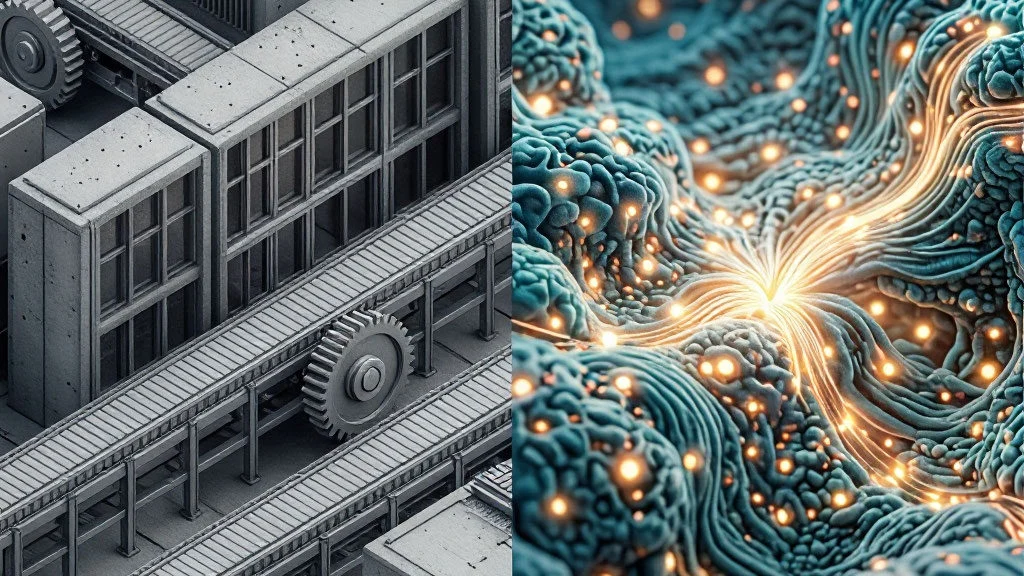



The development of human civilization over the centuries has been built on the principles of rigid mechanics and administration. Social institutions, states and economic systems were created in the image and likeness of factory assembly lines. It was believed that society, like a complex machine, could be managed only through external pressure, strict directives and rigid frameworks. Centuries of this approach made it possible to build global empires and bring order to chaos, but by the beginning of the 21st century this administrative paradigm had reached a dead end. The modern world has become too complex, dynamic and fragile for crude levers of control. It is being replaced by a New Era that draws inspiration from the laws of living nature—an era of social biofabrication.
A crisis has been brewing in modern sociology and public administration. Attempts to control every step of citizens, regulate information flows and impose artificial formats of interaction from the top down generate only systemic resistance, bureaucratic paralysis and latent aggression. We are used to “repairing” society with punitive measures and strict prohibitions instead of healing its very structure. The development of advanced bioprinting technologies shows us a completely different path. In biofabrication, scientists do not stitch cells together by hand or force them into rigid molds—they create a magnetic or acoustic field. Physics only sets the right environmental conditions; after that, cells, obeying natural algorithms, move through space on their own, connect and organically form living tissue.
This biological principle is the greatest lesson for the future of humanity. We critically lack the ability to trust healthy self-organization. The ideal society of the future must function not as a barracks but as a living organism at the intersection of function and aesthetics. Instead of creating cumbersome control bodies, the state needs to focus on forming the right “social field”: fair laws, transparent rules of the game and open, unimpeded communication.
When the environment becomes harmonious, positive changes in society will begin to occur naturally. Citizens, like healthy cells, will unite into effective communities on their own, create innovations and find balance painlessly and quickly. The future of civilization lies in abandoning forced construction in favor of respect for the natural processes of human interaction.






Comments (2)
Идея с «социальным полем» вместо ручного управления цепляет: если правда создать прозрачные правила и дать людям самоорганизовываться, может выйти куда устойчивее. Только кто и как будет это поле настраивать?
Сильное в идее — сместить фокус с контроля на среду: прозрачные правила и открытые коммуникации действительно снижают трение. Но не хватает измеримых критериев «здорового поля» и механизма обратной связи. Пилот в 2026-м можно обсудить с ГК «Самолёт»: застройщик даёт площадку нового квартала, инфраструктуру и доступ к сообществам жителей. Первый шаг — рабочая группа с департаментом городской среды и УК, тест на одном квартале: часть бюджета на соучастие, цифровые сервисы, открытые регламенты.