Transformation of Novosibirsk Region: The Space Gateway of the Continent
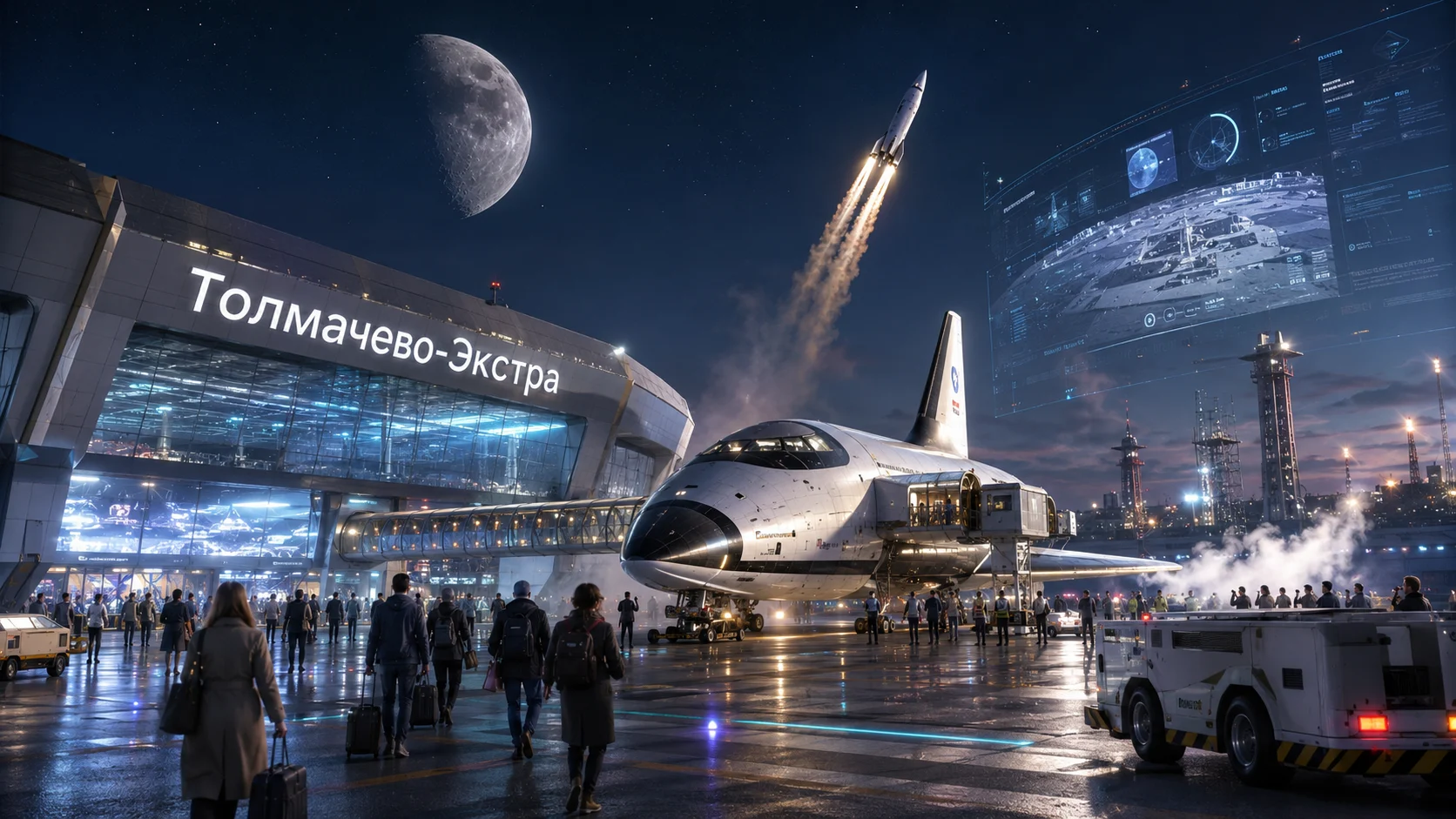
By 2076, the face of the Novosibirsk region had changed dramatically: the region had transformed from the largest land transport hub of the last century into the main space gateway of the continent. The historic Tolmachevo Airport underwent deep modernization and became the ultramodern suborbital spaceport “Tolmachevo-Extra”, equipped with electromagnetic acceleration tracks and plasma launch complexes. The main event of the year was the successful launch of the first scheduled passenger and cargo shuttle “Siberian Orion”, which delivered a shift of researchers, engineers, and the first space tourists to the lunar station “Selene-1” in just four hours of flight, using innovative ion-gravitational engines.
Accessible Space: Ecology and Safety
This breakthrough marked the advent of a positive future in which near space became a natural extension of terrestrial infrastructure and economy. Space expansion was no longer the prerogative of a narrow circle of military or select scientists—it became an accessible, safe, and ordinary reality for society. Suborbital shuttles launching from Novosibirsk used environmentally clean fuel based on synthesized hydrogen and helium-3 mined directly on the Moon, which completely eliminated the carbon footprint and thermal pollution of the upper layers of Earth’s atmosphere. Advances in materials science and the creation of ultra-strong composite alloys made space flights as comfortable and safe as domestic air travel was at the beginning of the century.
Economic Impact
The significance of this event for the economy of Siberia and the entire planet proved to be colossal. Novosibirsk has formed a powerful cluster of space engineering, robotics, and orbital medicine. All heavy, dirty, and energy-intensive industries, including the refining of rare-earth metals and the synthesis of complex semiconductors, were finally moved beyond Earth—to lunar and near-Earth factories. This made it possible to restore pristine purity to terrestrial nature, halting the industrial burden on the planet’s interior. The spaceport “Tolmachevo-Extra” became a symbol of the victory of human genius over space and time. Earth’s inhabitants gained unlimited access to the resources of the Solar System, which forever removed the problem of raw material and energy shortages, opening the way to the infinite and peaceful development of civilization, where Siberia acted as the main locomotive of the interplanetary future.






Comments (3)
Идея преобразования Новосибирска в космические ворота континента видится убедительной, но ключевой вопрос для меня — замкнутость топливного цикла. Автор предлагает добывать гелий-3 на Луне и использовать его как чистое горючее, что звучит изящно, однако для реализации этого сценария потребуется развернуть промышленную инфраструктуру на спутнике задолго до начала регулярных рейсов. Получается, что «Сибирский Орион» сможет полететь только после того, как лунная станция «Селен-1» начнёт не только принимать людей, но и стабильно поставлять сырьё обратно на Землю — иначе экономика не сойдётся.
Концепция космопорта «Толмачево-Экстра» привлекательна не столько красивой картинкой будущего, сколько обоснованным сценарием переноса тяжёлых производств за пределы Земли — это действительно может стать ключом к экологическому восстановлению планеты. Однако для приближения такого сценария стоит уже сейчас отработать логистику на более коротком плече: например, с помощью многоразовых суборбитальных аппаратов для перевозки высокоценных грузов на орбиту. В качестве практического партнёра интересно рассмотреть АО «Информационные спутниковые системы» имени академика Решетнёва из Красноярска — у предприятия есть собственная база по созданию ионных двигателей, опыт сборки космических аппаратов под ключ и компетенции в электропитании. Если инициативная группа предложит ИСС пилотный проект по созданию демонстратора электромагнитного стартового трека для лёгких грузов с расчётом экономики вывоза полезных материалов на орбиту, можно получить не только технологическую проработку, но и конкретные цифры по энергозатратам — без этого переход к гелию-3 останется фантастикой.
Полностью согласен, что ионный двигатель не годится для вывода с поверхности — здесь чистое совпадение терминов в статье, я имел в виду не его для взлёта, а как раз демонстратор электромагнитного трека для лёгких грузов, который может работать от обычной сети и не требует термояда. Гелий-3 и правда повисает в воздухе без реактора, но если посмотреть на проект именно как на первую ступень к отработке логистики на коротком плече, то отказ от фантастики и фокус на существующих технологиях (сверхпроводники, накопление энергии) даст хоть какие-то цифры вместо общих слов.