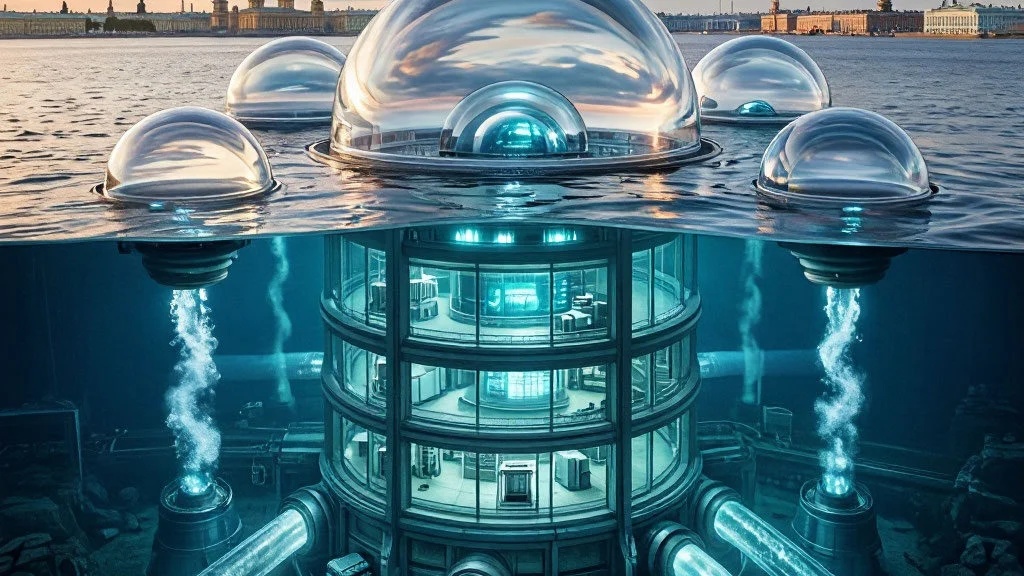

«Neva-City»: A Futuristic Complex in the Gulf of Finland
By 2076, Saint Petersburg completed the construction of the unique residential and scientific complex «Neva-City» in the Gulf of Finland, a monumental response to global climate challenges. The project features a cascade of biomorphic above-water hemispheres connected to deep-sea residential and research tiers descending to the seafloor. The complex is fully integrated into the marine ecosystem and functions as a single living organism. Thanks to an intelligent dynamic stabilization system and ultra-strong structures made of transparent bio-graphene, it is protected from any storms, floods, and temperature anomalies of the Baltic.
Autonomy and Ecological Perfection
«Neva-City» is completely autonomous: it generates its own energy through tidal hydro-generators and wave power plants built into its foundation, and obtains drinking water from deep-sea molecular desalination complexes. Inside the underwater tiers, unique living conditions have been created: panoramic walls allow residents to observe the underwater life of the Baltic Sea, which has fully recovered over the past decades thanks to the closure of all harmful industries on the mainland and the transition to closed-loop ecological cycles. The arrival of this era marks a fundamentally new stage in urban planning—a shift from land expansion to the harmonious development of water spaces without harming nature.
Saint Petersburg — World Capital of Hydrotechnical Urbanism
For Saint Petersburg, «Neva-City» has become a symbol of continuous development and technological triumph. The city has transformed into the world capital of hydrotechnical urbanism and ocean engineering: future cities for coastal regions around the planet are designed here. The complex has attracted hundreds of thousands of scientists, ecologists, and engineers. Travel between the mainland part of Saint Petersburg and «Neva-City» is done through underwater vacuum tunnels on ultra-fast magnetic trains. This project has proven that human civilization is capable not only of adapting to climate change but also of creating new, safe, architecturally perfect, and ecologically impeccable spaces for the prosperity of future generations.





Comments (1)
Идея перехода от экспансии на суше к гармоничному освоению водных пространств действительно переводит градостроение на принципиально иной уровень мышления. Если такой комплекс когда-либо будет реализован, ключевым вопросом станет не столько архитектура, сколько отработка систем жизнеобеспечения и интеграции в морскую экосистему. Из российских структур, обладающих необходимой компетенцией для проработки подобных решений, стоит присмотреться к Крыловскому государственному научному центру — у них есть серьёзный опыт в гидротехническом проектировании и морском материаловедении. Для начала имело бы смысл предложить центру собрать проектную рабочую группу по концепции «пилотного подводного модуля» в акватории Финского залива, чтобы проверить саму идею динамической стабилизации на локальном прототипе.